
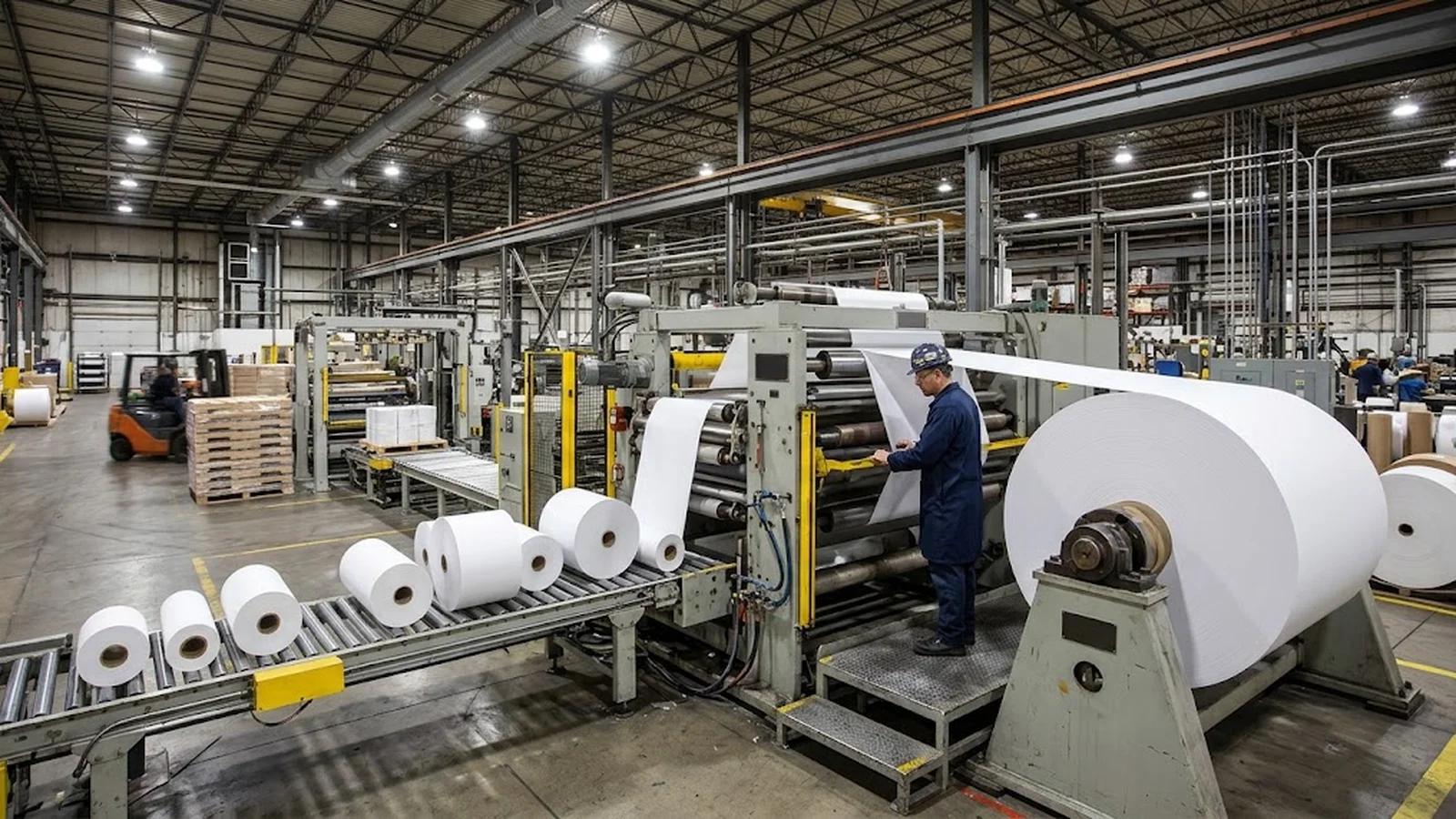
A thermal paper bulk OEM programme is a supply arrangement in which a buyer purchases large volumes manufactured against the buyer's own written specification and often under the buyer's brand — distinct from wholesale, which resells the manufacturer's standard catalogue. The bulk OEM model is defined by four structures: a specification pack (grade and GSM, width, core, roll diameter, developer class, back-web printing, carton and pallet packing) that the manufacturer certifies against; an MOQ and price-validity framework that rewards committed tonnage with stable per-tonne pricing; a QC and documentation regime (COA, SDS, batch traceability, retention testing) that makes every lot auditable; and a logistics plan that moves palletised, moisture-protected stock through containers without damage. Buyers who run bulk OEM well write the specification before negotiating price, sample against it, and hold every production lot to the same document set.
Wholesale thermal paper buying gets you a manufacturer's catalogue at volume pricing. Bulk OEM gets you something more useful: a programme in which the paper is manufactured to your written specification, packed to your layout, printed with your mark where wanted, and certified lot by lot against the sheet you wrote. For distributors, retail chains, bank fleets and converting operations buying container-scale tonnage, that difference — owning the specification rather than renting the catalogue — is what turns supply from a procurement task into a quality system.
This guide sets out how a bulk OEM programme is structured: what belongs in the specification pack, how MOQ and pricing behave at volume, which quality documents make bulk lots auditable, and how the freight moves.
Procurement teams standardising supply on one specification can review our 75 gsm heavyweight thermal paper alongside the comparisons in this guide, as one example of a grade documented per construction rather than per catalogue line.
The through-line in every section is the same: at bulk scale, the specification is the product, and everything else — price, lead time, documentation, freight — is the specification made real.
- Bulk OEM means manufacturing against the buyer's written specification and brand — not reselling a standard catalogue at volume discount.
- The specification pack covers grade and GSM, width, core, roll diameter, sensitivity and developer class, printing, and carton/pallet packing — each line certified by the manufacturer.
- MOQ at bulk scale is set per production run, not per carton; committed tonnage buys price validity and priority scheduling, not just a discount.
- COA, SDS, batch traceability and image-retention testing turn every bulk lot into an auditable document set.
- Freight is part of the specification: pallet patterns, moisture-barrier packing and container loading protect tonnage that was specified carefully at the factory.
What bulk OEM means in thermal paper
Three elements separate bulk OEM from ordinary wholesale. First, specification ownership: the buyer writes the technical sheet — grade, dimensions, developer class, packing — and the manufacturer certifies production against it, rather than the buyer selecting from fixed catalogue lines. Second, brand ownership: private-label cartons, printed sleeve labels, back-web logo printing and branded packing convert generic rolls into the buyer's product. Third, volume commitment: bulk OEM pricing is struck on committed tonnage over a horizon, which is what funds the dedicated setup the specification requires.
The model suits buyers who resell or consume thermal paper at scale under their own name: distributors building house brands, retail chains standardising receipt stock across an estate, ticketing and logistics operators with proprietary formats, and converters who need parent or slit stock to defined constructions. Buyers who only need volume on standard items are better served by plain wholesale — the bulk OEM machinery earns its keep precisely when the specification differs from the catalogue.
The economics deserve a plain statement: OEM setup carries real costs — artwork, trial runs, first-article inspection, dedicated packing print. At bulk tonnage these amortise to rounding errors; at catalogue volumes they do not, which is why serious OEM programmes start at container-scale commitments.
The specification pack: what your sheet must state
A bulk OEM specification is only as good as its least-documented line. The complete pack names: basis weight and tolerance (for example 48, 55, 65 or 75 gsm within a stated band); width or jumbo width with slit tolerance; core size and roll diameter per format; sensitivity class matched to the target print-head families; developer class — BPA-free, phenol-free, or conventional — with the documentation that supports the claim; back-web printing and artwork if the programme carries it; and packing, from inner carton counts and sleeve labels through pallet pattern and wrap.
Each line should carry a measurement and a tolerance, because that is what the manufacturer certifies against at production and what your QC team verifies at receipt. A specification that states '55 gsm, 80mm, 12.7mm core' without tolerances invites drift; one that states bands and test methods turns reorder disputes into document comparisons.
| Line | Example statement | Why it matters |
|---|---|---|
| Basis weight | 55 gsm ± 2 gsm, per ISO 536 | Cost per metre, stiffness, metres per roll |
| Width / diameter | 80mm x 70mm ± 0.5mm slit tolerance | Feeds correctly in the named printer fleet |
| Core | 12.7mm bore, stated per format | Yield arithmetic and machine fit |
| Sensitivity class | Matched to named print-head energy window | Print density and head life |
| Developer class | BPA-free / phenol-free, documented per batch | Regulatory and tender compliance |
| Printing | 1-colour back-web logo, artwork ref | Brand ownership on every roll |
| Packing | 50 rolls/carton, moisture-barrier lining, pallet pattern | Condition on arrival after ocean freight |
MOQ, lead time and pricing at bulk scale
Bulk OEM MOQs are set per production run rather than per item: a dedicated coating or slitting setup justifies a minimum run length, and buyers combine formats in one container to reach it. The practical structure most manufacturers offer is a per-format MOQ plus a programme-level commitment — for example, a stated tonnage across a quarter — which unlocks volume pricing bands and priority scheduling. Price validity follows the same logic: quoted against raw-paper input costs for a defined window, with longer validity available to committed programmes.
Per-tonne quotation is the honest baseline at this scale, and it makes comparing offers real: convert every quotation to cost per finished roll or per thousand metres at the agreed yield before comparing, because differing caliper assumptions quietly change the metres a container delivers. Lead time at bulk scale runs from paper-machine scheduling through converting, QC and container loading — typically weeks, not days — so programme buyers hold rolling forecasts with the manufacturer rather than treating each order as a fresh negotiation.
For production volumes, the same construction logic applies to our thermal paper jumbo rolls, quoted per jumbo roll, slit reel or finished format, which is the supply layer beneath most bulk OEM programmes.
Quality control and documentation for bulk lots
The document set is what makes a bulk lot auditable. Per production batch the manufacturer should supply a certificate of analysis tying the lot to measured values — basis weight, caliper, sensitivity class, developer class — plus SDS documentation for the chemistry, and batch traceability printed on cartons so a field complaint resolves to a production lot instead of a dispute. For programmes where image life matters, image-retention testing against the agreed method belongs in the pack as well.
Developer-class documentation deserves its own paragraph. Bulk OEM buyers increasingly specify BPA-free or phenol-free constructions, and the claim is only as strong as the paperwork: per-batch confirmation against the agreed test method, sufficient for the buyer's own regulatory and tender files. Where developer compliance is part of the specification, our BPA-free vs phenol-free guide documents the chemistry, the regulations and the paperwork behind each class, so the spec line is written from evidence rather than assumption.
On the buyer's side, incoming QC closes the loop: sample per lot against the specification pack — weight checks, dimensional checks, print tests on reference hardware — and hold the manufacturer to the tolerances both parties signed. Programmes that skip incoming verification discover specification drift the expensive way: at the point of sale, months later.
Logistics for bulk OEM shipments
Tonnage moves by container, and the specification extends into the freight plan: pallet pattern per container size, carton stacking limits, and moisture-barrier protection — thermal paper is hygroscopic, and a container crossing the equator presents humidity conditions the paper will remember. Wrapping, desiccants and lined cartons are line items in the specification, not courtesies.
Where container planning is the next step, our export shipping guide covers pallet standards, moisture-barrier packing and the document set for ocean freight, so the batch that arrives at your warehouse is the batch that left the factory.
A programme run this way — specification written first, sampled against, certified per lot, and freighted to plan — gives the buyer what bulk OEM exists to provide: not merely cheap paper, but paper that is yours, reproducibly, at any tonnage you commit.
Frequently asked questions
What does bulk OEM mean for thermal paper orders?
Manufacturing against your written specification and, typically, your brand, at committed volume. The buyer owns the specification pack — grade, dimensions, developer class, printing, packing — and the manufacturer certifies each production lot against it. Plain wholesale, by contrast, resells the manufacturer's standard catalogue at volume pricing.
What MOQ should I expect for a bulk OEM programme?
MOQs are set per production run — a dedicated coating or slitting setup needs minimum run length — with programme-level tonnage commitments unlocking better pricing bands and scheduling priority. Mixing formats in one container helps reach run minimums economically. Exact numbers depend on the formats and grade mix in the specification.
How is bulk OEM thermal paper priced?
Per tonne at the specification's yield, with price validity tied to raw-paper input costs for a defined window. Convert every quotation to cost per finished roll or per thousand metres before comparing offers — differing caliper assumptions change the metres a container actually delivers.
What documents should come with each bulk lot?
A certificate of analysis per production batch tying the lot to measured values (basis weight, caliper, sensitivity class, developer class), SDS documentation, and batch traceability on cartons. Programmes with image-life requirements add retention testing. The document set is what makes the lot auditable and field complaints resolvable.
How is bulk OEM stock protected during shipping?
Palletised to an agreed pattern, carton-stacked to stated limits, and packed with moisture-barrier lining — thermal paper is hygroscopic and ocean containers present humidity extremes. Wrapping and desiccant provisions belong in the specification, and the export document set should be agreed before the first container loads.