
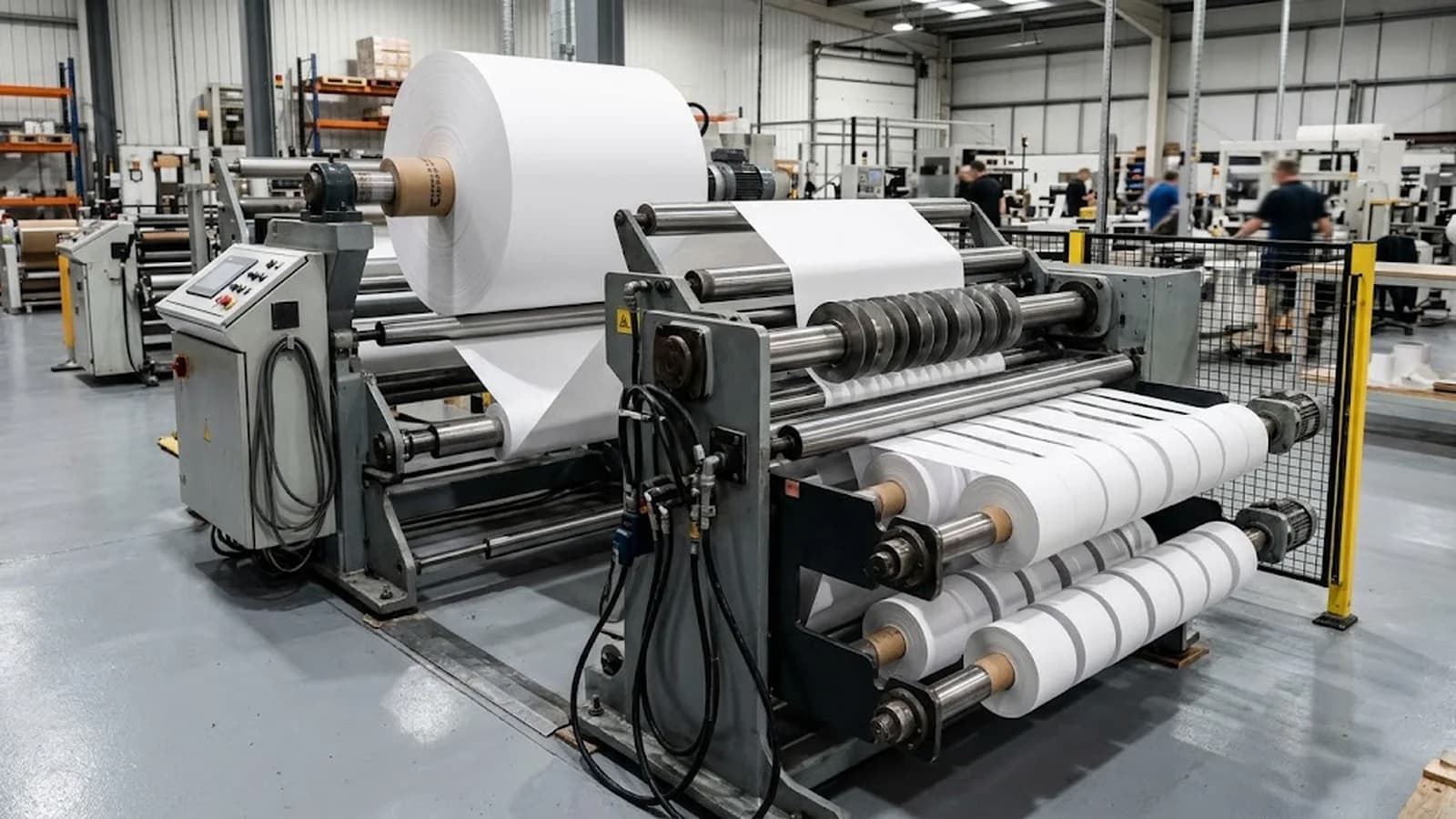
A 405mm thermal paper jumbo roll is the compact parent roll converters use when the finished programme is narrow receipt stock — 57mm and 80mm-class rolls — rather than wide label webs. It sits at the small end of the jumbo width ladder (405 / 565 / 636 / 800 / 875mm), and its defining virtue is fit: a 405mm parent divides almost exactly into seven 57mm webs or five 80mm webs with only a few millimetres of edge trim, so the slit plan is clean and the yield arithmetic is transparent. Converters choose it when their slitters are compact, their finished-roll mix is receipt-dominated, or their customers order mixed narrow SKUs in changeable ratios that a wide parent would force them to forecast rigidly. Buying one well comes down to the same discipline as any jumbo: GSM and sensitivity class declared per grade, geometry held across the whole parent, core and winding matched to the slitter, and moisture-barrier packing that survives ocean freight.
Jumbo rolls are usually discussed at the wide end — 800mm and 875mm parents feeding label stock and multi-web programmes. But a large share of the world's receipt paper starts life on a much narrower parent: the 405mm thermal paper jumbo roll, the compact workhorse behind 57mm and 80mm receipt-roll programmes. Its width is not an accident. Seven 57mm webs add up to 399mm; five 80mm webs add up to 400mm. Against a 405mm parent, both plans leave a trim margin of a few millimetres — close to the theoretical minimum — which is exactly what a converter wants when every point of yield is priced into the quote.
The compact parent earns its place in three situations. Small and mid-size slitters physically cannot handle an 800mm parent's weight and diameter. Receipt-dominated programmes with mixed narrow SKUs — some 57x40, some 80x80, ratios shifting month to month — are easier to plan from a parent that carries five to seven webs per pass instead of ten or more. And buyers consolidating two or three finished formats with one mill can hold a single 405mm parent specification instead of managing parallel wide-parent orders for each SKU.
Buyers comparing parent widths can review our thermal paper jumbo rolls, where widths from 405mm upward, core sizes and packing formats are documented on one specification sheet.
This guide covers where 405mm sits in the width ladder, the slit plans and yield arithmetic it carries, and the specification checklist converters and trade buyers should hold a 405mm parent to before a container order is placed.
- 405mm is the compact end of the jumbo ladder: seven 57mm webs or five 80mm webs per pass, with only a few millimetres of edge trim.
- Choose it for receipt-dominated mixes, compact slitters and mixed-SKU programmes — not for wide label webs, which belong to 800mm and 875mm parents.
- Yield arithmetic is the quote's backbone: parent length, web count and finished-roll length convert a 405mm order into exact roll counts per SKU.
- Specify GSM class, sensitivity class, core, winding direction and edge-trim allowance in writing; geometry consistency across the parent decides slitter uptime.
- Ocean-freight packing — moisture barrier, end protection, pallet plan — matters as much for a 405mm parent as for its wider siblings.
Where 405mm sits in the jumbo width ladder
Thermal jumbo widths cluster at a few standard points — 405, 565, 636, 800 and 875mm — each one corresponding to a dominant family of slit plans. The wide parents serve label houses and mixed receipt-plus-label converters: an 875mm parent divides into eight 108mm webs or six 145mm label webs, and an 800mm parent carries ten 80mm receipt webs in a single pass. The 405mm parent serves the other end of that spectrum: programmes where the finished mix is narrow receipt stock and the web count per pass is five to seven, not ten.
The choice between a compact and a wide parent is a planning decision, not a quality decision. Coating construction, sensitivity class and developer chemistry are identical across the width range — a 405mm parent and an 800mm parent of the same grade are the same paper. What changes is the converter's economics: a wide parent maximises webs per pass and suits long runs of a fixed SKU mix, while a compact parent trades some pass efficiency for flexibility, lower slitter load and cleaner changeovers when the SKU ratio moves. Converters running short-sequence orders for distributors — pallets built from a dozen receipt SKUs in shifting ratios — usually find the 405mm parent's flexibility pays for the difference.
There is a logistics dimension too. A 405mm parent is lighter and smaller per roll, which suits converters without heavy-duty unwind stands, and it packs more rolls per pallet. For regional converting operations supplied by sea freight, that packing density compounds across a container into genuinely more finished-roll capacity per shipment.
For production volumes, the same construction logic applies to our 48 gsm lightweight thermal paper, the grade class most 405mm receipt slit plans are built on.
Slit plans and yield arithmetic on a 405mm parent
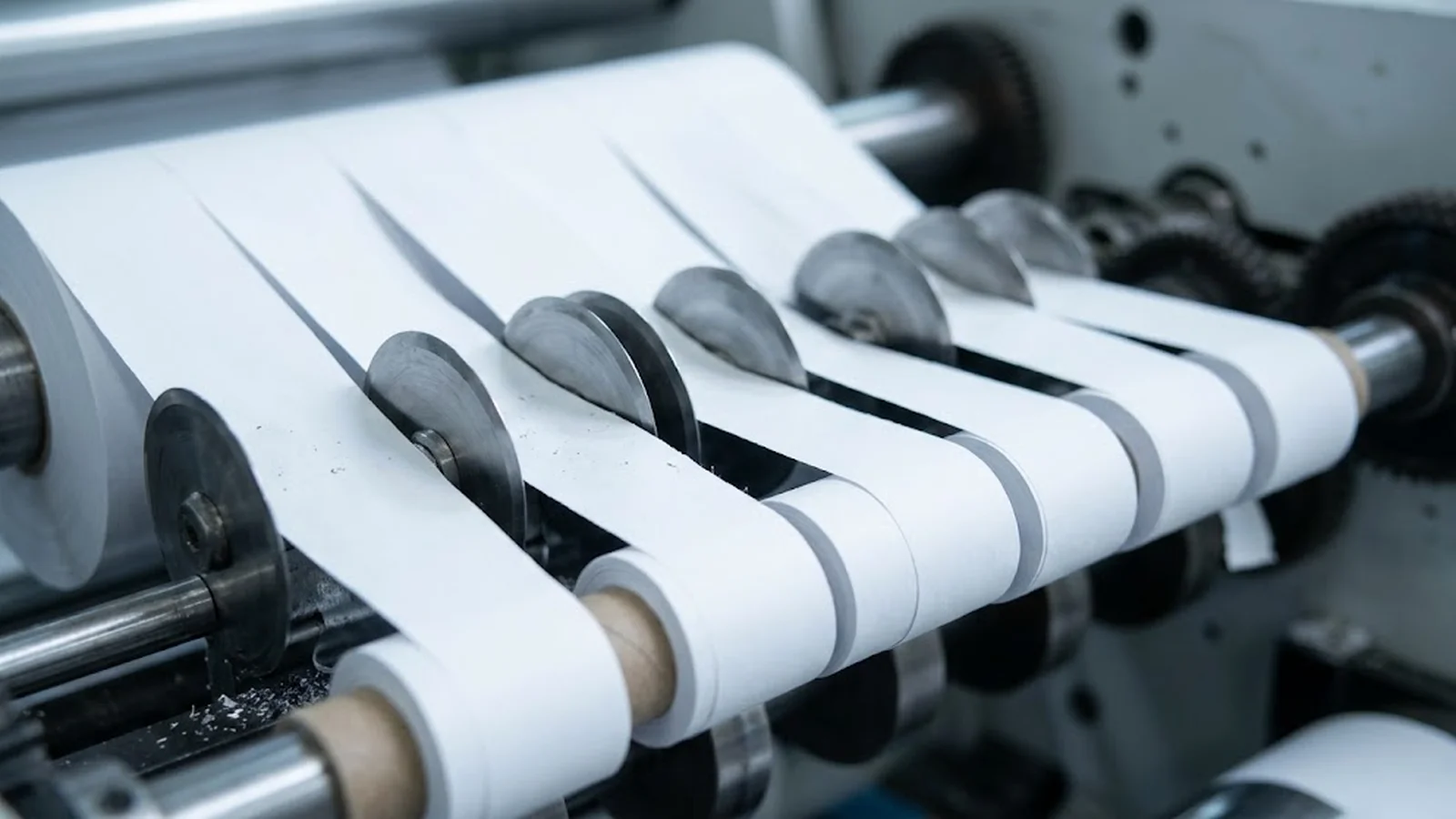
The two canonical plans define the width. Seven 57mm webs consume 399mm, leaving 6mm for edge trim — roughly 3mm per edge, enough to carry away the parent's outermost winding layers. Five 80mm webs consume 400mm, leaving 5mm. Both figures sit close to the trim minimum, which is why 405mm persists as a standard: a converter quoting either plan can price trim loss as a rounding error rather than a yield line.
Mixed plans are where the compact parent shows its range. A 405mm parent also divides into a 160mm label web plus four 57mm receipt webs (408mm nominal, one web trimmed to fit), or three 80mm webs plus three 57mm webs with the balance in trim — the kind of plan a wide parent makes either wasteful or impossible. Converters serving both retail counters and back-office label stations from one parent run exactly these hybrids.
Yield arithmetic then converts the parent into an order. A 405mm x 6000m parent at five 80mm webs yields 30,000 metres of 80mm stock; at 33 metres per finished 80x60-class roll, that is roughly 900 finished rolls before winding and end losses — the number a distributor needs to convert a jumbo quote into carton counts. The same calculation at seven 57mm webs and a 25-metre 57x40-class roll lands near 1,680 rolls. Writing the plan down — web count, widths, trim, target roll length per SKU — before ordering turns the parent from a commodity into a scheduled output.
Where a programme needs several formats from one supplier, our custom thermal paper programme covers width, core, roll diameter and developer class in a single specification sheet.
405mm slit-plan shorthand for RFQs: 'Thermal jumbo 405mm x [length] m on 76.2mm (3") core; slit plan [7 x 57mm / 5 x 80mm / mixed]; edge trim [mm]; GSM class [48-65]; sensitivity class declared; moisture-barrier packing, rolls vertical on pallet.'
Buying a 405mm parent: the specification checklist
The checklist mirrors any jumbo purchase, scaled to the compact width. GSM class declared per grade — lightweight classes around 48-55 gsm dominate receipt slit plans, with heavier classes reserved for stiffness-critical finished formats. Sensitivity class stated and consistent batch to batch, because a slitter running five or seven webs at once amplifies any density variation across the parent. Geometry held across the full roll: width tolerance, diameter consistency and hardness profile, since a soft-wound parent will telescope on the unwind stand long before the last web is slit.
Core and winding are the next lines. A 76.2mm (3-inch) core is standard for the 405mm class, and winding direction must match the slitter's unwind geometry — a parent wound the wrong way round costs a changeover and a reorder. Packing completes it: moisture-barrier wrap per roll, end protection, and a pallet plan that keeps rolls vertical through ocean transit, because a parent that arrives with a damaged edge loses one web's worth of yield per incident.
Documentation closes the loop. A mill that publishes per-grade test data — basis weight, coating construction, developer class, image density — lets the converter verify the parent against its own slitter trials instead of a catalogue claim, and per-batch COAs keep the finished rolls' compliance paperwork traceable back to the parent they were slit from. Where container planning is the next step, our export shipping guide covers pallet standards, moisture-barrier packing and the document set for ocean freight.
Finally, consolidate the programme. Converters running 405mm parents for receipt stock usually also carry wide parents for label programmes and finished rolls for direct distribution; aligning those lines with one mill aligns tolerances, sensitivity classes and delivery rhythm across the whole converting schedule — and turns a spread of one-off orders into one managed supply chain.
Frequently asked questions
What is a 405mm thermal paper jumbo roll used for?
It is the compact parent roll behind narrow receipt programmes: seven 57mm webs or five 80mm webs per slit pass, with only a few millimetres of edge trim. Converters choose it for receipt-dominated SKU mixes, compact slitters and short-sequence orders where a wide parent's rigidity is a planning cost.
How many receipt rolls come out of a 405mm jumbo roll?
It depends on parent length and finished-roll size. A 405mm x 6000m parent at five 80mm webs yields about 30,000 metres of 80mm stock — roughly 900 finished rolls at 33 metres each. At seven 57mm webs, the same parent yields roughly 1,680 rolls of a 25-metre 57mm class. Write the slit plan down and the arithmetic follows directly.
Should I buy a 405mm or an 800mm jumbo roll?
Match the parent to the programme. Wide parents maximise webs per pass for long runs of a fixed SKU mix; a 405mm parent wins when the mix shifts, the slitters are compact, or the programme is receipt-dominated. The paper itself is the same grade — the choice is an economics and planning decision.
What core size does a 405mm jumbo roll use?
The 405mm class standard is a 76.2mm (3-inch) core. Confirm winding direction against your slitter's unwind geometry when ordering, since a parent wound the opposite way needs a changeover or a reorder.
How should 405mm jumbo rolls be packed for export?
Each roll in a moisture-barrier wrap with end protection, packed vertically on a documented pallet plan for ocean freight. Edge damage on a parent costs one web's worth of yield per incident, so packing discipline converts directly into yield protection.