
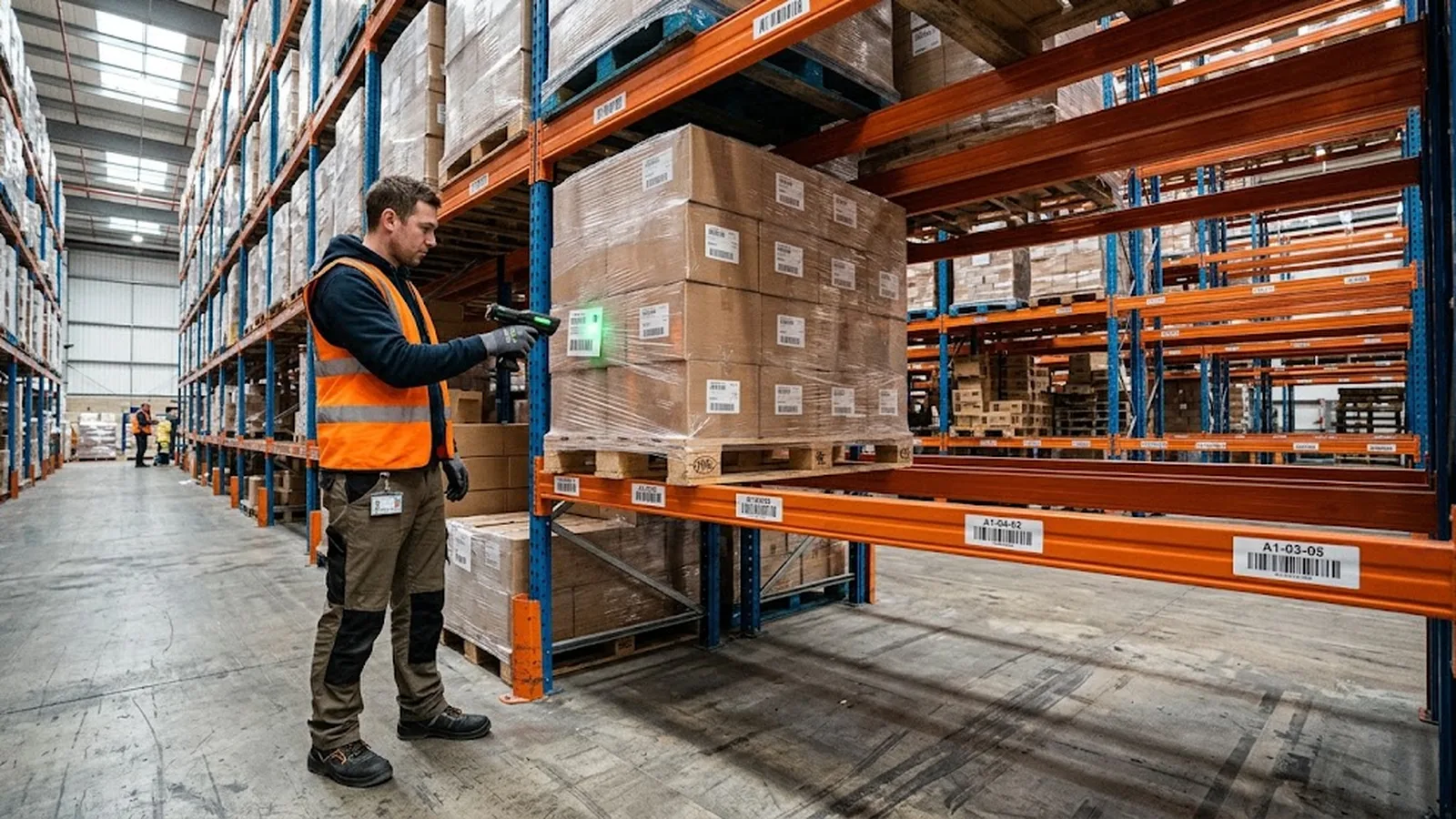
Warehouse barcode labels are identification labels — rack and bin locations, pallet SSCC tags, pick-face and carton labels — most commonly produced in direct thermal stock for short-to-medium dwell, and in top-coated direct thermal constructions wherever scuffing, moisture or cool-store conditions enter the picture. The buying decision is a stack of four choices: facestock grade (58–65 gsm for stiff, scuff-resistant location labels), adhesive (general permanent versus freezer-grade for cold stores and low-surface-energy plastics), construction (top-coated where scan reliability over months matters), and format (die-cut rolls or fanfold in 100 x 150 mm, 4 x 6 inch and custom shapes). Specifying all four in one sheet — and testing on the actual surface at the actual temperature — is what separates a rollout that scans for years from one that relabels every quarter.
Every scan in a warehouse is a label doing its job: the rack-beam code that puts a pallet away, the bin label that confirms a pick, the SSCC plate that travels with the pallet to the customer. Warehouses run thousands of these scans per hour, and the economics are unforgiving in both directions — labels that fail to scan stop the operation, while over-specified labels quietly inflate the cost of every carton handled.
Direct thermal stock dominates warehouse identification for exactly that reason: it prints on demand, needs no ribbon inventory, and covers the majority of dwell times and environments at the right price. But 'direct thermal' is a family of constructions, not one product, and the difference between a non-top-coated bin label and a top-coated cold-store grade is the difference between a two-year rack label and a quarterly relabelling programme.
This guide works the warehouse decision properly: the label types and where each lives, how environment and dwell drive the facestock and adhesive stack, the size and format standards, the scan-reliability checks that catch problems before a rollout, and the specification frame for multi-site programmes.
Where a programme needs label stock matched to its scan environment, our top-coated thermal label stock documents facestock grades, adhesive classes and coating construction per specification sheet before an order is placed.
- Match the label to its job: rack and bin labels need stiffness and long dwell; pallet and carton labels need adhesion through compression and transit.
- Top-coated construction is the default wherever labels face abrasion, moisture, cool stores or months of dwell; uncoated stock suits short-dwell, gentle indoor use.
- Cold stores and low-surface-energy plastics need freezer-grade adhesives — general-purpose adhesive is the single most common cold-chain label failure.
- 100 x 150 mm (4 x 6 inch) is the pallet and carton standard; 50 x 25 to 100 x 50 mm covers bin and pick-face identification.
- Test on the actual surface at the actual temperature before rollout — adhesive and scan behaviour cannot be certified from a datasheet alone.
The label family: where each type lives in the warehouse
Rack and location labels are the longest-lived items in the family: fixed to beams, uprights and mesh decks, read thousands of times and expected to survive years. They carry the highest stiffness requirement in the stack — which is why they are typically converted from 65 gsm-class facestock, often with a top-coated build, and laminated or over-sized where fork contact is frequent.
Bin, tote and pick-face labels run the middle of the dwell range: weeks to months of handling, frequent thumb contact and resealing. A 58–65 gsm direct thermal facestock with a good permanent adhesive handles the duty; top-coating earns its place where totes are washed or where condensation cycles between chill zones and docks.
Pallet and carton labels are the short-dwell, high-risk end: printed at the pack-out station, applied under compression in stacks, and scanned through transit to the customer. The 100 x 150 mm SSCC format is the global standard here, and the label must survive stacking friction, cold chains and the occasional damp trailer floor — the point where facestock quality and adhesive class stop being fine print.
| Label type | Typical size | Dwell | Facestock | Adhesive class |
|---|---|---|---|---|
| Rack / beam location | 100 x 150 / custom wide | Years | 65 gsm class, top-coated | High-tack permanent |
| Bin / tote / pick-face | 50 x 25 – 100 x 50 mm | Weeks–months | 58–65 gsm direct thermal | Permanent |
| Pallet SSCC / carton | 100 x 150 mm (4 x 6 in) | Days–weeks | 58–65 gsm, top-coated for transit | Permanent / freezer grade |
| Returnable-container tags | Custom with laminate pockets | Years, re-usable | Insert card or protected stock | Mechanical pocket |
Sizes are the common export-standards; regional and WMS-driven variations are die-cut to order from the same facestock families.
Environment and dwell: the facestock and adhesive stack
Direct thermal image life is chemistry plus construction. An uncoated (non-top-coated) facestock prints sharp and costs less, but the image scuffs and fades with abrasion, moisture and time — perfectly adequate for bin labels replaced on a schedule, marginal for anything that travels. A top-coated build adds a protective layer that resists scuffing, splashes and label-to-label contact in stacks, and buys months of extra scan life in the same chemistry. Warehouse practice is therefore simple to state: uncoated for short, gentle, indoors; top-coated for transit, cool zones and anything scanned months after printing.
Adhesive is where environments do the real damage. General-purpose permanent adhesive is formulated for room-temperature application onto cardboard and rigid plastics; in a cold store it stiffens before it wets out, and on shrink-wrap or high-density plastics it may never build the tack the datasheet promises. Freezer-grade adhesives wet out at low application temperatures and keep their bond through thaw cycles, and high-tack versions exist for low-surface-energy plastics where standard adhesive peels at the corner after days.
The stack is chosen together, not separately: a top-coated facestock on the wrong adhesive still falls off the rack, and a freezer adhesive cannot rescue a facestock whose image faded in the chiller. Specify the pair as one decision — construction class and adhesive class on the same specification line — and require the supplier to confirm both against the destination environment in writing.
Where the two builds are being compared for a specific programme, our top-coated vs non top-coated guide compares the constructions on retention, cost and machine behaviour.
- Uncoated facestock: short dwell, dry indoors, scheduled relabelling — lowest cost.
- Top-coated facestock: abrasion, moisture, cool zones, transit scans — longer scan life.
- Freezer-grade adhesive: application below ~5 °C, thaw cycles, cold-store racks.
- High-tack adhesive: shrink-wrap and low-surface-energy plastics.
Formats and converting: rolls, fanfold and die-cut shapes
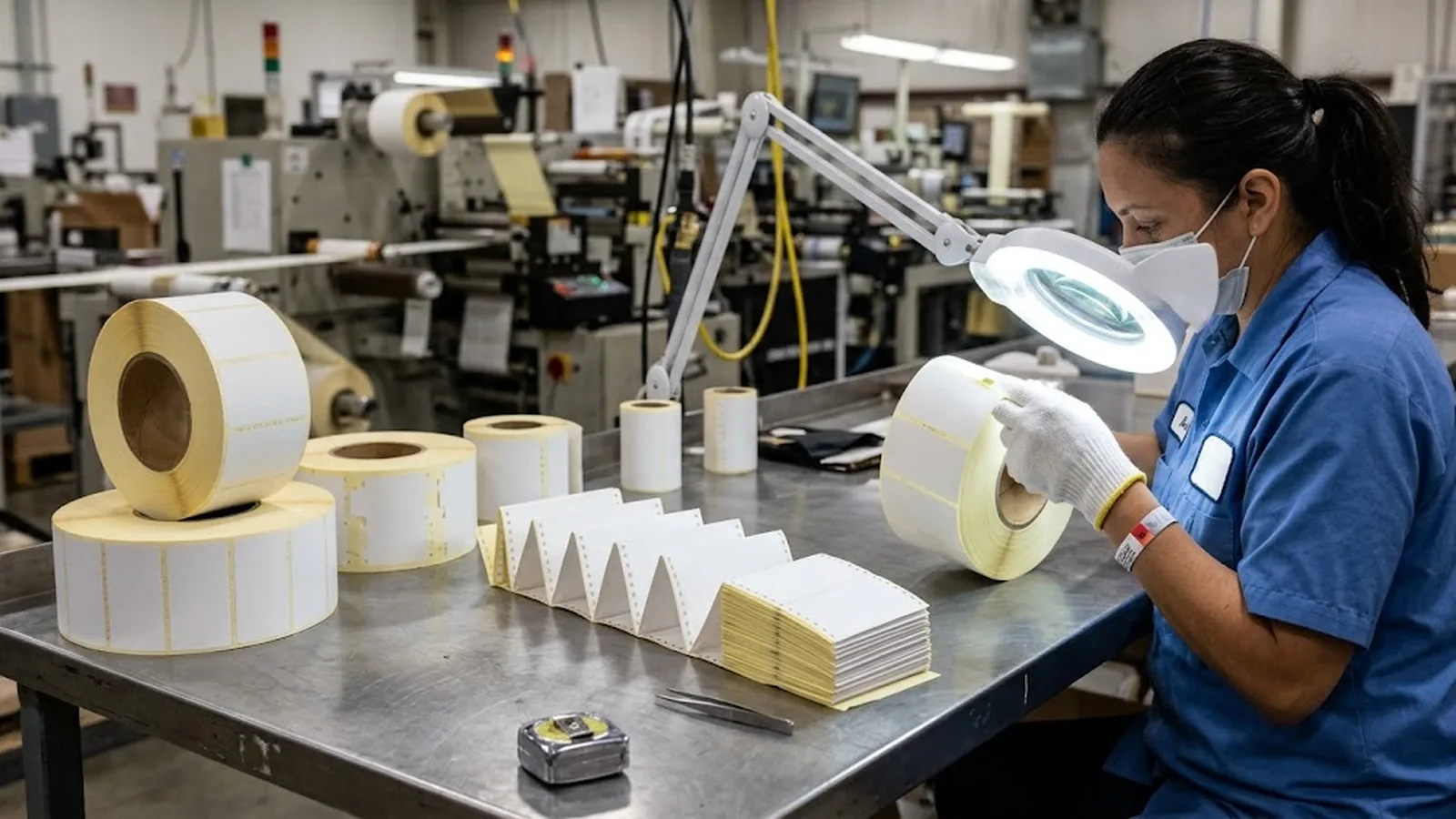
Warehouse labels are bought as finished die-cut goods or as converting input. Die-cut rolls arrive ready for the print station in the warehouse's own terminal fleet — gap or black-mark registration, liner specified to the applicator, roll diameter and core specified to the dispensing hardware. Fanfold stock trades the roll for stacking density: labels folded in z-form pack far more labels per carton and suit high-volume fixed stations, while rolls remain the default for mobile and multi-station fleets.
For converters producing their own finished labels, the parent economics mirror receipt converting: a 565 mm jumbo under a 5 x 108 mm plan turns each parent metre into five finished metres, and yield per parent is a two-multiplier division exactly as on receipt stock. Facestock choice at this stage — 58, 62 or 65 gsm, coated or uncoated — is the specification that everything downstream inherits, so it belongs to the buyer rather than the converting floor.
Liner and die-cut quality are the quiet reliability factors: a weak liner breaks at speed in the applicator, a burr-cut edge lifts at the corner and collects dust until the code stops reading. Converting tolerance — die-cut depth, gap consistency, liner caliper — is as much a part of the label specification as the facestock itself.
- Die-cut rolls: mobile fleets and multi-station warehouses; specify core, OD and registration.
- Fanfold: maximum labels per carton for fixed high-volume stations.
- Converters: parent-roll yield maths identical to receipt converting, with facestock grade as the buyer's call.
- Inspect liner and die-cut edges — they decide applicator uptime and corner lift.
Specification and rollout checks before the PO
First, test on the real surface at the real temperature. Adhesion on a lab plate tells you little about adhesion on a frozen shrink-wrapped pallet or a powder-coated rack beam; a twenty-label trial applied in the actual zone and scanned after 24 hours, one month and one quarter is the cheapest insurance in the programme. Warehouse rollouts that skip the surface trial are the ones that relabel.
Second, pin the specification sheet. Facestock gsm and coating class, adhesive class, liner, die-cut dimensions and tolerance, roll or fanfold format, core and outer diameter, and the developer system of the thermal chemistry — all on one page. Destination-market chemical rules on phenols in customer-facing and transit labels are now routine in audits, so request the compliance documentation with the shipment as standard practice rather than as an exception.
Third, plan the replenishment like an operation, not a purchase. Location labels are consumed by relabelling projects and new racking; pallet labels by throughput — the two flows need different stock depths and different pack sizes. Buyers who separate the flows typically hold one long-dwell stock for infrastructure and one high-turnover stock for pack-out, both from the same facestock family so image quality is identical across the site.
Procurement teams consolidating label and receipt stock on one supplier can review our thermal paper jumbo rolls, where converter-format parent stock in 58–65 gsm facestock grades is documented alongside the finished-roll programme.
- Surface-and-temperature trial before rollout — 24 h, 1 month, 1 quarter scans.
- One specification page: facestock, adhesive, liner, die-cut, format, chemistry.
- Compliance documentation with shipment for destination-market chemical rules.
- Separate replenishment flows: infrastructure relabelling versus pack-out throughput.
A warehouse label programme is only as reliable as its worst surface trial — everything else on the specification sheet is secondary to how the label behaves on the actual rack, tote or pallet.
Frequently asked questions
What are warehouse barcode labels made from?
Most are direct thermal labels: a thermal facestock (typically 58–65 gsm for stiffness), a thermal chemistry layer, optionally a protective top coat, and a pressure-sensitive adhesive on a release liner. Rack and location labels use the stiffer, often top-coated builds; pallet and carton labels prioritise adhesive performance through transit.
When do warehouse labels need a top coat?
Whenever the label faces abrasion, moisture, cool-store conditions or is scanned months after printing: transit pallet labels, chiller-zone location labels, tote labels that get handled daily. Uncoated stock is fine for short-dwell, dry, indoor labels replaced on a schedule.
What size are standard warehouse barcode labels?
100 x 150 mm (4 x 6 inch) is the global standard for pallet SSCC and carton labels; bin and pick-face identification typically runs 50 x 25 to 100 x 50 mm; rack labels are often custom die-cuts sized to the beam profile. All are converted from the same facestock families.
Why do labels fall off in cold stores?
Almost always the adhesive, not the facestock. General-purpose permanent adhesive needs room-temperature application to wet out properly; below about 5 °C it stiffens before bonding. Freezer-grade adhesives wet out at low temperatures and survive thaw cycles — specify them for any cold-store or winter-dock application.
Can one label stock serve both rack labels and pallet labels?
Often yes at the facestock level — a 65 gsm top-coated direct thermal stock covers both — but the adhesive and format should differ: high-tack or freezer-grade adhesive and beam-profile die-cuts for infrastructure, standard permanent in 100 x 150 mm for pallets. Holding one facestock family with two finishing specifications keeps image quality identical while matching each duty.