
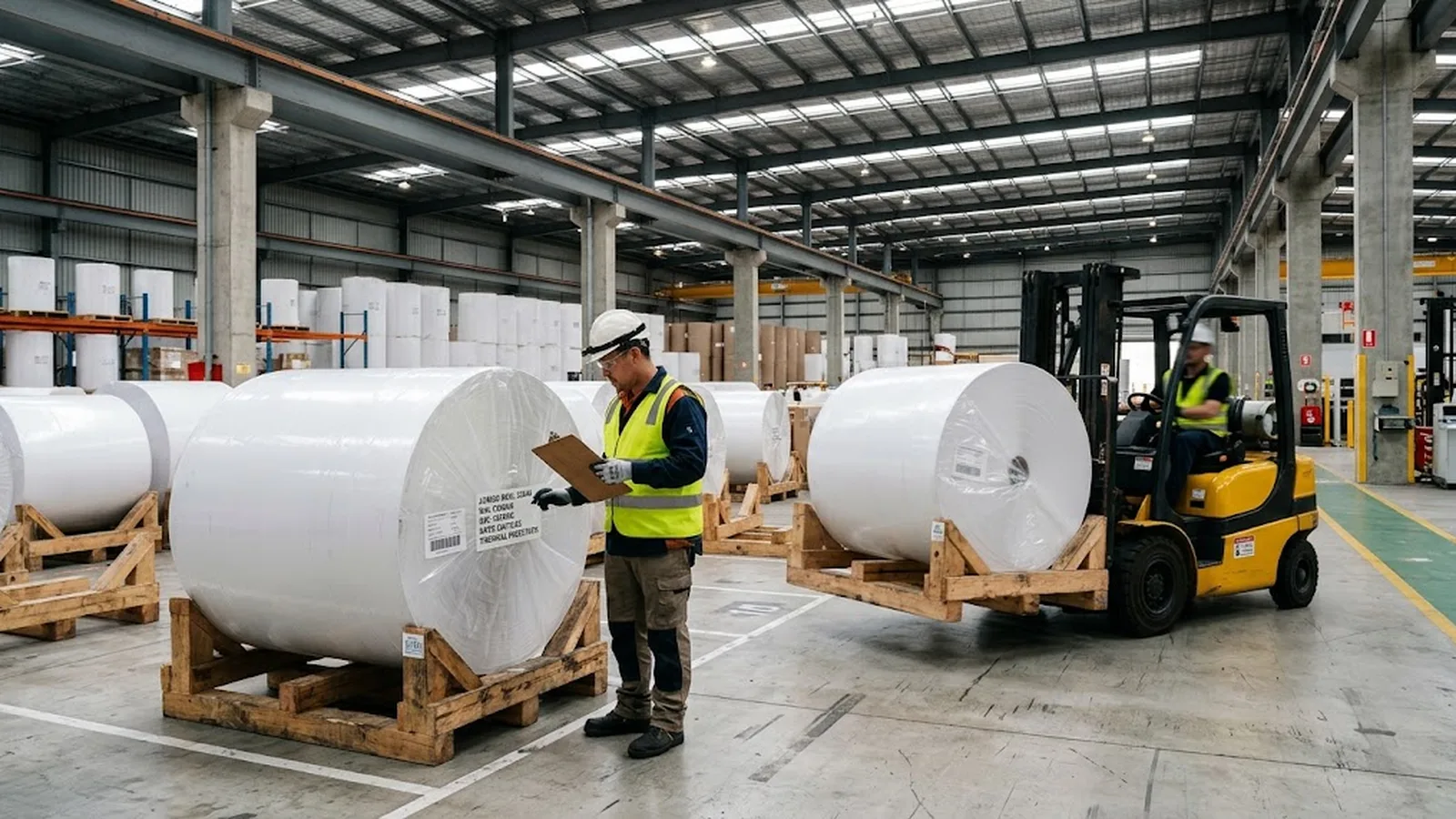
A thermal paper parent roll — jumbo or mother roll — is the wide, large-diameter roll of coated thermal stock that comes off the mill coater and feeds converting lines that slit it into finished receipt and label rolls. Converting buyers specify six things: web width, grammage (typically 48–80 gsm), core inner diameter (commonly 3 or 6 inches), outer diameter or length (up to 6,000 m and beyond), winding direction and firmness, and moisture-barrier wrap. Pricing is quoted per tonne but decided per square metre — grammage and yield, not the tonne price, determine the real cost of finished output. Serious converter programmes add incoming QC (moisture, coating weight, edge quality, bar-code of batch traceability) and container-grade packing, because a parent roll damaged in transit is damaged at the most expensive point in its life.
Every finished thermal roll begins as a parent roll: a web metres wide and kilometres long, coated on one side with the microcapsule-and-developer chemistry that makes direct thermal printing work, wound at the mill into the jumbos that converters slit, rewind, die-cut and pack into the formats the market buys. The parent roll is where quality, yield and cost are set — and where the converting business's margin is quietly decided long before the first finished roll ships.
For converters and stocking distributors, buying parent stock is a different discipline from buying finished rolls. The specification vocabulary is that of the mill — width, grammage, caliper, coating weight, core, winding — and the purchasing logic runs per tonne and per square metre rather than per roll. Add the physics of shipping a 700-kilogram roll across an ocean, and the buying decision becomes a small engineering project in its own right.
This guide works that project end to end: what a parent roll actually is and how it is built, the six-part specification that defines one, how pricing structures really resolve, the incoming QC that protects the converting line, and the export packing and container planning that gets parents to the floor undamaged.
Buyers sourcing converter-grade stock can review our thermal paper jumbo rolls, where parent widths, grammage grades and core options are documented per grade alongside the finished-roll programme.
- A parent roll is the mill output converters buy: wide web, large diameter, coated one side, wound on 3- or 6-inch cores — the specification you write here decides your finished quality.
- Six parameters define the buy: web width, grammage, core ID, outer diameter or length, winding direction/firmness, and wrap.
- Price per tonne is a quotation device; cost per square metre of usable output is the real comparison — grammage, yield and trim loss decide it.
- Incoming QC on moisture, coating weight, edge quality and batch traceability protects the converting line from the defects that finished-roll buyers ultimately see.
- Parent rolls are freight-critical cargo: moisture-barrier wrap, cradle or pallet support and container loading plans are part of the specification, not an afterthought.
What a parent roll is and how it is built
Parent rolls come off the mill's coating machine as wide webs — commonly in the 400 to 1,200 mm range for thermal converting stock, with dedicated thermal mills running broader coater decks — wound onto cores of 3 inches (76.2 mm) or 6 inches (152.4 mm). The web carries the full direct thermal stack: base paper, precoat, thermal coating with its microcapsules and developer, and optionally a top coat, with the chemistry on one side only. Winding direction is documented because converting lines feed from a defined side of the roll, and a parent wound the wrong way out forces rewinding or an awkward line reconfiguration.
Roll size is the economics of the format. Outer diameters in the 800 to 1,200 mm class are common, carrying anywhere from two to six thousand metres of stock depending on width and grammage. Larger diameters spread handling and changeover costs over more metres, but raise the weight each splice, lift and container position must carry — most converters standardise on the largest diameter their unwinding stands and lifting gear can cycle safely.
Between the coater and the parent, the mill also controls the variables that decide converting behaviour: moisture content of the base paper, coating weight uniformity across the web, and edge quality after the web is trimmed to ordered width. These are the properties a converter is really buying — the visible roll is just their container.
| Parameter | Common options | Why it matters |
|---|---|---|
| Web width | 400–1,200 mm, slit to order | Sets the finished formats and trim loss of the programme |
| Grammage | 48, 55, 60, 65, 70, 75, 80 gsm | Drives cost per m2, stiffness, roll lengths and print feel |
| Core ID | 3 in / 6 in | Must match the converting line's unwinding stands |
| Outer diameter / length | 800–1,200 mm OD; up to 6,000 m+ | Changeover economics versus handling weight |
| Winding | Direction documented; firm, uniform tension | Feed geometry and defect-free unwinding |
| Wrap | Moisture-barrier film, sealed ends | Hygroscopic stock; ocean-freight survival |
Envelopes vary by mill and coating line; the converter's job is to pin the parameters the line actually needs rather than accept a generic 'jumbo roll' description.
The six-part specification and what each decision costs
Width is the first economic decision because it sets trim loss. Parent stock is slit to order from the coater's deck widths, and a converting programme built on finished widths that nest cleanly into the parent wastes almost nothing, while an awkward programme can shed several percent of paid-for paper as trim. Converters planning a new format range should map finished widths against available parent widths before ordering — the arithmetic takes an hour and pays back every production day.
Grammage is the second: it fixes the square metres per tonne (a tonne of 55 gsm stock is about 18,180 m2; a tonne of 65 gsm about 15,380 m2), and with it the finished-roll lengths, stiffness and freight weight per delivered metre. The choice runs from 48 gsm lightweight stock for mobile and high-yield programmes through the 55–65 gsm receipt core to 70–80 gsm grades for tickets and durable applications — each with a documented coating class and retention profile.
Core, diameter and winding are the mechanical trio: they must match the unwinding stands, splicing equipment and storage handling of the specific line, and mismatches surface as downtime rather than as disputes. The wrap decision — moisture-barrier film, sealed ends, and for some routes an inner liner — belongs in the specification because thermal stock is hygroscopic and the wrap is what survives the ocean leg. Where container planning is the next step, our export shipping guide covers pallet standards, moisture-barrier packing and the document set for ocean freight.
- Width: nest finished formats into parent widths to cut trim loss to near zero.
- Grammage: fixes m2 per tonne and finished-roll lengths — choose for duty, not habit.
- Core and OD: match the line's unwinding and lifting capacity exactly.
- Winding direction: documented per order to avoid line reconfiguration.
- Wrap: moisture-barrier film and sealed ends specified in the contract, not assumed.
Pricing: per tonne, per square metre and the yield arithmetic
Parent stock is quoted per tonne because that is how mills buy pulp and sell paper, but two quotations at the same tonne price can differ meaningfully in delivered value. The converter's comparison runs through square metres: divide the tonne price by grammage (in grams per square metre, with a zero removed) and the result is cost per square metre of parent — the number that, after yield and trim, becomes the true input cost of finished output.
Yield is where the comparison gets honest. Real converting lines lose paper to start-up splices, width trim, out-of-spec rolls and reel changes; well-run programmes hold yield in the mid-nineties, and the difference between a 96 and a 90 percent yield is worth more than most tonne-price discounts. Converters evaluating a new parent supplier should therefore run the same trial specification on both and compare finished output, not invoices.
Commercial structure follows volume and relationship. Container-scale programmes are typically priced against a published grade list with volume bands, agreed specification and batch documentation; smaller converters buying by the single parent or partial pallet pay a handling premium for it. Distributors bridging that gap — holding parent stock locally and selling by the roll — exist because the container is the efficient purchase unit but not every converter can absorb one.
For buyers standardising finished output on one supply chain, our POS and receipt paper rolls programme documents the finished formats that parent stock feeds, so parent and finished specifications can be reviewed side by side.
Incoming QC and the freight that protects the buy
Incoming QC on parents is cheap insurance at the most valuable point in the chain. The standard checks take minutes per roll: verify width and outer diameter against the order, sample grammage and caliper, check moisture (thermal stock should sit in a narrow band around 4.5–5.5 percent), inspect end faces for telescoping, ridging and dust, confirm the developer class from the batch documentation, and log the batch code into traceability. Defects caught at goods-in are claims; the same defects caught at the finished-roll packing station are product, labour and a customer complaint.
Coating defects deserve a specific eye. Streaks, bare patches and coating skips show as pale bands in a print test across the parent's width — a five-metre trial print on a test press or a heated bar across the web finds them before the slitter does. Edge quality predicts finished-roll dust: a parent with fuzzed or burst edges will distribute that defect into every finished roll cut from it.
Freight is the last QC gate. Parent rolls ship as heavy, dense cargo — typically cradled or chocked on pallets or beams, wrapped in moisture-barrier film with sealed ends, loaded in a planned pattern that survives ocean transit — and the packing method belongs in the purchase specification, agreed with the mill before the first booking rather than negotiated after a damaged arrival.
- Goods-in checks: width, OD, grammage, caliper, moisture band, end faces, batch code.
- Print trial across the full web width to catch streaks and coating skips early.
- Edge quality inspection predicts finished-roll dust before slitting.
- Packing in the specification: barrier wrap, chocking, planned container pattern.
- Photograph unloading at both ends to protect damage claims.
A parent roll is at its most valuable the day it arrives and its most vulnerable the day it sails — QC and packing are the two gates between the two.
Frequently asked questions
What is a thermal paper parent roll?
The wide, large-diameter roll of coated thermal stock produced by the mill and bought by converters for slitting into finished receipt, ticket and label rolls — also called a jumbo or mother roll. It carries the full thermal coating stack on one side of the web and is wound on 3- or 6-inch cores.
What sizes do thermal parent rolls come in?
Common web widths run from about 400 to 1,200 mm, slit to order; outer diameters in the 800–1,200 mm class carry from roughly 2,000 to over 6,000 metres depending on width and grammage. Core inner diameter is typically 3 or 6 inches, matched to the converting line's unwinding stands.
How is parent roll pricing compared between suppliers?
Normalise tonne quotes to cost per square metre (tonne price divided by grammage) and then apply expected yield and trim loss. Two equal tonne prices can differ several percent in delivered value, and a yield difference between 90 and 96 percent is worth more than most discounts.
What QC checks should converters run on incoming parents?
Verify width, outer diameter and grammage against the order; sample caliper and moisture (around 4.5–5.5 percent); inspect end faces for telescoping, ridging and dust; run a print trial across the full web width for streaks and coating skips; and log the batch code for traceability.
How are parent rolls packed for export?
Moisture-barrier film with sealed ends, rolls chocked or cradled on pallets or beams, and a planned container loading pattern rated for the roll weights. The packing method should be written into the purchase specification, and unloading should be photographed at both ends to support any transit damage claim.