
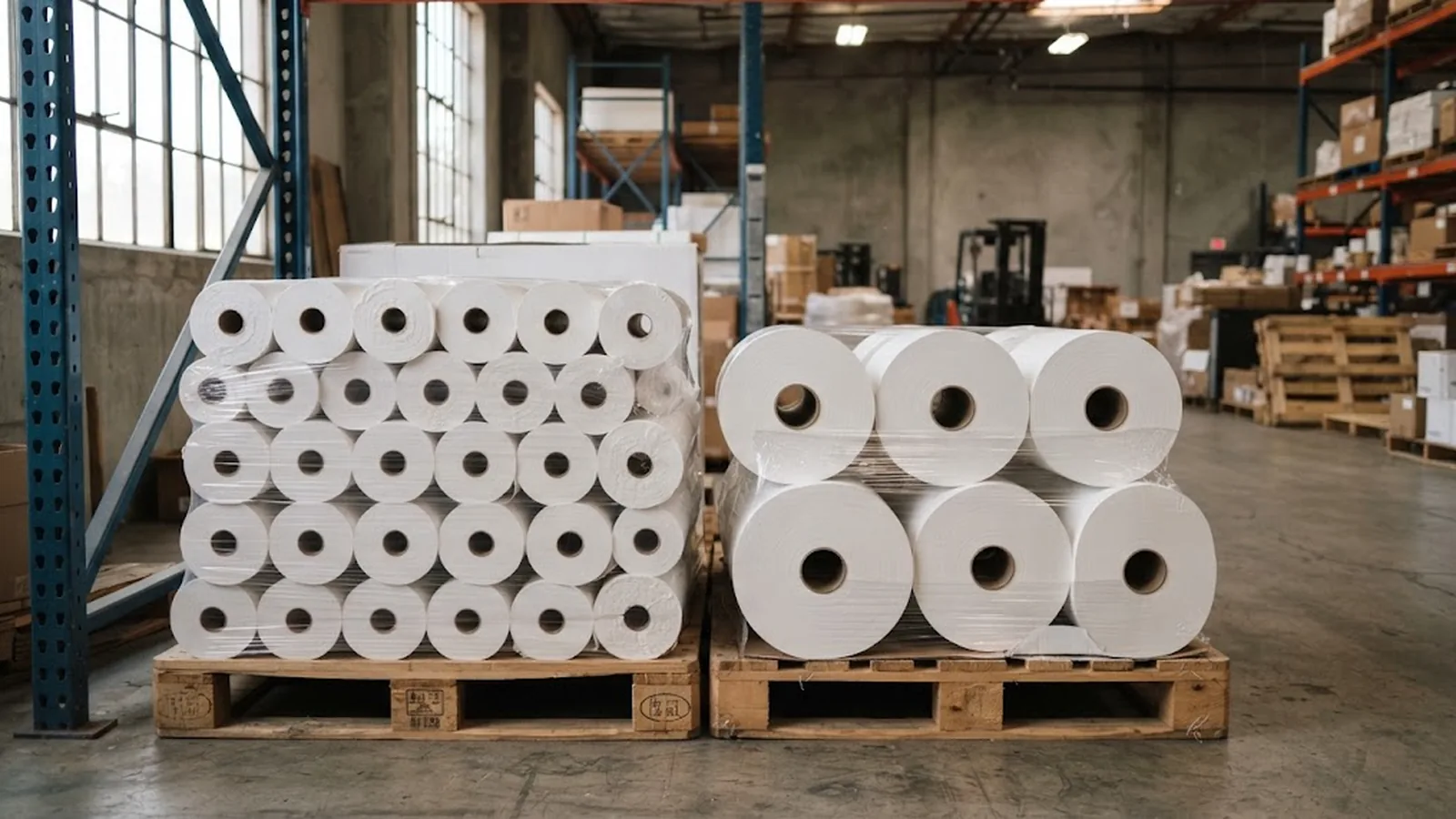
The core is the cardboard tube at the centre of a thermal paper roll, and its size determines two things: which machine spindle the roll fits, and how much paper the roll can hold for a given outer diameter. A 1-inch (25.4 mm) core is the common default for POS receipt rolls; 3-inch (76 mm) cores are used for higher-volume machines, jumbo converting and label stock. Because paper volume grows with the square of the radius, a small core change significantly changes roll length — a 80 mm diameter roll on a 1-inch core holds noticeably more paper than the same diameter on a 3-inch core. Buyers should always state core size, core material and wall thickness explicitly, because 'same size roll' with the wrong core will not fit the machine or will under-deliver paper per roll.
Roll width and diameter get all the attention on a purchase order, yet the small cardboard tube at the centre quietly decides whether a shipment works. Core size controls which spindle the roll drops onto, how many metres of paper fit inside a fixed outer diameter, how the roll behaves at high feed speeds, and how efficiently pallets and containers fill up. Get it wrong and the product is effectively unusable, no matter how good the paper is.
The two dominant standards are the 1-inch core (25.4 mm) used across most POS and mobile receipt formats, and the 3-inch core (76.2 mm) used in higher-capacity machines, kiosks, label lines and throughout jumbo-roll converting. Between them sit regional variants — 12.7 mm, 25 mm, 40 mm and others — that mostly reflect machine generations in specific markets. For converters, core choice also ripples upstream: parent jumbo rolls are wound on 3-inch cores almost universally, and every downstream slit roll inherits decisions about core, wind and length.
This guide explains what the core actually does, the maths connecting core diameter, outer diameter and roll length, and the specification points export buyers should confirm before ordering — including the details that most often cause disputes: core tolerance, wall strength and 'roll length' definitions.
- Core size must match the machine spindle — 1-inch (25.4 mm) dominates POS receipt rolls, 3-inch (76.2 mm) dominates high-capacity machines, labels and jumbo converting.
- Roll length grows with the square of the radius: for the same outer diameter, a smaller core holds meaningfully more paper.
- Core specifications include more than diameter: wall thickness, material, moisture resistance and burst strength all affect machine reliability.
- Jumbo parent rolls are standardised on 3-inch cores; converters slit downstream to 1-inch or 3-inch depending on the end market.
- State core size, OD target and minimum metres per roll separately on the purchase order — 'same size' rolls with different cores are a common dispute source.
What the core actually does
The core is a spiral-wound cardboard tube, but it is a functional component, not packaging. It carries the roll onto the machine spindle, transmits the drive torque that pulls paper through the mechanism, and holds the paper's geometry square so the web feeds straight. A soft, out-of-round or crushed core shows up immediately as skew feeding, tearing or stalls — faults that get blamed on the machine long before anyone inspects the core.
Cores are specified by inside diameter (ID), which is the number people quote: 1 inch (25.4 mm) and 3 inch (76.2 mm) are the standards, with 12.7 mm cores common in compact mobile devices and 40 mm or 2-inch variants in some regional machine fleets. Wall thickness and material grade vary just as much as diameter. A thin-wall core maximises paper capacity but must still resist crushing in transit and under storage stacking; heavier walls add strength at the cost of a slightly larger roll for the same paper length.
Moisture is the quiet enemy. A core that absorbs humidity in a container or warehouse can deform or shed fibres, and its diameter can shift enough to loosen or tighten the winding. Reputable manufacturers use moisture-resistant cores and store finished rolls in controlled conditions — one of those unglamorous details that separates consistent supply from intermittent complaints.
| Core ID | Typical formats | Typical users |
|---|---|---|
| 12.7 mm (1/2") | Compact mobile receipt rolls | Mobile POS, metering devices |
| 25.4 mm (1") | 57/80 mm receipt rolls, most POS formats | Retail, hospitality, banking counters |
| 40 mm | Regional machine variants | Legacy fleets in specific markets |
| 76.2 mm (3") | High-capacity rolls, label stock, jumbo parent rolls | Kiosks, logistics, converters |
Core versus outer diameter: the maths that decides roll length
Roll length follows from simple geometry, and the core diameter sits inside the equation in a way that surprises many buyers. Paper length on a roll is the cross-sectional area of the paper ring divided by paper thickness. The ring area is π × (OD² − core OD²) / 4, so every millimetre of core diameter is subtracted from the diameter squared — the effect is significant because radius terms are squared.
A worked example with a real receipt format: an 80 mm OD roll wound on a 1-inch (25.4 mm) core holds roughly 20–25% more paper than the same 80 mm OD on a 3-inch (76.2 mm) core. Equivalently, if a machine can only accept a fixed OD, the 1-inch core version delivers more documents per roll — fewer changeovers and lower per-metre logistics cost. This is precisely why most retail receipt formats standardised on small cores, while machines with generous paper compartments can afford 3-inch cores and their mechanical advantages.
The relationship cuts the other way for converters. Jumbo parent rolls on 3-inch cores reach diameters over a metre, and at that scale the core is a small fraction of the ring — but the core must then support enormous winding tension and weight. Core strength specifications for jumbo converting are an order of magnitude beyond receipt-roll cores, which is one reason parent rolls and finished rolls should never be specified interchangeably.
- Length ≈ π × (OD² − core OD²) / (4 × paper thickness) — thickness and both diameters must be stated.
- Same OD, smaller core → more paper: a 1-inch core beats a 3-inch core by a wide margin at 80 mm OD.
- Same paper length, smaller core → smaller OD: useful where machine compartments are tight.
- Always confirm whether quoted 'roll length' is minimum guaranteed or nominal average.
Converting implications: from jumbo core to finished roll core
In the converting plant, core decisions bookend the process. Parent jumbo rolls arrive on 3-inch cores with heavy-duty walls, slit into finished rolls that are rewound onto cores chosen for the end market. The rewinding step is where quality is won or lost: tension must be high enough for a firm, dense wind but not so high that the core is stressed or the print surface damaged. A well-wound roll feels solid, has a clean edge profile, and the core shows no crushing at either end.
Core choice also interacts with shipping economics. Cores add volume and weight to every pallet, and for 1-inch formats across thousands of rolls the difference between wall thicknesses shows up in container loading calculations. Export buyers ordering container quantities do well to discuss core specification openly with their supplier — wall thickness, moisture resistance and even flute direction affect both machine performance and freight efficiency.
Finally, labelling and traceability hang off the core. End labels carrying batch number, production date and specification are applied at the core face; buyers who need scan-based inventory or expiry traceability should agree label formats in advance, because re-labelling at destination is labour nobody wants to pay for twice.
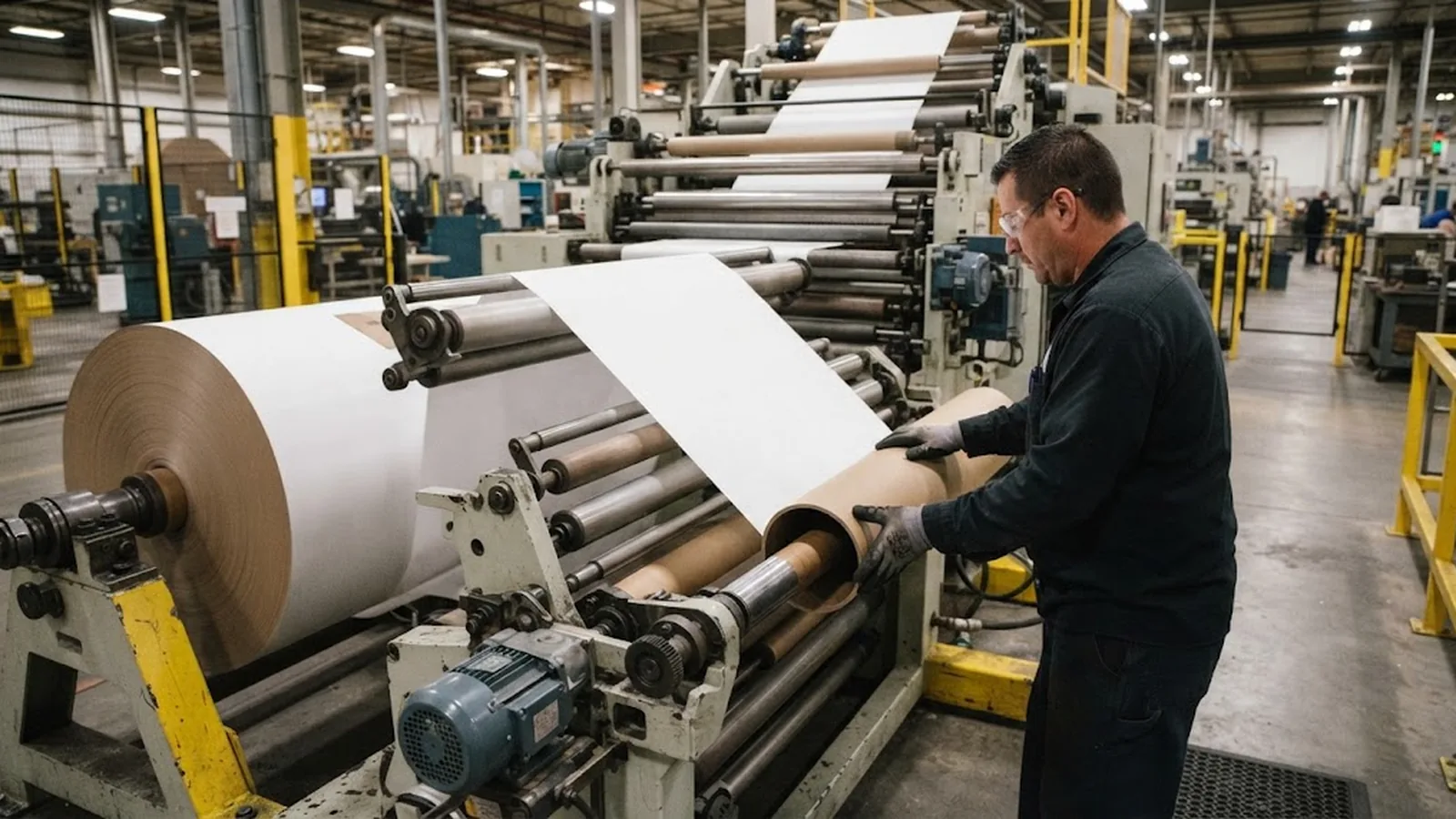
If you are switching suppliers, send one existing roll in — the core ID, wall and wind direction can all be measured and matched before your first production order.
What buyers should state on the order
A complete core specification takes one extra line on the purchase order and prevents the most common receipt-roll complaints. State: core ID (25.4 mm or 76.2 mm, not 'standard'), wall thickness or minimum crush strength, core material (spiral cardboard, moisture-resistant if sea freight or humid climates are involved), and wind direction if the machine requires paper out from a specific face.
Pair the core line with the three length-related numbers: target outer diameter, minimum guaranteed metres per roll, and paper thickness (gsm and caliper). When a dispute arises about 'short rolls', the resolution almost always comes down to whether these were agreed up front — rolls quoted by nominal length versus guaranteed minimum length are a classic mismatch. A manufacturer running its own gauges can commit to a measured minimum; a trader passing through third-party stock often cannot.
For converters buying jumbo stock, the equivalent conversation covers core strength at your rewind speeds, roll hardness targets, and whether the parent core returns to the mill or is scrapped. None of these are exotic — they are one email — but they are far cheaper settled before the container sails than after.
Frequently asked questions
What is the difference between 1-inch and 3-inch thermal paper cores?
They are spindle-fit standards, not performance grades. 1-inch (25.4 mm) cores fit most POS receipt machines and hold more paper at a given outer diameter. 3-inch (76.2 mm) cores fit high-capacity machines, label lines and are the standard for jumbo parent rolls, offering mechanical stability at large diameters.
Can I use a 3-inch core roll in a 1-inch core machine with an adapter?
Some machines accept adapter spindles, but the trade-off is real: for the same outer diameter, the 3-inch core roll holds substantially less paper, so you change rolls more often. Where possible, order the core size the machine was designed for rather than adapting.
Why do rolls with the same diameter sometimes have different lengths?
Roll length depends on core diameter and paper thickness as well as outer diameter, and quoted lengths may be nominal averages rather than guaranteed minimums. Compare specifications on all four numbers — OD, core ID, caliper and minimum metres — when evaluating quotes.
Does core quality really affect printing?
Indirectly but strongly. The core transmits drive torque and holds the roll concentric; a weak, out-of-round or moisture-deformed core causes skew feed, slipping and paper jams that look like machine faults. Specifying crush strength and moisture-resistant cores is cheap insurance.
What core size do jumbo rolls use?
Thermal jumbo parent rolls are standardised on 3-inch (76.2 mm) cores with heavy-duty walls to withstand winding tension and weight. Converters slit and rewind onto 1-inch or 3-inch cores depending on the destination market and machine format.