
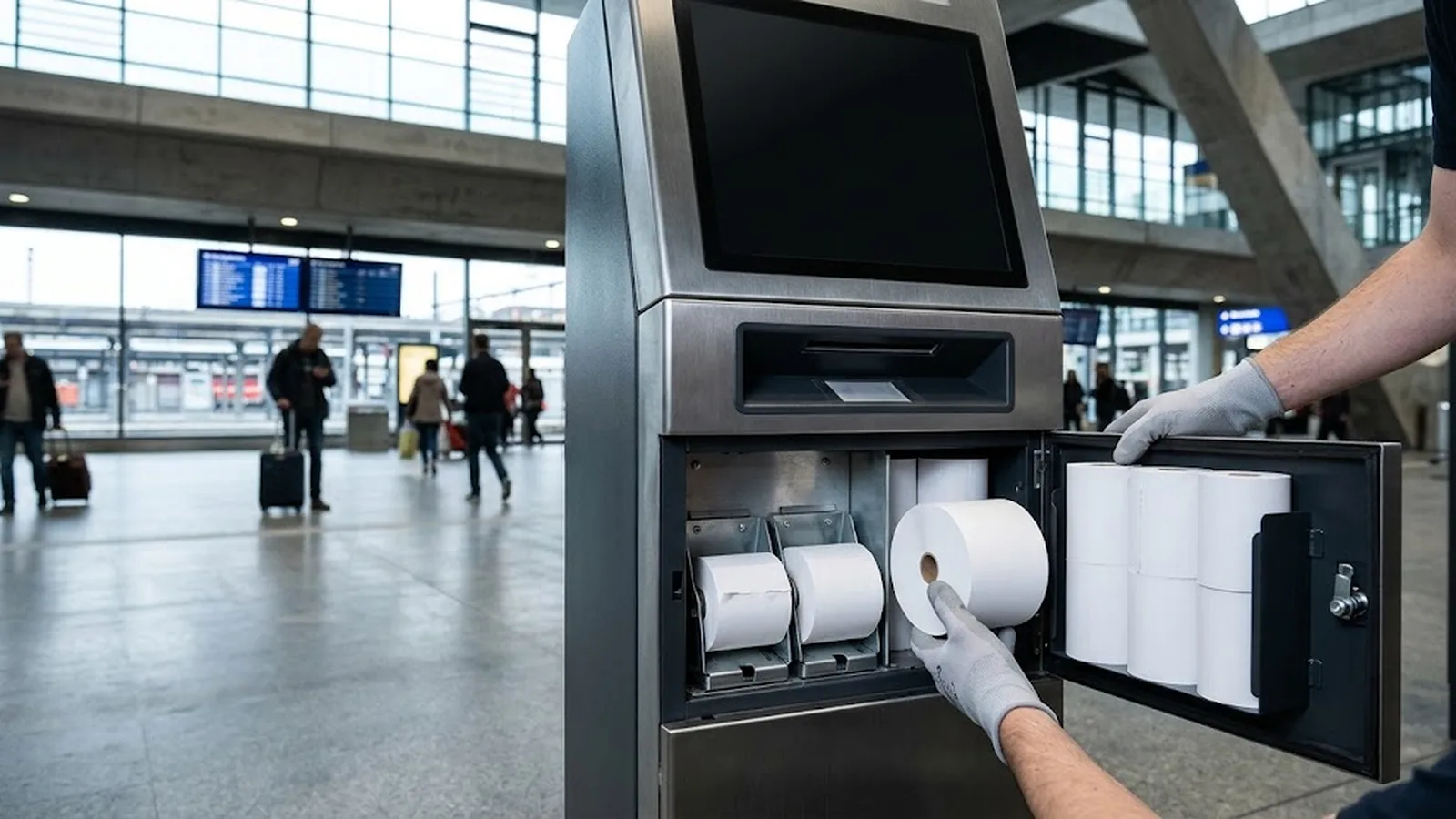
Kiosk thermal paper is specified around three unattended-service realities: the roll must run to the kiosk printer's exact width, diameter and core so service visits stay rare; sensitivity and coating must image reliably across a wide duty cycle without operator intervention; and the developer chemistry must carry BPA-free or phenol-free documentation because the receipts pass through the public's hands. Buy on a fixed per-kiosk-model specification sheet from a manufacturer, not on generic receipt-roll stock.
A kiosk is the only place in a retail or service estate where paper runs with no staff member watching it. The receipt printer inside a parking terminal, queue dispenser or self-checkout has one job: never be the reason the machine is out of service. That single requirement reshapes every specification decision — roll capacity is chosen to extend the interval between service visits, image reliability is chosen so a first-time user's ticket prints fully, and the paper must behave identically in a hot outdoor parking kiosk in August and a climate-controlled mall in January.
This guide sets out how a buyer specifies thermal paper for a kiosk fleet: matching the roll format to each kiosk printer model, the sensitivity and coating decisions that unattended duty cycles demand, the chemistry compliance that public-facing receipts require, and the supply structure that keeps a multi-site programme stocked without a pallet of mismodelled rolls sitting in a corner.
The sections follow the buyer's sequence: format first, image specification second, chemistry third, environment fourth, and the supply structure last.
- Kiosk rolls are a per-model specification: width, maximum diameter and core must match each kiosk printer exactly, because a roll that is 2mm too wide takes the terminal out of service.
- Diameter is a service-interval decision — the largest diameter the mechanism accepts directly extends the time between roll changes at unattended sites.
- High-sensitivity grades and, where tickets are handled or stored, top-coated constructions buy print reliability that unattended duty cycles need.
- Public-facing receipts make chemistry documentation non-optional: BPA-free as baseline, phenol-free for sensitive channels, SDS with every shipment.
- Multi-site kiosk supply works on a per-model specification matrix, a shared service forecast and moisture-barrier packing — not on generic receipt-roll stock.
Format first: a per-model roll matrix, not one SKU for the estate
Kiosk printers are far less standardised than front-of-house receipt printers. A single estate can run 80mm thermal mechanisms in self-checkouts, 57mm compact printers in queue dispensers, and proprietary wide formats in parking or ticketing terminals — each with its own width tolerance, maximum roll diameter and core size. The first discipline of kiosk paper buying is therefore a matrix: every kiosk model on one axis, its required width, diameter, core and any special features (black mark, sensor position) on the other, and one approved specification per cell.
The consequences of skipping the matrix are physical. A roll two millimetres too wide binds in the guide and jams; a roll a few millimetres under-diameter is rejected by the low-paper sensor long before it is empty; a wrong core spins on the spindle and skews every ticket. Each of these takes an unattended terminal out of service until a technician arrives — which is precisely the failure mode kiosk operators pay to avoid.
Diameter deserves its own decision: unlike staffed counters, a kiosk tolerates a larger roll because nobody minds a heavier cassette. Specifying the maximum diameter the mechanism accepts is the cheapest way to extend the service interval and cut truck rolls.
| Kiosk type | Typical width | Roll decision drivers |
|---|---|---|
| Self-checkout / payment kiosk | 80mm | Maximise diameter for service interval; mid-weight gsm for stiffness |
| Parking / outdoor terminal | 80mm wide-format | Top-coated construction for heat and handling; high sensitivity for cold mornings |
| Queue dispenser | 57mm | Lightweight gsm to stretch ticket count per cassette |
| Ticketing / voucher kiosk | Model-specific | Black mark or sensor position if the model requires it |
Image specification: sensitivity, coating and the unattended duty cycle
An unattended printer faces duty cycles a staffed counter never sees. It may print one ticket an hour all morning, then a queue of forty in ten minutes; it runs in an enclosure that heats through the day and cools overnight; and when an image fails, the user has no staff member to blame but the machine. Sensitivity class is the first lever: high-sensitivity grades image fully at lower head energy, which keeps print density consistent across speed swings and in cold enclosures, and reduces the marginal-print behaviour that reads as 'the machine is broken'.
Coating construction is the second lever. Where the ticket leaves with the customer — parking validation, entry passes, vouchers that must survive a wallet or a car dashboard — a top-coated grade protects the image against moisture, oil and light that a non-top-coated receipt would fade through. Where the output is a short-lived queue slip, a standard construction is the economical choice. The decision belongs in the matrix per kiosk type, not as a blanket grade across the estate.
For production volumes, the same construction logic applies to our top-coated thermal label stock, quoted per jumbo roll, slit reel or finished format — the coating classes used for durable label stock are the same families that protect kiosk tickets.
Chemistry and documentation for public-facing receipts
Kiosk receipts pass through the public's hands, which places them squarely inside the compliance expectations that now govern thermal paper. BPA-free structures are the baseline: REACH restricts BPA in thermal paper in the EU, and large operators increasingly demand BPA-free documentation worldwide regardless of local law. Phenol-free grades go further and are the appropriate choice for operators serving sensitive channels or marketing an explicit chemical-safety position.
The paperwork is part of the product for kiosk fleets. A current safety data sheet naming the developer system should travel with every shipment, and compliance declarations should be aligned to the destination market's rules — because an operator running terminals across borders inherits the strictest market's expectations in practice. Fix the chemistry class per market in the specification matrix; changing it mid-programme is a requalification that touches every terminal's print behaviour, not a substitution on the next pallet.
Environment: heat, cold, humidity and storage on site
Kiosk paper lives in worse conditions than storeroom receipt stock. Outdoor terminals cycle through full sun and overnight cold; enclosed kiosks in malls sit near lighting and heat sources; and spare rolls are often stored in service rooms with no climate control at all. Three specifications answer this: a sensitivity class with margin for the cold end of the range, a top-coated construction where tickets face heat or handling, and moisture-barrier packing on every case, since thermal coating is hygroscopic and a roll stored for months before loading is the norm at unattended sites.
On-site storage discipline belongs in the service routine, not just the purchase order: spare rolls kept sealed in their barrier wrap, away from direct light and heat sources, rotated so the oldest stock loads first. Most faded-image complaints at kiosks trace to storage conditions on site rather than to the grade.
Structuring supply for a multi-site kiosk programme
Kiosk paper is bought in lumpy, forecastable volumes: roll consumption per terminal per month is stable once the matrix is set, which makes the format well suited to programme supply from a manufacturer. The structure has three parts. First, the per-model specification matrix as the contract document, so every repeat order is a reference rather than a renegotiation. Second, a shared forecast aligned to terminal rollout and service-visit schedules — the mill can level production, and the buyer is rewarded in price and allocation. Third, agreed packing: per-model case labelling so the technician loading a van knows exactly which case serves which terminal, moisture-barrier wrap, and private-label case work where the operator's brand goes on the box.
Where developer compliance is part of the specification, our BPA-free vs phenol-free guide documents the chemistry, the regulations and the paperwork behind each class — the reference most operators hand to their own compliance teams when fixing the matrix.
Where a programme needs several formats from one supplier, our custom thermal paper programme covers width, core, roll diameter and developer class in a single specification sheet — the consolidated document that keeps a mixed kiosk estate auditable.
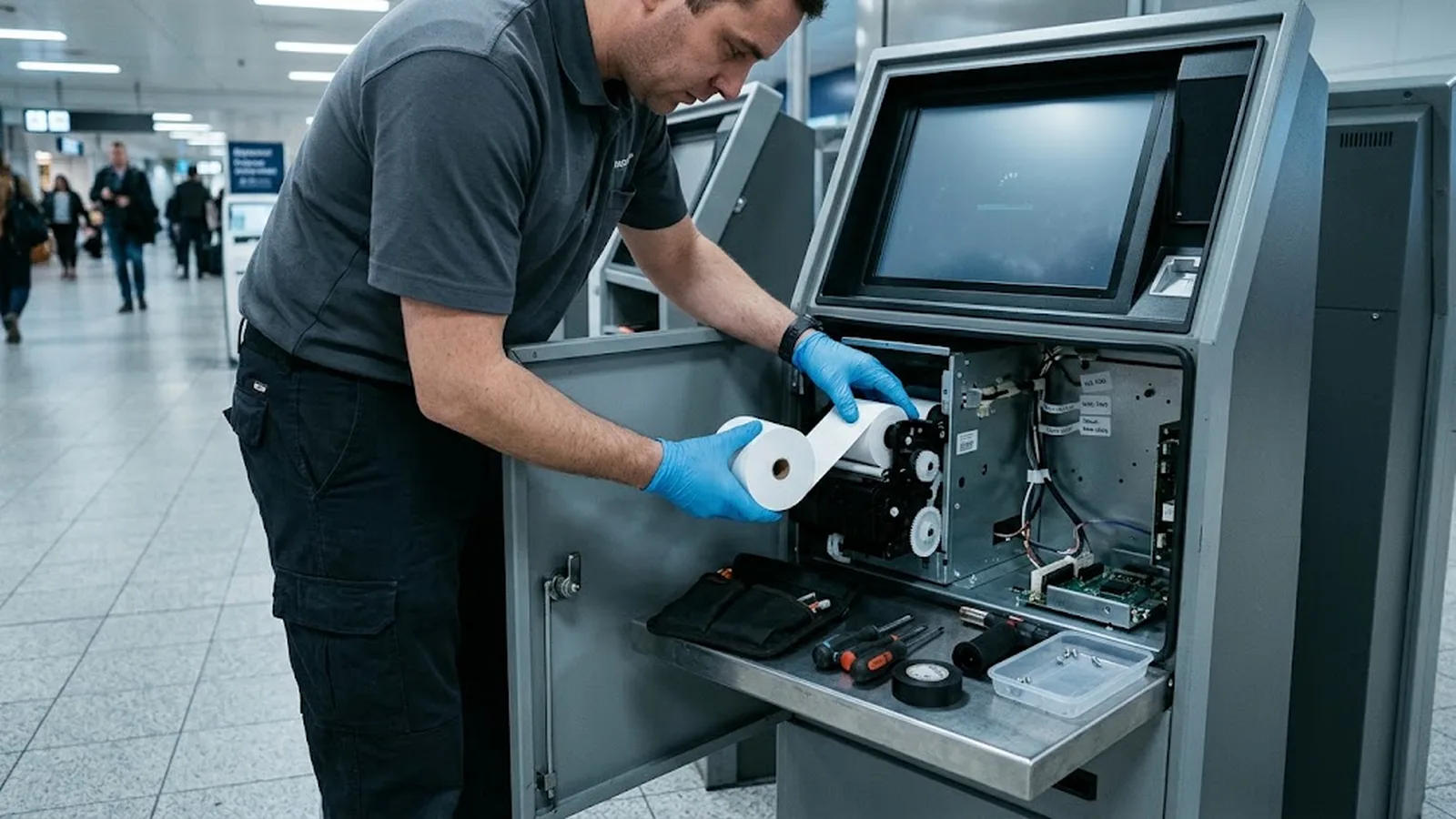
Programme shorthand: 'One matrix per kiosk model — width, diameter, core, sensitivity, coating; chemistry fixed per market with SDS; barrier-packed, forecast-aligned repeats from the mill.'
Frequently asked questions
What size thermal paper do kiosks use?
It depends on the kiosk printer model, which is why a per-model matrix is the first purchase-order document. Common formats are 80mm and 57mm widths, but parking and ticketing terminals often run wider proprietary formats, and each mechanism has its own maximum roll diameter and core size that must be matched exactly.
Why do kiosk rolls need higher sensitivity than normal receipt paper?
Unattended terminals face wide speed swings, heated and cooled enclosures, and cold-morning starts. High-sensitivity coatings image fully at lower head energy across that range, preventing the faint or partial prints that users read as a broken machine — a cost far above the paper-price difference.
Do kiosk receipts need to be BPA-free?
In the EU, REACH restricts BPA in thermal paper, making BPA-free the compliance baseline there, and large kiosk operators typically demand BPA-free documentation worldwide. Phenol-free grades suit operators serving sensitive channels or wanting a broader chemical-safety position, with SDS paperwork shipped with every batch.
How is kiosk thermal paper supplied in volume?
Programme supply from a manufacturer works on the per-model specification matrix, a rolling forecast aligned to terminal rollout, and agreed packing with per-model case labelling and moisture-barrier wrap. Mill-direct volume starts at pallet scale per specification and reaches container economics across a mixed-format programme.