
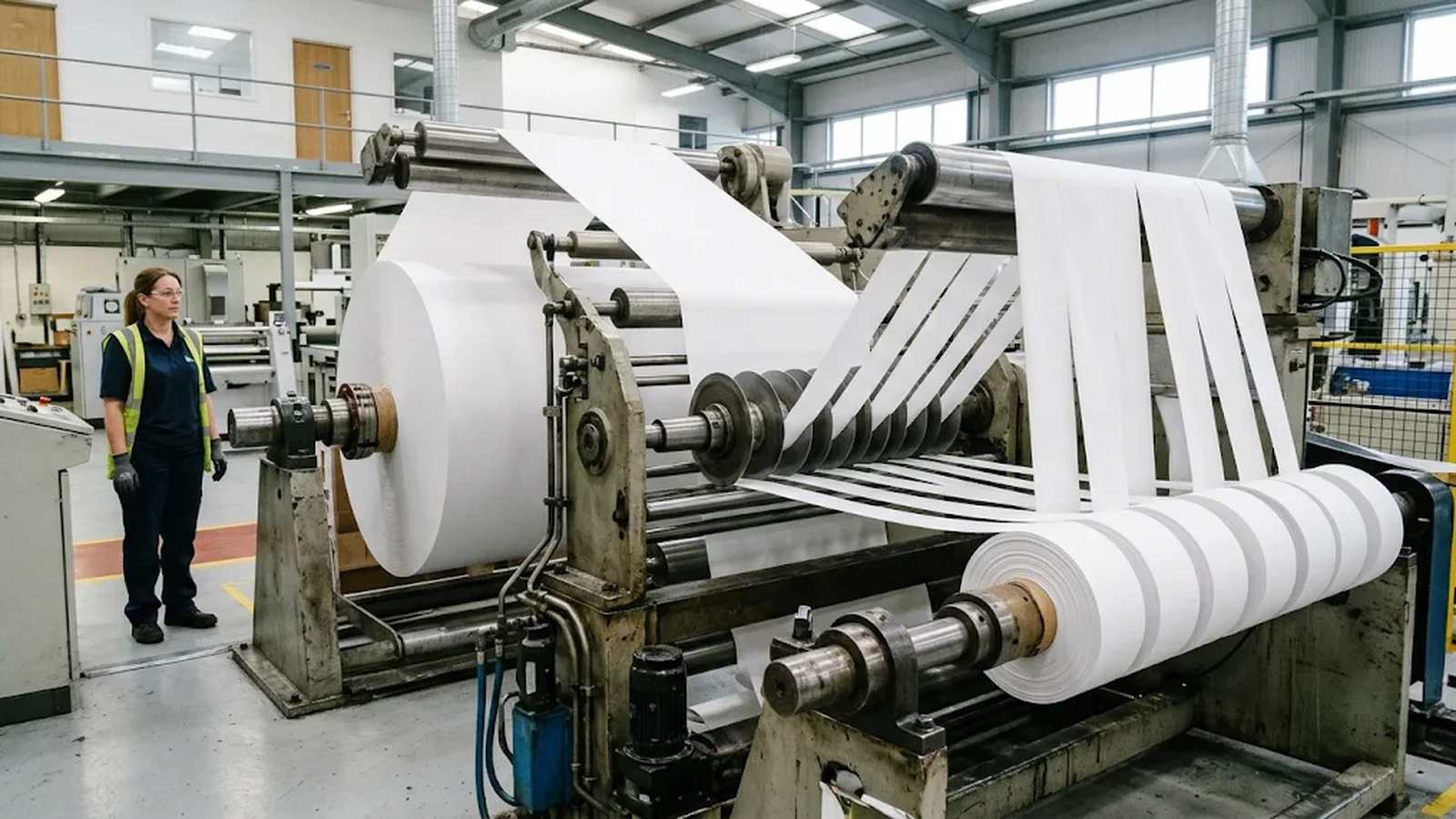
A thermal paper converter takes coated jumbo stock and turns it into sellable product — slitting to customer width, rewinding to specified core and diameter, cutting, wrapping and packing rolls to a written specification. The converter, not the coater, determines whether a programme's rolls feed consistently: width tolerance (±0.5 mm on receipt classes), winding hardness, edge quality, core precision and roll-to-roll diameter control are all set at the converting stage. Qualifying a converter therefore means auditing five things — the slitting and rewinding equipment, the in-process measurement discipline, the traceability from jumbo batch to finished carton, the specification ownership (who holds the drawing when a diameter or core changes), and the packing spec that protects the rolls through ocean freight. Manufacturers who convert their own coating outperform traders who buy and re-sell, because the tolerance chain never changes hands.
Every thermal roll in the market passes through two hands: the coater who applies the chemistry to base paper at jumbo width, and the converter who cuts that jumbo into the widths, diameters and formats buyers actually order. The distinction sounds like supply-chain trivia, but it decides product behaviour. Width tolerance, winding tension, core fit, edge quality and even the moisture protection inside a carton are all established at conversion — the partner you qualify as your thermal paper converter is, in practice, the manufacturer of your product.
The buying risk is that 'converter' is used loosely. Some companies coat and convert under one roof; some convert jumbo stock they buy from several mills; some own no machinery at all and trade between the two. All three can appear in a search for converting services with identical vocabulary, yet they differ fundamentally in what they can promise: only the first controls the tolerance chain end to end.
Buyers comparing these specifications can review our thermal paper jumbo rolls, where the parent-roll basis of every converting programme is documented per width and grade before an order is placed.
This guide covers what converting contributes to coated jumbo stock and why it governs roll behaviour, the process controls to audit when qualifying a converter, the documentation and OEM programme structure a serious partner provides, and the commercial terms — MOQ, lead time, mixed-width consolidation, packing — that determine whether the partnership scales beyond the first container.
- The converter owns the tolerance chain: width (±0.5 mm class), winding hardness, edge quality, core fit and roll diameter are all set after coating, at the slitting and rewinding stage.
- Qualify equipment and measurement, not vocabulary: ask which slitters run your widths, what in-line gauging exists, and how jumbo batch numbers trace into finished cartons.
- A manufacturer-converter that coats its own jumbo stock can sign one specification covering chemistry, geometry and packing; a trader structurally cannot, and its quotes will show it.
- OEM and private-label programmes live or die on specification ownership — one written spec sheet per SKU, revision-controlled, with the converter responsible for conformance on every repeat order.
- Commercial structure matters at scale: stated MOQs per format, realistic lead times against the coating schedule, mixed-width container consolidation and an export-grade packing spec are what turn a good converter into a supply partner.
What a converter actually adds to coated jumbo stock
Converting is where a coating becomes a product. The jumbo leaves the coater at widths of 400–800 mm and diameters beyond a metre — perfect for coating economics, useless for a receipt printer. Between the two sits the converting operation: slitting the web into customer widths, rewinding it onto the specified cores at controlled tension, cutting rolls to length or diameter, inspecting, wrapping and packing. Each step has a tolerance, and each tolerance survives into the buyer's device fleet.
The physics that matter most happen at the slitter. Width accuracy decides whether the roll feeds or jams — receipt classes run ±0.5 mm, and a roll two tenths over can bind a tight paper path. Blade condition and web tension decide edge quality: a burnt or burred edge sheds dust into the mechanism, and a crushed edge reads as a false end-of-life. Rewind tension decides roll hardness — a soft wind telescopes in transit and wobbles on the spindle, producing the 'random jam' complaints that no office test can reproduce.
Core and diameter complete the geometry. A core that is a half-millimetre oval misaligns the roll on fixed spindles; an outside diameter a few millimetres over spec binds in the cavity or defeats the lid sensor. None of this is visible on a datasheet — all of it is visible in a returns log. This is why converter selection is a manufacturing audit, not a price comparison: the same jumbo stock converts into dramatically different finished products depending on who runs the rewind.
Where a programme needs several formats from one supplier, our custom thermal paper programme covers width, core, roll diameter and developer class in a single specification sheet, so the tolerance chain is owned by one party end to end.
Qualifying a converter: five audits that matter
First, equipment fit. Ask which slitting and rewinding lines would run your programme, their width ranges, and their minimum and maximum roll diameters — then compare against your format list. A converter whose machinery was bought for one width class will improvise on yours, and improvisation shows up as tolerance drift across batches.
Second, measurement discipline. Serious operations measure, not assume: in-line width gauging or caliper verification per setup, basis-weight and coating checks against the jumbo certificate, image-density sampling per shift, and diameter verification at rewind. Ask to see a completed inspection record from a recent batch — the format of that record tells you more about the operation than the audit tour does.
Third, traceability. Every finished carton should trace back to a jumbo batch number, which traces back to a coating date, a base-paper lot and a developer system. When a field complaint arrives six months later, that chain is the difference between a targeted replacement and a blanket credit. Converters who cannot produce the chain on request are running on memory.
Fourth, specification ownership. One document per SKU — width and tolerance, core, OD, wind, gsm, coating class, developer system, packing — revision-controlled, with the converter contractually responsible for conformance on repeat orders.
Fifth, packing and export competence. Rolls are hygroscopic; a pallet that crosses an ocean in August without moisture-barrier wrapping and desiccant arrives as a different product. An export-grade converter quotes the packing spec — wrap, barrier, desiccant, carton, pallet, container plan — as part of the product, not as an afterthought.
Where container planning is the next step, our export shipping guide covers pallet standards, moisture-barrier packing and the document set for ocean freight.
| Audit point | Manufacturer that converts | Trader without converting assets |
|---|---|---|
| Tolerance chain | Coating to carton under one roof; one signatory | Splits at the jumbo purchase; disclaimed |
| Spec sheet scope | Chemistry + geometry + packing on one document | Geometry only; chemistry 'per mill certificate' |
| Traceability | Jumbo batch → coating date → finished carton | Depends on the mill's willingness to share |
| Repeat-order conformance | Same lines, same setup records | Re-quoted per order; source may change |
| Compliance paperwork | Issued by the producing plant | Forwarded, often untranslated |
OEM and private-label converting programmes
Most B2B volume in this industry runs as OEM or private-label work: the buyer owns the brand, the specification and the customer, and the converter manufactures to it. A competent converting partner brings structure to that arrangement — artwork handling for printed rolls and branded wrappers, die and core inventory management for repeat SKUs, packing design that survives the buyer's distribution chain, and a documented change-control process so a core or diameter change can never happen silently.
The specification sheet is the programme's constitution. It should carry the full geometry, the grade and developer system with test methods, the packing construction, and the revision history — and both parties should treat any deviation as a formal event. Converters who volunteer this discipline are telling you how they run their plant; converters who resist it are telling you something else.
Volume phases matter too. A realistic partner quotes pilot quantities for device validation, states the MOQ per format honestly, and schedules production against the coating calendar rather than promising dates the coating line cannot support. Buyers consolidating several widths from one converter should ask for mixed-width container consolidation — loading jumbo stock or finished formats of several SKUs into one ocean container — which cuts freight per roll materially at programme scale.
For production volumes, the same construction logic applies to our top-coated thermal label stock, quoted per jumbo roll, slit reel or finished format, so label and receipt programmes can run from one converting source with one tolerance discipline.
Commercial terms that decide whether the partnership scales
Price is the least diagnostic number on a converting quote. MOQ per format reveals whether the converter plans production or brokers it; lead time reveals the real distance between the converter and the coating line; payment terms and price validity reveal who carries risk between orders. A converter quoting a 12-month price validity on its own coating has a cost position to defend; a trader quoting the same has merely copied the format.
Mixed-format buyers should normalise quotes the way converting physics suggests: cost per usable square metre delivered to the warehouse, including freight, packing and the expected rejection rate. A converter whose width tolerance and winding discipline cut rejects from three percent to half a percent is cheaper at a nominally higher unit price — the arithmetic appears the first time a fleet jams its way through a support queue.
Finally, match the partner to the programme's ambition. A single-SKU receipt programme and a multi-format OEM range need different depth: the former rewards a converter with one perfectly-run width class, the latter demands the full audit — equipment, measurement, traceability, spec ownership, export packing. Qualify accordingly, and re-audit after the first year, because converting capability is built and lost one capital decision at a time.
Buyers standardising on one supplier can review our POS and receipt paper rolls alongside the comparisons in this guide, where finished-format specifications are documented against the same tolerance discipline the converting audit demands.
Qualification shorthand: 'One spec sheet per SKU (geometry + grade + developer + packing), jumbo-to-carton traceability, ±0.5 mm width class, per-batch inspection records, export-grade moisture-barrier packing, MOQ and lead time stated per format.'
Frequently asked questions
What does a thermal paper converter do?
A converter takes coated thermal jumbo rolls and produces sellable product: slitting to customer width, rewinding onto specified cores at controlled tension, cutting to diameter or length, inspecting, and packing to specification. Width tolerance, winding hardness, edge quality and core fit — the properties that decide whether rolls feed reliably — are all established at this stage.
Why choose a converter that also coats its own jumbo stock?
Because the tolerance chain never changes hands. A manufacturer-converter can sign one specification covering chemistry, geometry and packing, trace every carton back to a coating batch, and hold repeat orders on the same lines. A converter buying jumbo from third parties can convert well but cannot own the full chain, and the seams show in complaints.
What tolerances should a converting programme specify?
Width ±0.5 mm for receipt classes, outside diameter to the device fit chart, core diameter with ovality controlled, and consistent winding hardness. Add caliper and basis-weight tolerances from the grade certificate, and name the test method for each so incoming QC can verify against the same numbers.
How do I verify a converter's quality claims?
Ask for a completed inspection record from a recent batch, the traceability chain from a finished carton to its jumbo batch, and sample rolls for on-device trials. Then audit the five points: equipment fit, measurement discipline, traceability, specification ownership and export packing competence.
Can one converter supply multiple roll formats and grades?
Yes — that is the point of a converting partnership. A well-equipped converter produces receipt rolls, label stock and specialty formats from the same coating base under one tolerance discipline, and consolidates mixed widths into single containers. Confirm MOQ, lead time and packing per format, and hold one spec sheet per SKU.