
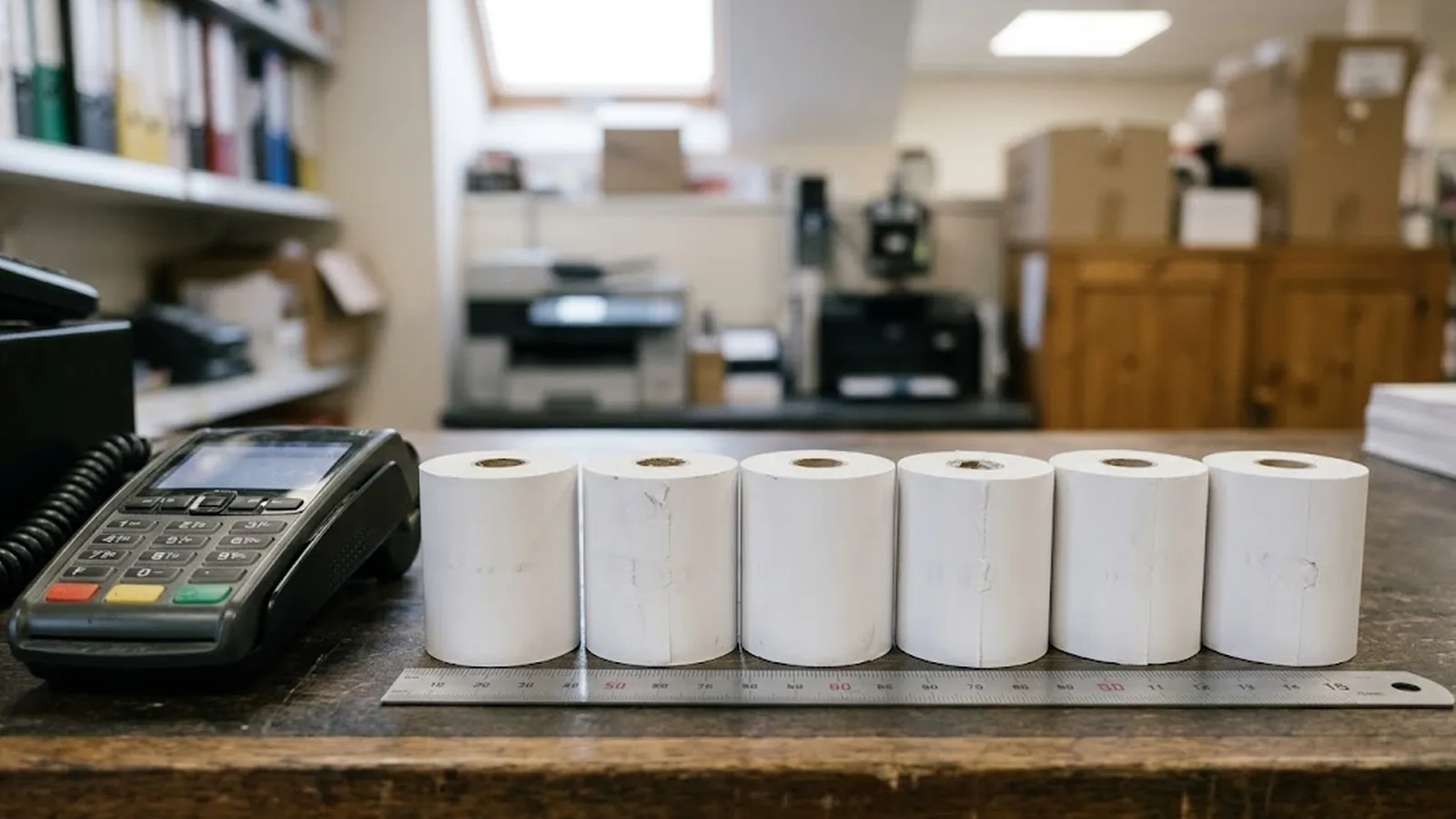
A 2 1/4 x 50 thermal paper roll is the standard North American handheld and card-terminal receipt roll: 2-1/4 inches (57.15 mm) wide, holding 50 feet (about 15.2 m) of paper. The label reads width by length in feet — so the roll's outer diameter is roughly 40 mm on a 12.7 mm core, which makes it the exact physical twin of the metric-coded 57 x 40 roll. One roll prints roughly 120–190 short receipts, the standard case is 100 individually sleeved rolls, and the buying checks that matter are three: verify length in metres, confirm core and winding direction, and get the developer system (BPA-free or phenol-free) in writing.
The smallest roll on the consumables shelf carries the biggest labelling confusion. In the United States and Canada, handheld card terminals and compact mobile receipt devices are stocked with rolls labelled 2 1/4 x 50 — a code that looks almost identical to the metric 57 x 50 printed on European and Asian cartons, while meaning something completely different. One is a length in feet; the other is an outer diameter in millimetres.
The two conventions describe overlapping but not identical products, and the mismatch generates a steady trickle of mis-orders: buyers who treat the numbers as equivalent receive rolls that are either half the expected length or too large for the compartment. The translation between them is a five-minute exercise once the notation is decoded — and it converts directly into per-receipt cost, case planning and freight maths.
This guide decodes the 2 1/4 x 50 label number by number, proves its equivalence to the metric 57 x 40 class, works through the yield and packing arithmetic, lists the device families that take it, and closes with the specification checklist used for export replenishment of the format.
Buyers standardising on one supplier can review our POS and receipt paper rolls alongside the comparisons in this guide, where basis weight, coating construction and packing are documented per grade before an order is placed.
- 2 1/4 x 50 reads width x length in feet: 57.15 mm wide, 50 ft (≈ 15.2 m) of paper per roll.
- At ≈ 40 mm outer diameter on a 12.7 mm core, it is the physical twin of the metric 57 x 40 roll.
- Do not confuse it with the metric-coded 57 x 50 (50 mm OD, ≈ 25 m) — that is closer to the US 2-1/4 x 85.
- Yield: roughly 120–190 short receipts per roll at typical 80–120 mm card and mobile receipt lengths.
- Standard packing is 100 individually sleeved rolls per carton on 12.7 mm cores, wound paper-out for North American terminals.
Reading the label: 2-1/4 inches wide, 50 feet long
The imperial receipt-roll convention writes width first and paper length second, with length in feet. So 2 1/4 x 50 means a roll 2.25 inches (57.15 mm) wide holding 50 feet (15.24 m) of paper. The width serves the 57 mm-class print mechanisms used across handheld card terminals and compact mobile devices; the tolerance runs +0/-0.5 mm, so 57.15 mm paper feeds identically in any 57 mm compartment.
The second number is the trap. Because paper length grows with the square of the diameter, 15.2 m of typical 55 gsm paper winds to an outer diameter of only about 40 mm on a 12.7 mm core. That is precisely the geometry sold in metric markets as 57 x 40 — same width, same core, same paper content. The imperial code describes length; the metric code describes diameter; the product is the same roll.
The near-miss is the metric 57 x 50. A 50 mm outer diameter holds roughly 25 m of paper — nearly two-thirds more than a 2 1/4 x 50 — and corresponds instead to the US 2-1/4 x 85 (85 ft ≈ 25.9 m). Treating '50' as the same number in both conventions over-orders by 65 percent or strands buyers with rolls that jam a 40 mm-compartment device. Converting every quotation to metres per roll removes the ambiguity at the source.
| Label | Notation | Width | Paper length | Equivalent OD | Relative yield |
|---|---|---|---|---|---|
| 2-1/4 x 50 | width x length (ft) | 57.15 mm | ≈ 15.2 m | ≈ 40 mm | 1.00 (baseline) |
| 57 x 40 | width x diameter | 57 mm | ≈ 15.1 m | 40 mm | ≈ 0.99 — the twin |
| 2-1/4 x 85 | width x length (ft) | 57.15 mm | ≈ 25.9 m | ≈ 50 mm | ≈ 1.70 |
| 57 x 50 | width x diameter | 57 mm | ≈ 24.5–25 m | 50 mm | ≈ 1.62–1.65 |
| 57 x 30 | width x diameter | 57 mm | ≈ 7.7 m | 30 mm | ≈ 0.51 |
Yields assume 0.075–0.078 mm caliper (55–58 gsm grade including coating); heavier grades shorten length at the same OD.
Yield per roll and the 100-roll case
Handheld and card-terminal receipts are short: a typical card payment slip prints 80–120 mm including merchant block, amount, tip line and footer, while mobile delivery and field-service receipts cluster slightly longer. At 15.2 m per roll that is roughly 120–190 receipts — call it 150 for planning. A café terminal taking 80 payments a day consumes a roll about every second day; a courier handheld scanning 40 drop receipts stretches the same roll across a working week.
Case packing reflects the roll's small size. The standard export case is 100 rolls arranged 10 x 10, each roll individually sleeved in moisture-barrier film, because thermal coating absorbs moisture and image density degrades when small rolls ship loose. A 100-roll carton of 2 1/4 x 50 measures roughly 440 x 240 x 220 mm and weighs about 7–8 kg gross, so a standard export pallet carries 100–150 cartons.
For procurement maths, the same three numbers make any quotation comparable as on every other format: metres per roll (15.2 for this format), rolls per carton (100 standard), and price per metre (price per roll divided by 15.2). Anything quoted without a verifiable length — or with the diameter-coded and length-coded conventions blended — should be re-quoted against them.
Requests that combine several formats can be quoted together; see our custom thermal paper programme for the construction options behind each one, then align core, winding and sleeve packing across the whole terminal fleet in a single purchase order.
- Yield: ≈ 120–190 receipts per roll (80–120 mm receipt length).
- Planning figure: ≈ 150 receipts per roll for mixed card and mobile use.
- Case: 100 rolls (10 x 10), each sleeved; ≈ 440 x 240 x 220 mm, 7–8 kg gross.
- Pallet: 100–150 cartons depending on stack height and pattern.

Which devices take 2 1/4 x 50
The format serves the 57 mm class: countertop and handheld card terminals, compact mobile receipt devices used by couriers and field-service teams, and the pocket-sized mechanisms common in parking, transit and queue-adjacent retail. Compartment clearance is generous — the 40 mm outer diameter fits even the smallest 57 mm bays — so the two checks that actually prevent returns are winding direction and paper grade. North American market stock is overwhelmingly wound paper-out; a minority of compact mechanisms thread from inside and need paper-in slitting, so ordering against the device list is the reliable habit.
Fleet mixing is where buyers save real money. Card terminals and 80 mm counter devices cannot share a width, but both draw on the same parent stock at the mill: a single 55 or 58 gsm grade slit to 57 mm and 80 mm webs keeps image density, edge quality and developer class identical across the fleet. Consolidating on one grade typically outperforms sourcing the small rolls as an afterthought from a retail channel.
One adjacent format causes recurring mis-orders beside the 57 x 50 trap already covered: the 2-1/4 x 16 and x 30 mini-rolls used in some pocket pagers and meter devices. They share the width but carry a quarter to half the paper; treat every length variant as its own SKU and keep the length figure on the purchase order line, not just the width.
- Fits all standard 57 mm-class card and mobile compartments at ≈ 40 mm OD.
- Verify winding direction (paper-out standard for North America) against the device list.
- Consolidate grade with the 80 mm counter fleet for identical image quality.
- Keep 2-1/4 length variants (x 16 / x 30 / x 50 / x 85) as separate SKUs.
Winding direction is the specification line most often missed on small-roll POs — state it once per device list and keep it on file.
Buying checks: what to confirm before the PO
First, grade. Card and mobile receipts are handled briefly, but image life still matters for chargeback evidence and warranty slips, and regulators in several destination markets restrict phenols in customer-handled paper. Ask for the developer system in writing — BPA-free as the baseline, phenol-free where retailer policy or destination-market rules require it — and request the compliance documentation with the shipment as standard export practice.
Second, the physical specification. Confirm width 57.0–57.15 mm, length 50 ft (15.2 m) actual — not 'approximate' — core 12.7 mm, winding direction, and sleeve-wrapped packing. Reputable converters measure length at slitting and print it on the carton; a sample roll can be verified in minutes with a length counter or by weighing against a known-good roll.
Third, the commercial frame. Compare offers per metre (price per roll ÷ 15.2 m), agree the 100-roll case configuration, and align carton marking with your barcode and labelling requirements before production. Freight and packing efficiency dominate landed cost on high-turnover small rolls — buyers who anchor on the three-number frame typically find that factory-direct 2 1/4 x 50 stock undercuts retail-channel pricing by a wide margin at identical specification.
Where image life is the deciding factor, our top-coated vs non top-coated guide compares the two constructions on retention, cost and machine behaviour.
- Grade: BPA-free baseline; phenol-free where policy requires; compliance docs with shipment.
- Spec lines: width, actual length, core, winding, sleeve packing — all on the PO.
- Verification: length counter or weigh-back against a known roll.
- Commercial: price per metre, 100-roll case, carton marking agreed pre-production.
A five-line specification (width, length, core, winding, grade) turns small-roll replenishment into a first-pass quotation instead of a sampling round.
Frequently asked questions
What does 2 1/4 x 50 mean on a receipt roll?
Width by length in feet: the roll is 2-1/4 inches (57.15 mm) wide and holds 50 feet (about 15.2 m) of paper. The outer diameter is roughly 40 mm on a 12.7 mm core with typical 55 gsm paper.
Is 2 1/4 x 50 the same as 57 x 40?
Physically yes. The imperial code states paper length (50 ft ≈ 15.2 m); the metric code states outer diameter (40 mm). Wound on the same 12.7 mm core at the same caliper, both hold about 15.2 m of 57 mm-wide paper. The different animal is the metric 57 x 50 — a 50 mm diameter holding about 25 m.
How many receipts does a 2 1/4 x 50 roll print?
Roughly 120–190 receipts, depending on receipt length. Card payment slips of 80–120 mm give about 150 receipts per roll as a planning figure; courier and field-service receipts run slightly shorter per print and slightly higher per roll.
How many rolls come in a case of 2 1/4 x 50?
The standard export case is 100 rolls arranged 10 x 10, each individually sleeved in moisture-barrier film. A carton measures roughly 440 x 240 x 220 mm, weighs 7–8 kg gross, and a standard pallet carries 100–150 cartons.
Will 2 1/4 x 50 fit my card terminal?
If the terminal takes 57 mm-class rolls — which covers the vast majority of handheld and countertop card terminals and compact mobile devices — yes, the 40 mm outer diameter clears standard compartments. Confirm winding direction (paper-out is the North American standard) and avoid substituting metric 57 x 50 stock unless the compartment accepts a 50 mm roll.