
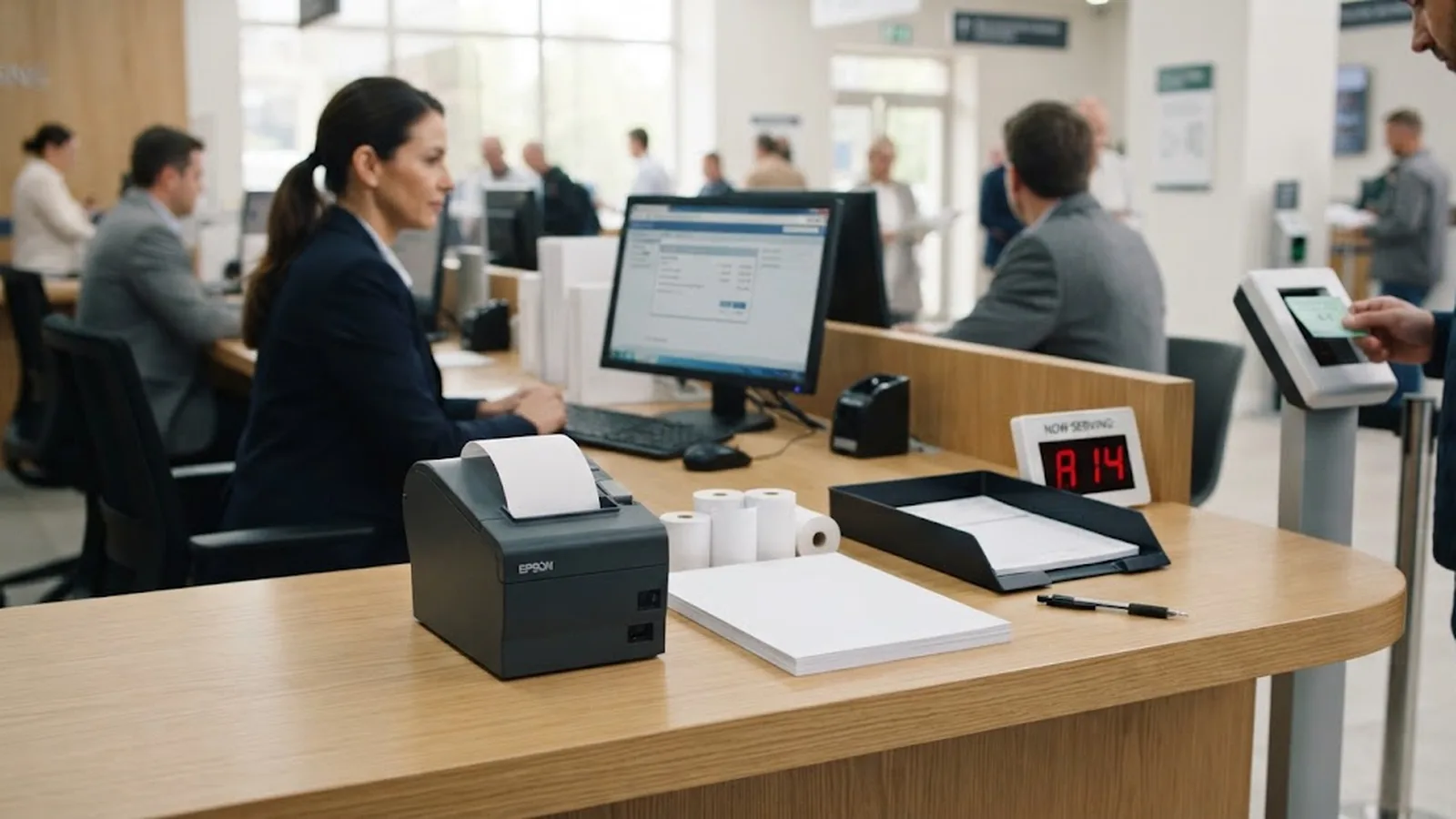
Banking thermal paper is direct thermal media specified for one requirement most retail buyers never face: the printed record must stay legible for years, because counterfoil vouchers and customer receipts function as evidence for disputes, audits and regulatory retention schedules. The practical specification combines a heavier construction — typically 55 to 75 gsm with image-life data behind it — a declared developer system (BPA-free or phenol-free) for guest-handled slips, correct widths and black-mark variants for the ATM and queue-ticket fleet, and batch COAs that tie every shipment to the documented grade. Banks that buy on price alone usually discover the gap when a stored voucher fades before the retention period ends.
A bank branch looks paperless from the app, but inside the counter it still consumes thermal paper every operating hour: teller receipts handed to customers, counterfoil vouchers retained for the bank's own records, queue tickets at the door, and ATM rolls that keep the self-service lobby running. The volumes are smaller than a supermarket's, but the stakes attached to each slip are higher — a bank receipt is not just a courtesy copy, it is often the physical trace of a transaction someone later disputes.
That changes the buying logic. Retail paper is specified for cost per receipt and machine fit; banking thermal paper is specified for survival. Retention schedules that run five, seven or ten years, storage in branch archives with imperfect climate control, and the legal weight the document may have to carry all push the specification toward heavier grades, documented image life and disciplined chemistry declarations.
Buyers comparing these specifications can review our thermal paper jumbo rolls, where basis weight, coating construction and packing are documented per grade before an order is placed.
This guide maps the paper streams across a branch network, explains what record retention demands from the coating, sets out a station-by-station specification matrix, and describes how network-wide procurement should structure tenders, converter supply and per-batch documentation.
- Bank paper streams differ in stakes: customer receipts, retained counterfoils, queue tickets and ATM rolls each need their own width and grade line, not one SKU for the branch.
- Record retention is the deciding specification — image-life data (temperature, humidity, storage condition) belongs in the tender, not in a marketing sentence.
- Heavier constructions from 55 up to 75 gsm buy stiffness, archive tolerance and print permanence; the increment is small against the value of the record.
- Guest-handled slips carry the bisphenol conversation: BPA-free or phenol-free developer systems declared on datasheet and COA, uniform across the network.
- Network programmes succeed on documents: batch COAs, a one-page QC standard, and converter-level supply behind the branch-facing grades.
The paper streams across a branch network
Teller receipts and transaction vouchers are the core stream. The customer copy leaves the counter in the customer's hand; the bank's counterfoil is filed or scanned and then archived. Both print on the same units in the 76-80 mm width family, but the retention requirement attaches mainly to the counterfoil — the copy the bank may need to produce years later. Specifying the two copies as one grade is common and defensible, provided the grade itself carries documented image life.
Queue and token tickets at the branch entrance are a low-volume but visible stream; they print in narrow formats, turn over constantly, and carry no retention burden, so they are the natural place to run a lighter grade. The ATM stream behaves differently again: wider rolls, longer metres, a black-mark or sense-mark variant to keep the hardware's paper-end detection working, and — because replenishment happens on a service route — packaging that suits cash-in-transit handling. This guide stays at the programme level; the ATM-specific media questions are covered on the dedicated ATM application page.
Back-office and vault printing adds a trickle of internal slips — cash-transfer documents, bag tags and audit trail copies — that inherit the same retention logic as counterfoils even though volumes are small. Treated as its own line from the start, it avoids the retrofit conversation when a records audit asks which grade produced a five-year-old voucher. The planning exercise is the same as in any multi-site network: consumption per branch per week by stream, converted into case configurations and replenishment rhythm.
Record retention: what archive life demands from the coating
Direct thermal images are organic chemistry, not ink, and their enemy is slow environmental attack: ambient heat, humidity, light and contact with plastics or adhesives all degrade the developed dye over months and years. A retail receipt that fades after a season is an inconvenience; a bank counterfoil that fades inside a seven-year retention schedule is a records problem with audit consequences. This is why banking tenders ask for image-life evidence rather than assurances — accelerated ageing data at defined temperature and humidity, and a stated storage condition under which the quoted years hold.
Construction choices drive the outcome. Heavier base stock — 55 to 65 gsm for counter work, and up to 75 gsm where a voucher must stay flat and legible in long-term file storage — gives the record physical stability against curl and handling. Coating quality decides the chemistry: well-formulated thermal layers with protective overcoats retain density dramatically longer than commodity stock, and the difference shows up precisely in the accelerated-ageing tests a bank can request. Pre-testing is straightforward: file identically printed samples in a branch-archive drawer for six months alongside a control, and measure density loss.
Our 75 gsm heavyweight thermal paper programme publishes the test data behind each grade, so specifications can be verified against the mill's own measurements rather than a catalogue claim — the same evidence discipline a tender committee should demand from any bidder.
A station-by-station specification matrix
The tender conversation gets simpler once the streams are priced and specified separately. The matrix below is a workable starting point for a retail branch network; vault and back-office media inherit the counterfoil line, and the ATM line is ordered against the installed fleet rather than a generic catalogue width:
| Application | Typical width | GSM range | Construction | Key requirement |
|---|---|---|---|---|
| Teller receipts / counterfoils | 76-80 mm | 55-65 gsm | Documented image life, BPA-free | Retention-grade permanence |
| Long-retention vouchers | 76-80 mm | 65-75 gsm | Overcoated, archival data | Stiffness and archive tolerance |
| Queue / token tickets | Narrow formats | 48-55 gsm | Standard non-top-coated | Cost per ticket |
| ATM rolls | Per hardware fleet | 55-65 gsm | Black-mark variant | Sense-mark position, CIT-friendly packing |
Chemistry declarations for guest-handled slips
Every slip a bank hands to a customer sits inside the bisphenol regulatory conversation. The EU restricts BPA in thermal paper, several US states have enacted their own rules, and institutional customers increasingly treat a declared phenol-free developer system as the default expectation for any document the public touches. For a branch network the requirement is uniformity — one declared chemistry across every branch and every stream, so the compliance answer never depends on which counter printed the slip.
The documentation carries the claim. The datasheet names the developer system; the batch COA repeats it; and the tender file keeps both against the certificate of the mill that produced the coating. Where developer compliance is part of the specification, our BPA-free vs phenol-free guide documents the chemistry, the regulations and the paperwork behind each class — the reference most procurement teams hand to their compliance reviewers.
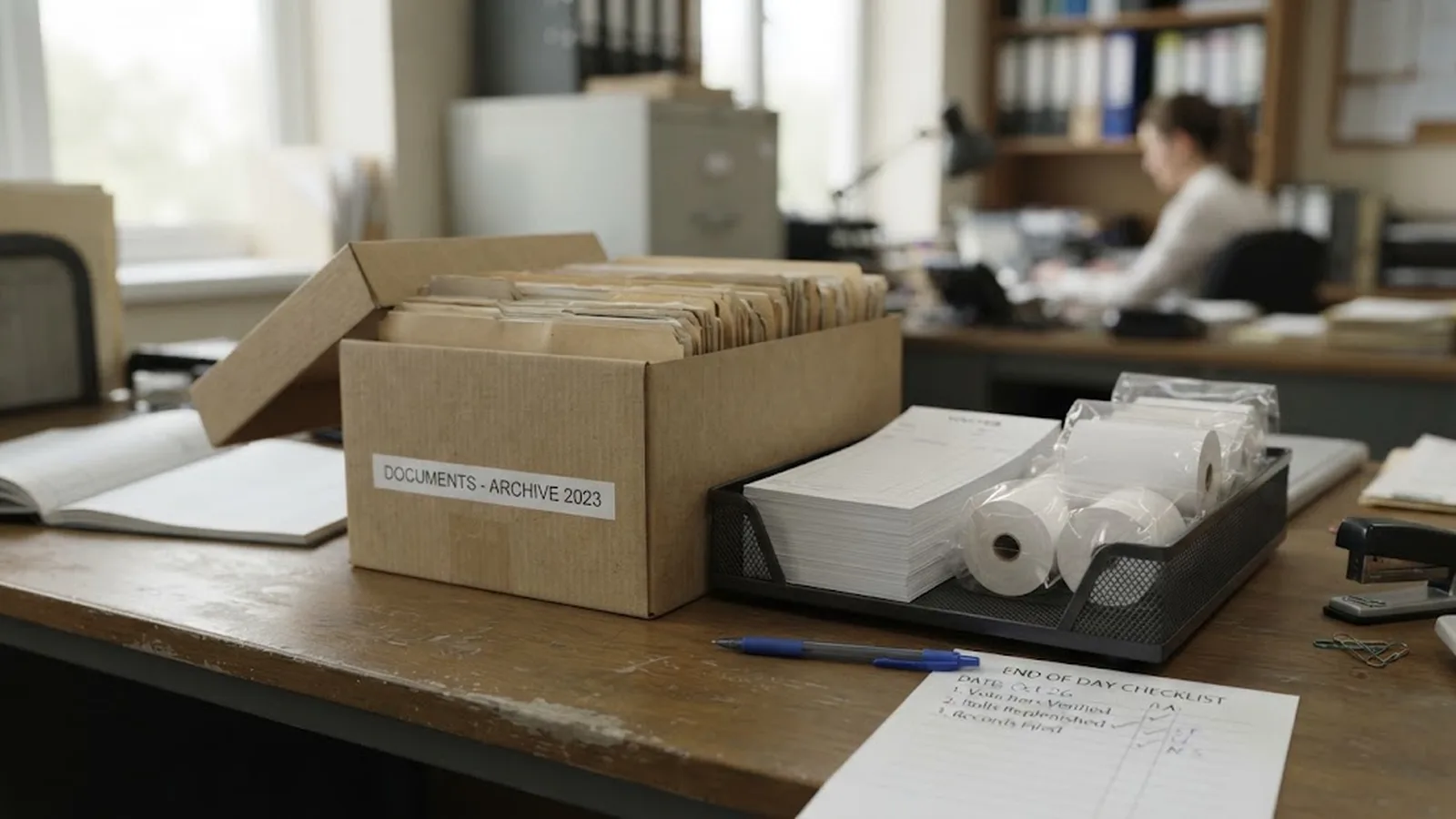
Structuring a network-wide programme
Bank procurement runs on tenders, and thermal paper earns better outcomes when the tender separates the streams. Pricing a bundle of 'branch paper' invites one compromise grade; pricing teller media, retention-grade vouchers, queue tickets and ATM rolls as distinct lines lets each carry the construction it actually needs, and makes bidder comparisons meaningful on the line that matters — image life for the archived record.
Supply structure follows the same logic. Branch-facing rolls are a converting product: widths, cores, diameters and black-mark positions are cut from jumbo stock, and the converter's slitting tolerance, roll roundness and carton discipline show up on site as either smooth replenishment or mid-service jams. Banks with regional service partners should qualify the converter as carefully as the mill — a site visit or a documented audit of the slitting operation is a reasonable tender requirement, and converters supplying the trade quote construction options, cores and packing per grade through our custom thermal paper programme.
The closing documents are familiar: a one-page QC standard (width and core tolerance, roundness, print density against a reference, curl, declared developer chemistry), batch COAs per shipment, and image-life evidence filed against the awarded grade. Where container planning is part of an imported supply route, our export shipping guide covers pallet standards, moisture-barrier packing and the document set for ocean freight.
Tender shorthand: 'Teller and counterfoil media 65 gsm BPA-free with accelerated-ageing data; vouchers 75 gsm overcoated for archive; queue tickets 55 gsm; ATM rolls black-mark per fleet list; batch COA with declared developer system per shipment.'
Frequently asked questions
How long must bank receipts stay legible?
It depends on the jurisdiction and the record class, but retention schedules of five to ten years are common for transaction vouchers. The practical answer for procurement is to specify a grade with documented image life under defined storage conditions, and to keep the accelerated-ageing evidence in the tender file rather than relying on a marketing sentence.
What GSM is used for teller receipts and vouchers?
Counter receipts typically run 55-65 gsm — enough substance for a crisp, stable record without inflating cost. Vouchers destined for long-term file storage justify 65-75 gsm, where the heavier base adds stiffness and archive tolerance. Queue and token tickets can run a lighter 48-55 gsm grade because they carry no retention burden.
Do bank receipts need to be BPA-free?
Customer-handled slips sit squarely inside the bisphenol rules: the EU restricts BPA in thermal paper and several US states have their own requirements. Most networks now standardise on BPA-free or phenol-free developer systems across every branch, with the declaration stated on the datasheet and repeated on the batch COA.
Why do ATM rolls need a black mark?
Many ATM and self-service units detect the end of the roll with an optical sensor that reads a pre-printed black mark on the paper's reverse. The mark's position and size follow the hardware fleet's specification, so rolls for the ATM channel are ordered as a black-mark variant rather than standard stock.
Can branch paper be supplied pre-printed with the bank's logo?
Yes. Logo printing, faint security artwork and branch-code legends are standard converting services, quoted per design with the artwork held under the bank's control. Pre-printing turns the receipt into a brand-consistent document and can carry simple anti-copy features without changing the thermal construction.