
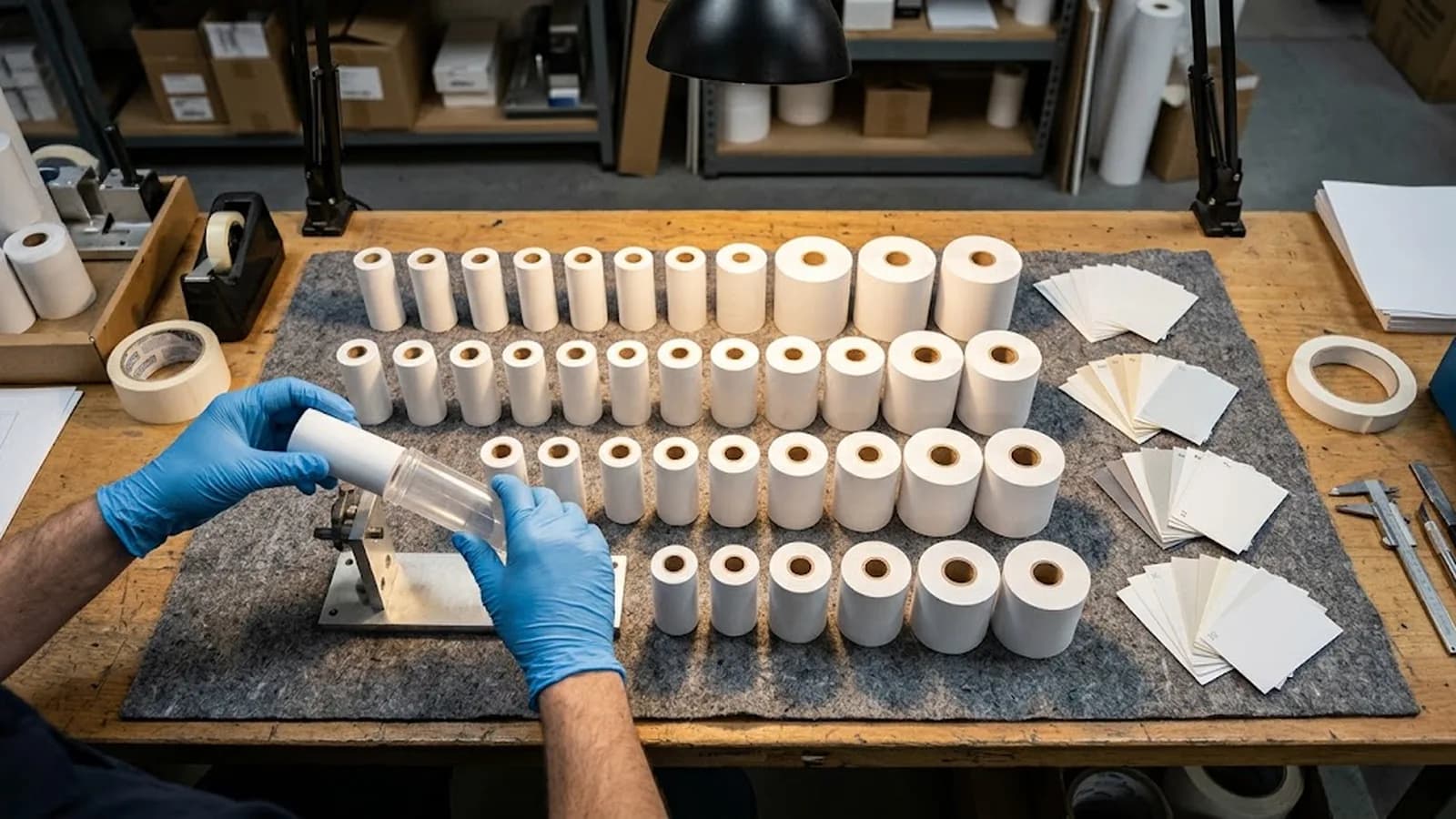
A thermal paper sample manufacturer is a mill that supplies grade samples for qualification before production orders. The process works when the buyer sends the full specification context — printer or device model, roll dimensions, current sample, gsm and chemistry class — and the mill returns a sample pack with per-grade spec sheets, COA and SDS. Samples are then qualified in three stages: bench tests (density, sensitivity, retention), a machine trial on the actual printer or converting line, and a commercial conversion into a first order with retained samples and a batch protocol agreed in writing.
Sampling is the cheapest mistake insurance in thermal paper procurement: a week of qualification prevents a container of the wrong grade. Yet most failed trials trace back to how the sample was requested — a width and a quantity, with no printer model, no current reference sample and no statement of the chemistry class required. The mill then guesses, the sample prints differently from expectations, and both sides conclude the grade was wrong when the enquiry was incomplete.
This guide covers the sourcing side of thermal paper from a manufacturer's bench: what to include in a sample enquiry so the first sample is the right sample, what a properly built sample pack contains, how to run a three-stage qualification that predicts production behaviour, what sampling costs and how it ships across borders, and how to convert a passed sample into an order with the batch discipline that keeps later production identical to what you tested.
Requests that combine several formats can be quoted together; see custom thermal paper programme for the construction options behind each one — sampling, spec sheet and production quote run on the same grade data.
The sections follow the process chronologically: the enquiry, the sample pack, the qualification, the logistics, and the conversion into a programme.
- A sample enquiry without a printer model, a reference sample and a chemistry class forces the mill to guess — incomplete enquiries are the leading cause of failed trials.
- A proper sample pack is documented: per-grade spec sheets, COA and SDS travel with the paper, or the sample tests nothing but itself.
- Qualify in three stages — bench tests, a machine trial on the real device or line, then a small commercial trial — before committing container volume.
- Samples ship by courier against a pro-forma invoice with honest declared value; sampling cost is a negotiation point, not a hidden fee.
- Convert a passed sample into an order by fixing retained samples per batch and a batch protocol in the sheet — otherwise production can drift from what you qualified.
The enquiry: what to send so the first sample is the right one
A complete sample enquiry reads like a specification, not a shopping list. The essentials: the printer, terminal or converting equipment the paper must work in (model names, or at minimum printhead type and energy class); the roll or sheet dimensions — width, core, outer diameter or sheet size; the current paper in use, ideally with a physical reference sample sent alongside; the gsm class and budget band; and the chemistry requirement — BPA-free or phenol-free — with the market the goods will be sold into. One paragraph of context about the application (receipts, labels, tickets, medical printouts) lets the mill's technical staff flag mismatches the buyer has not thought of.
The reference sample is the single most valuable item in the envelope. With it, the mill can benchmark coating weight, sensitivity and caliper against what the buyer already accepts, and return a sample that is a comparison rather than a guess. Without it, 'similar to what we use now' is a specification the mill has to imagine.
Buyers comparing these specifications can review our top-coated thermal label stock, where basis weight, coating construction and packing are documented per grade before an order is placed — the same documentation standard applies to every sample that leaves the bench.
What a mill sample pack should contain
A sample pack is a qualification kit, and the paper is only half of it. The paper half: slit roll samples in the exact width and core requested, or sheet samples cut from the parent stock; a jumbo swatch for converters who will slit their own; and, where relevant, samples of the adjacent grade above and below the target so the buyer can see the sensitivity and cost trade-off rather than test in a vacuum.
The documentation half is what separates a manufacturer from a reseller: a specification sheet per grade (gsm with tolerance, caliper, sensitivity class, image-life data at stated conditions), a COA for the batch the sample came from, an SDS naming the developer chemistry, and compliance declarations where the destination market requires them. A sample without documents can be printed on; it cannot be qualified against a tender or a customer audit.
Mid-article checklist — what arrives in a properly built sample pack:
- Slit roll samples at the requested width, core and outer diameter; sheet samples where the enquiry is sheet format.
- Neighbouring-grade samples (one above, one below) so sensitivity and cost trade-offs are testable.
- Jumbo swatch for converter enquiries, cut from the parent roll class quoted.
- Per-grade spec sheet: gsm tolerance, caliper, sensitivity class, retention data at stated conditions.
- COA for the sample batch and SDS naming the developer chemistry (BPA-free / phenol-free).
- Indicative production pricing per volume band and packing description — so the sample decision can be a commercial one, not just a technical one.
Qualification: bench tests, machine trial, commercial trial
Stage one is the bench: print density and blackness at the target device's energy, sensitivity curve if the buyer has means to measure it, static and dynamic friction for label stock, and an accelerated-aging check for retention against the spec sheet's claim. This stage kills obvious mismatches cheaply, and it is where the documented sample pack pays off — every result compares against a stated figure rather than an impression.
Stage two is the machine trial: run the sample on the actual printer, terminal or converting line at production settings. This is where the surprises live — feed friction in a specific roll channel, dust on a high-speed slitter, curl behaviour as a roll empties, scan-rate performance on barcode label stock. A machine trial should use at least one full roll and ideally a shift's worth of running, because single-sheet behaviour flatters every grade.
Stage three is the commercial trial: a small production order — a pallet, or a few cases per format — produced on the coating line that will run the programme, not on sample stock. It validates the mill's consistency, the packing and the document set end to end, and it becomes the benchmark batch that later production is compared against.
Where image life is the deciding factor, our top-coated vs non top-coated guide compares the two constructions on retention, cost and machine behaviour — the trade-off most trial results resolve.
| Stage | What runs | What it proves |
|---|---|---|
| Bench tests | Density, sensitivity, friction, aging vs spec sheet | The grade matches the documented claims |
| Machine trial | Full roll on the real device or line, production settings | Feed, dust, curl and scan behaviour in service |
| Commercial trial | Pallet-scale order from the production line | Mill consistency, packing and documents end to end |
Sample logistics: cost, courier and customs
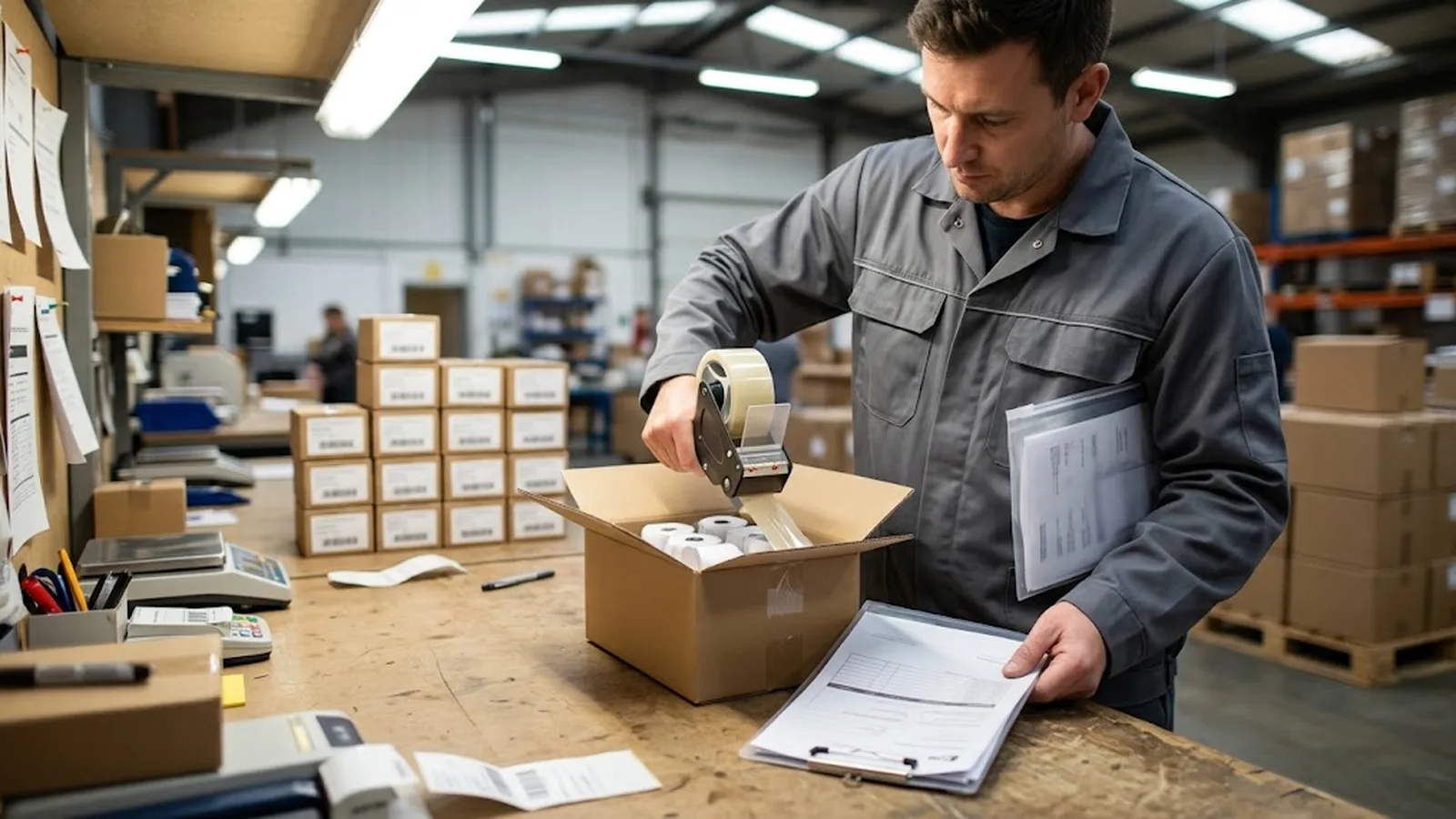
Sampling logistics are small-freight discipline. Samples ship by international courier against a pro-forma invoice with an honest declared value and a clear description — thermal paper samples, no commercial value misdeclared — because customs holds are the usual reason a trial schedule slips. A mill that ships samples weekly will have the paperwork templated; a first-time exporter of a two-kilogram parcel will not, and that difference is worth noticing during supplier evaluation.
Cost practice varies and should be stated openly by both sides: many mills supply sample paper free and charge only the courier, others charge a pack fee credited against the first order. What should never vary is the timeline — dispatch within days of a complete enquiry, tracking shared, and a stated readiness to discuss results. Slow, opaque sampling predicts slow, opaque production communication; the sample process is the audition for the programme relationship.
Where container planning is the next step, our export shipping guide covers pallet standards, moisture-barrier packing and the document set for ocean freight — the grown-up version of the same paperwork the sample parcel rehearsed.
Converting a passed sample into a programme
The trial ends, the results are good, and the risk is now drift: production six months later differs from the sample that passed. The conversion into a programme prevents it. Fix the specification sheet to the qualified construction — gsm with tolerance, sensitivity class, chemistry with SDS, dimensions — and write a batch protocol into the order terms: retained samples per batch, goods-in checks against the sheet, and an agreed remedy if a batch lands outside it. The retained sample from the qualifying batch becomes the physical reference both sides judge drift against.
From there the sampling relationship changes scale but not structure. New formats are sampled before they join the programme; any construction change — gsm, chemistry, core — requalifies through the same three stages in compressed form; and the annual review walks the retained-sample archive against complaint data. Mills keep the discipline that buyers measure, and a buyer who qualified properly once holds the best leverage in thermal paper: a documented baseline.
Frequently asked questions
Do thermal paper manufacturers charge for samples?
Practice varies: many mills supply sample paper free and charge only the courier, others apply a pack fee credited against the first order. Either way the practice should be stated upfront along with dispatch time — and the sample pack should carry full documentation (spec sheets, COA, SDS), because paper without documents cannot be formally qualified.
What should I include in a sample request?
The printer or device model, exact roll or sheet dimensions with core size, a physical reference sample of your current paper if possible, the gsm class and budget band, the required chemistry class (BPA-free or phenol-free) and the destination market, plus a line about the application. Complete enquiries get accurate first samples; incomplete ones get guesses.
How long does sample qualification take?
Courier transit is days; the qualification is what takes time — bench tests a few days, a machine trial running a full roll through production equipment days to a week, and a pallet-scale commercial trial two to three weeks including production scheduling. Compressed, a disciplined buyer can move from complete enquiry to qualified programme in under a month.
Can samples be produced from the same line as the eventual order?
The final qualification stage should be: sample-grade material cut from parent stock is useful for bench work, but the pallet-scale commercial trial must come from the coating line that will run the programme, so mill consistency, packing and documents are validated on the same configuration as the production order.