

Buying thermal paper jumbo rolls wholesale means purchasing parent-roll supply by the tonne — full pallet positions, mixed-width containers and per-tonne pricing — rather than finished rolls by the carton. The wholesale arithmetic rewards buyers who specify like converters: every tonne of 48 gsm stock carries roughly twice the metres of 75 gsm stock, so quote comparison must normalise for grammage, width, core and outside diameter before any per-tonne price means anything. A disciplined wholesale programme sets a written specification per width (gsm class, core, OD, winding, moisture-barrier packing), compares quotes on metres per tonne and landed cost, secures MOQ and price validity in writing, verifies pallet patterns and container fill against freight maths, and runs incoming QC on each lot — because at jumbo scale, one mis-specified container is not an inconvenience but a quarter of supply.
Wholesale in finished receipt rolls means cartons and mixed pallets. Wholesale in jumbo rolls means something different: tonnes. Converters, distributors and importers who buy at parent-roll scale are purchasing the mill's output by weight, and the entire buying discipline — specification, quotation, logistics, inspection — changes accordingly. A buyer who treats a jumbo container like an oversized carton order will overpay, mis-plan freight and discover specification problems after the paper is already in the warehouse.
The upside of buying wholesale at this scale is equally real: the lowest landed cost per metre of thermal stock available anywhere in the chain, supply secured for a quarter or more, and the freedom to slit to whatever finished widths the market demands. Getting that upside requires buying like a converter, and the discipline is teachable.
For production volumes, the same construction logic applies to our thermal paper jumbo rolls, quoted per jumbo roll, slit reel or finished format.
This guide covers what wholesale means at parent-roll scale, how to compare quotes on a normalised basis, and how palletisation, container fill and incoming QC protect the tonnes you buy.
- Jumbo wholesale is weight-based procurement: prices are per tonne, so quotes must be normalised to metres per tonne at a stated gsm, width, core and OD before they are comparable.
- Grammage drives the maths — 48 gsm stock yields roughly 20,800 m² per tonne against roughly 13,300 m² for 75 gsm, so the same tonne buys very different metreage.
- Set the specification per width in writing — gsm class, core, OD, winding, sensitivity class, moisture-barrier packing — and hold MOQ and price validity to fixed terms.
- Freight is part of the price: pallet patterns, container fill weight and moisture-barrier packing decide whether the landed cost per metre matches the invoice cost.
- Run incoming QC per lot — grammage, width, OD, density, curl — so specification drift is caught at the dock, not on the slitter.
What wholesale means at jumbo scale
A parent roll is the mill's output before conversion: a single wide web, typically hundreds of millimetres across and thousands of metres long, wound on a 76.2mm (3-inch) core and wrapped for protection rather than presentation. Wholesale buyers purchase these parents by the tonne because weight is how paper mills measure, price and schedule production. One tonne of 48 gsm stock is roughly 20,800 square metres of paper; the same tonne at 75 gsm is roughly 13,300 square metres. Grammage therefore converts directly into metreage per tonne, and it is the first number to fix in any wholesale conversation.
The wholesale tier exists because it removes cost at every stage downstream of the parent: no slitting labour per finished roll, no cartons and color boxes, no per-SKU packing, and freight concentrated into dense full-container loads. Buyers who slit in-house or contract converting locally capture that margin themselves; distributors who resell parents to converters price against the same arithmetic. The trade-off is responsibility — the wholesale buyer owns the specification, the logistics and the incoming quality of every tonne.
The specification sheet is where that ownership lives. Per width, it should state the gsm class with tolerance, core size, maximum outside diameter, winding direction, sensitivity class matched to the end print hardware, developer class (BPA-free or phenol-free as the market requires), and moisture-barrier packing. A written sheet converts 'wholesale thermal paper' from a wish into an enforceable contract, and it is the document against which every incoming lot is later checked.
Comparing quotes on a normalised basis
Per-tonne prices are only comparable once they are converted to a common denominator, and the honest one is landed metres per tonne at the buyer's specification. Take each quote's price per tonne, divide by the gsm to get square metres per tonne, apply the width to get linear metres, and then add freight, duties and port charges to reach a landed cost per metre. Two quotes that differ by four percent on the invoice can differ by twelve percent landed once grammage tolerance, roll OD (which decides how many rolls fit a pallet) and freight terms are taken into account.
MOQ and price validity then shape the deal around the number. Mills set wholesale MOQs in tonnes or in pallet positions, and the efficient buyer plans requirements so that a full mixed-width container lands exactly on the MOQ rather than padding it. Price validity matters because pulp and energy inputs move: a thirty-day validity is normal, and a programme that rebalances volumes between valid quotations — rather than re-quoting every month — captures the stability that wholesale buying is supposed to provide.
Requests that combine parent supply with finished formats can be quoted together; see our POS and receipt paper rolls for the finished-format constructions behind each programme.
| Grade | Grammage | m² per tonne | Linear metres per tonne at 565mm width | Relative yield |
|---|---|---|---|---|
| Lightweight | 48 gsm | ≈ 20,800 m² | ≈ 36,800 m | Baseline (highest) |
| Standard | 60 gsm | ≈ 16,700 m² | ≈ 29,500 m | ≈ 80% of lightweight |
| Heavyweight | 75 gsm | ≈ 13,300 m² | ≈ 23,500 m | ≈ 64% of lightweight |
Palletisation, container fill and incoming QC
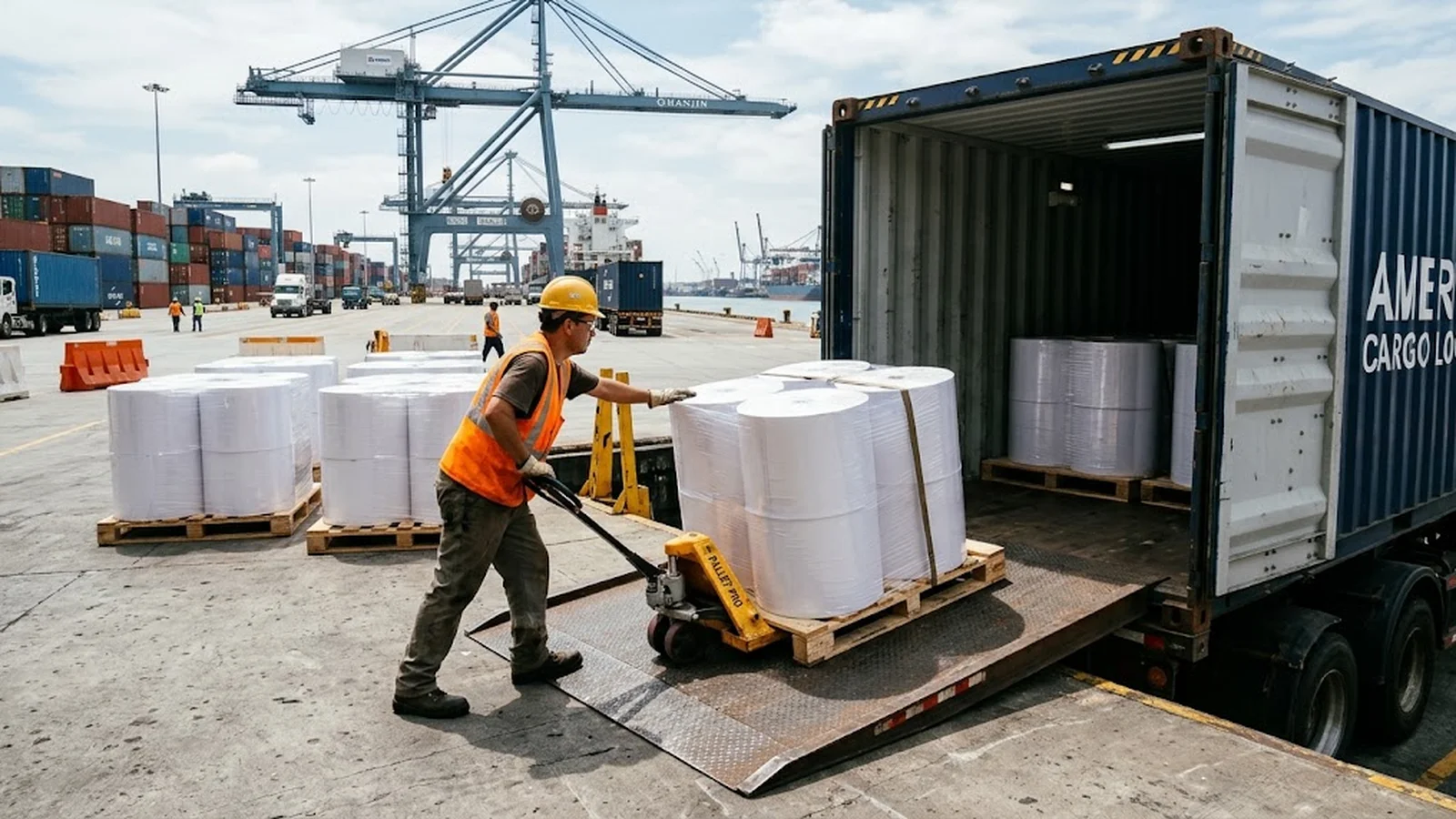
Freight is where wholesale margins are won or lost. Jumbo rolls are heavy and dense, so most full-container loads are weight-limited rather than volume-limited: the pallet pattern, roll diameter and core strength decide how much of a container's weight allowance is actually usable. Buyers should agree pallet dimensions, wrapping and inter-layer protection in the specification, and ask the mill for the container loading plan per order — a plan that shows how many tonnes of which widths land where. Where freight economics favour metreage over stiffness, the lightweight classes earn their place: our 48 gsm lightweight thermal paper documents the class and its metres-per-tonne advantage.
Moisture-barrier packing is not an upgrade but a requirement at this scale: a container crossing an ocean passes through humidity cycles that unwrapped or poorly wrapped parents absorb invisibly, and the damage appears later as curl, wrapping wrinkles and edge fog on the slitter. Confirm that every pallet is bagged or shrink-wrapped with barrier material and that the specification names the packing standard.
Incoming QC closes the loop. Per lot, check grammage against tolerance, width and OD against the specification, wind quality and core integrity, and print density against the agreed sensitivity class — a half-day of dock-side checking that protects a quarter of supply. Wholesale buyers who inspect at receipt turn specification drift into a supplier conversation; those who do not turn it into a converting problem. Where container planning is the next step, our export shipping guide covers pallet standards, moisture-barrier packing and the document set for ocean freight.
Frequently asked questions
What does wholesale pricing on thermal paper jumbo rolls look like?
Jumbo wholesale is quoted per tonne, typically with MOQs set in tonnes or pallet positions and thirty-day price validity. Because grammage decides how many metres a tonne contains, quotes should always be normalised to landed cost per metre at a stated gsm, width, core and outside diameter before comparison.
How many tonnes fit in a container of jumbo rolls?
It depends on grammage, roll diameter and pallet pattern, but full containers are usually weight-limited rather than volume-limited with dense paper stock. Ask the mill for a container loading plan per order showing tonnage and widths per pallet position, and agree pallet dimensions and moisture-barrier packing in the specification.
What specification should I fix before buying jumbo rolls wholesale?
Per width: gsm class with tolerance, core size (typically 76.2mm at parent scale), maximum outside diameter, winding direction, sensitivity class matched to the end print hardware, developer class (BPA-free or phenol-free as the market requires), and moisture-barrier packing standard. This sheet is the enforceable contract and the reference for incoming QC.
Is it cheaper to buy 48 gsm or 75 gsm jumbo stock wholesale?
Per tonne the grades price differently, but per metre the lightweight class wins decisively: a tonne of 48 gsm carries roughly 20,800 square metres against roughly 13,300 for 75 gsm. Choose by end duty — lightweight for cost-driven receipt programmes, heavyweight where stiffness, retention or ticket durability is specified.
How do I QC incoming jumbo roll lots?
Check grammage against tolerance, width and OD against the specification, wind quality and core integrity, and print density against the agreed sensitivity class — per lot, at receipt. Per-batch certificates of analysis should accompany every shipment so any deviation traces to a production lot and becomes a supplier conversation rather than a converting problem.