
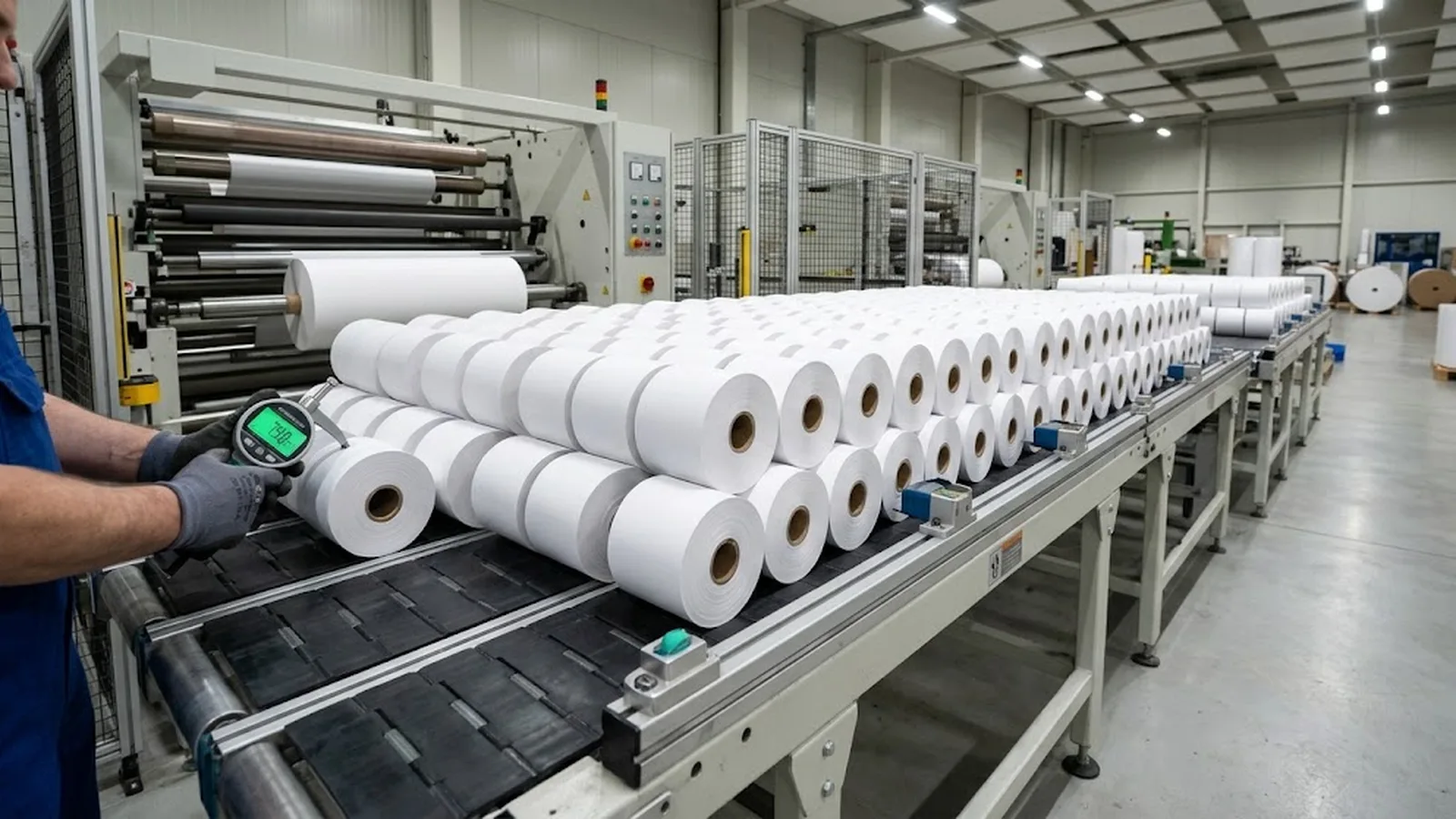
An 80x80 thermal paper roll is an 80mm-wide receipt roll wound to 80mm outer diameter — the highest-capacity format that fits standard 80mm receipt printers. Buyers should specify width, diameter, core size (12.7mm or 25.4mm as standard), gsm by roll-bay capacity, sensitivity class for the printer fleet and developer chemistry per market, then buy against a fixed manufacturer specification sheet rather than roll by roll.
The 80x80 thermal paper roll is the workhorse format of general retail. It fits the 80mm printer class that dominates checkout counters, adds roughly twenty percent more receipt length per roll than a 57x50 format, and slots into the same printers as 80x70 and 80x83 variants — which is exactly why it is also the format where specification drift quietly costs buyers the most. Two rolls with the same label can differ in gsm, core fit and sensitivity, and the difference only shows up as roll changes at peak hour or faint prints from the back counter.
This guide sets out what an 80x80 roll actually consists of as a specification: the width and diameter envelope, the core options, the gsm decision and what it does to metres per roll, the sensitivity class that matches 80mm printer mechanisms, and the chemistry class that compliance now requires. It closes with the arrival checks and the commercial structure that turn a repeat purchase into a programme.
Buyers comparing these specifications can review our POS and receipt paper rolls, where basis weight, coating construction and packing are documented per grade before an order is placed — the 80x80 format sits inside that same specification framework.
The sections that follow follow the order a programme buyer would settle them: dimensions first, gsm second, core and winding third, sensitivity and chemistry fourth, and the buying structure last.
- 80x80 means 80mm width and 80mm outer diameter — the format trades a few millimetres of diameter against the 83mm variant for wider printer-bay clearance, at the cost of metres per roll.
- GSM decides capacity: a 48 gsm grade fits roughly 100–115 m of receipt into an 80mm diameter, while 75 gsm cuts that to around 60–70 m — the arithmetic every buyer should run before choosing a grade.
- Core size is not negotiable in the field: 12.7mm for most 80mm mechanisms, 25.4mm for some tabletop units — a half-millimetre of play becomes a registration complaint.
- Sensitivity class should match the installed printer fleet; chemistry (BPA-free or phenol-free) should be fixed per destination market with SDS paperwork as part of the deliverable.
- Programme buying works on a fixed specification sheet, a rolling forecast and agreed packing — not on spot quotes per pallet.
What 80x80 actually specifies: width, diameter and the format family
The first number is the paper width: 80mm nominal, usually converting at 79.5 to 80.0mm so the roll feeds 80mm-class mechanisms without binding. The second is the outer diameter: 80mm of wound paper on top of the core. Together they define how many metres of receipt the roll carries and whether it clears the printer's roll bay. The format family around it — 80x70, 80x75, 80x80, 80x83 — shares the width but trades diameter against capacity, and printers specify a maximum diameter the mechanism and lid can accept.
Why choose 80x80 over 80x83 if both fit? The three millimetres are bought by sites that run mixed fleets or older enclosures where an 83mm roll occasionally drags or where operators stock one diameter for simplicity. The cost is measurable: at the same gsm, an 80x83 roll holds roughly five percent more paper. Neither choice is wrong; the mistake is buying diameter changes without recalculating metres per roll and roll-change frequency.
Width tolerance matters as much as the nominal figure. Slitting that wanders by half a millimetre shows up as edge scraping in tight mechanisms, so programme buyers pin width tolerance — typically ±0.5mm — into the specification sheet rather than trusting the label.
GSM selection: the metres-per-roll arithmetic
Basis weight is the decision that drives cost per receipt more than any other. Paper weight runs from lightweight grades near 48 gsm through mid-weights of 55 to 65 gsm up to heavyweight 70 to 80 gsm stocks, and every additional gram per square metre shrinks the printable length wound into a fixed 80mm diameter. A 48 gsm grade at 80x80 typically delivers around 100 to 115 metres; a 65 gsm mid-weight lands near 75 to 85 metres; a 75 gsm document-grade stock falls to roughly 60 to 70 metres.
The buying check is simple division: printable length divided by average receipt length, divided by transactions per shift. A high-volume grocer running 180mm average receipts will feel the difference between 100 and 70 metres as a visible change in roll-change frequency; a pharmacy printing short slips will not. Choose the lightest gsm the application's stiffness requirement allows — wide 80mm statements need body to feed straight and survive a wallet, short till slips do not.
- Run the metres-per-shift calculation per site class before fixing gsm — one grade rarely fits every site in a chain.
- Confirm the gsm quoted is actual basis weight, not a 'thickness equivalent' — conversion quality varies between suppliers.
- Note that heavier gsm also raises pallet weight and freight per metre of receipt; the effect is small per roll but real per container.
| GSM | Approx. metres per roll | Typical fit |
|---|---|---|
| 48 gsm | 100–115 m | High-volume till rolls, maximum capacity |
| 55–60 gsm | 85–100 m | General retail default |
| 65 gsm | 75–85 m | Balanced stiffness and capacity |
| 75 gsm | 60–70 m | Document-grade statements and payment slips |
Core size, winding and the arrival checks that prevent complaints
Core specification is where format buying most often goes quietly wrong. The standard for 80mm receipt mechanisms is a 12.7mm (half-inch) core; some tabletop and kitchen units run 25.4mm. The printer's spindle tolerances leave little room, so the programme should fix inner diameter, core wall thickness and core material (typically cardboard, sometimes plastic for humid climates) as part of the sheet. A roll that spins free on the spindle produces registration drift long before anyone connects the complaint to the core.
Winding and edge quality are the other physical markers. Even, tensioned winding prevents telescoping in transit and blocking in storage; clean-cut edges prevent coating dust from shaving into the mechanism; a tab or glue-point closure keeps the roll end tidy until loading. None of these are visible on a quotation, and all of them are checkable in a ten-minute goods-in inspection on one case per pallet.
Procurement teams standardising on one supplier can review our thermal paper jumbo rolls alongside the comparisons in this guide — converter-grade parent stock is where the winding and slit quality of every downstream 80x80 roll is actually decided.
- Core — 12.7mm or 25.4mm per the printer fleet, wall and material specified, no free play on the spindle.
- Winding — square and tensioned; no telescoping, staggered layers or loose wraps on arrival inspection.
- Edges — clean cuts without burrs or visible coating dust along the rim.
- Roll end — tab or glue-point closure consistent across the batch.
- Packing — moisture-barrier wrap inside the case; thermal coating is hygroscopic and sea freight punishes a dry-only specification.
Sensitivity class and chemistry for 80mm printer fleets
80mm printers span compact single-station units to multi-station countertop mechanisms, and their thermal heads differ in energy and speed. Sensitivity class is the coating property that matches them: standard grades suit modern uniform fleets running medium speed, while high-sensitivity formulations earn their premium in mixed or older fleets and in cold back-office environments where a marginal printer must still image fully. Buying more sensitivity than the fleet needs purchases head wear without visible print benefit — the class should be validated by test prints on the destination machines, not by datasheet maximums.
Chemistry is the second half of the coating specification. BPA-free structures are the compliance baseline in the EU under REACH and increasingly the de facto requirement of retail chains worldwide; phenol-free grades remove the broader bisphenol family for buyers serving sensitive channels. For a programme buyer the action is to fix the class per destination market in the specification, with a current safety data sheet naming the developer system travelling with every shipment — switching chemistry mid-programme is a requalification, not a substitution.
Buying the 80x80 format as a programme
80x80 rolls are almost never bought alone. A distributor or chain buying the format usually needs 57mm rolls for compact terminals, 80x70 or 80x83 variants for other sites, and label stock alongside — and the economics improve when the whole basket is quoted by one manufacturer on one forecast. Programme buying has three components: a fixed specification sheet per format, a rolling volume forecast that lets the mill level production, and agreed packing and labelling, including private-label case work where the buyer's brand goes on the shrink wrap.
Requests that combine several formats can be quoted together; see our 75 gsm heavyweight thermal paper for the construction options behind each one, alongside the lightweight and mid-weight grades that cover the rest of a multi-format programme.
Where image life is the deciding factor, our top-coated vs non top-coated guide compares the two constructions on retention, cost and machine behaviour — the natural companion when deciding whether any format in the programme needs a protective top coat.
Close the loop commercially: log roll-change frequency and complaint rates per batch, requalify after any gsm or chemistry change, and keep a retained reference roll per specification until its batch is consumed. Suppliers keep the discipline that buyers measure.
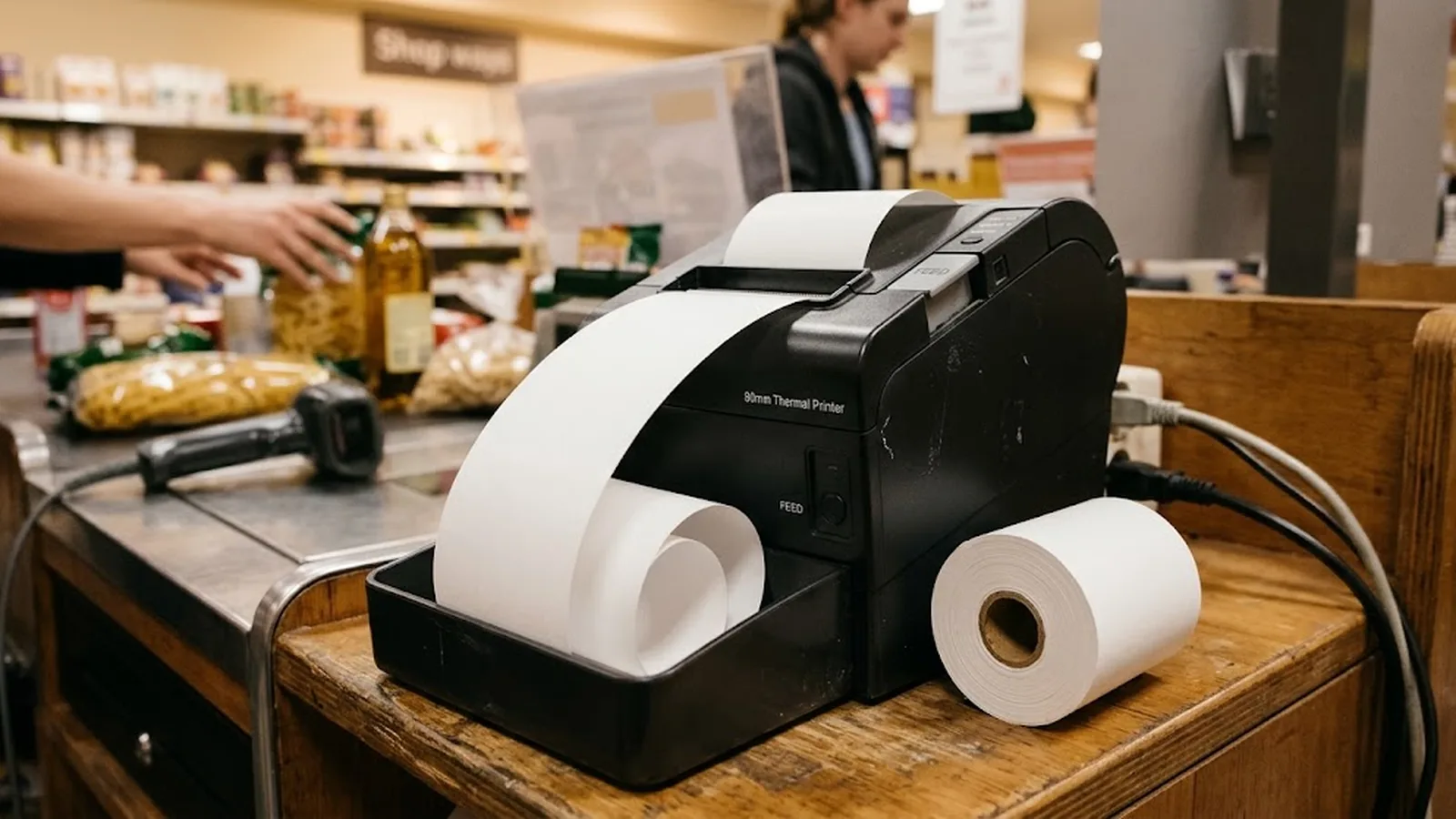
Programme shorthand: '80x80 fixed in the sheet with width tolerance, core and gsm; sensitivity matched to the fleet; chemistry fixed per market; repeats placed against a signed specification and a rolling forecast.'
Frequently asked questions
What is the difference between 80x80 and 80x83 thermal rolls?
Both share the 80mm width; the difference is outer diameter. An 80x83 roll holds roughly five percent more paper at the same gsm, while 80x80 offers clearance for printers and enclosures with tighter roll bays. The choice should follow the printer manufacturer's maximum diameter specification and the site's metres-per-roll arithmetic.
How many metres are in an 80x80 thermal paper roll?
It depends on gsm and core. At a 12.7mm core, a 48 gsm grade typically yields 100–115 metres, a 60 gsm mid-weight around 85–95 metres, and a 75 gsm heavyweight about 60–70 metres. Always confirm metres against the supplier's actual basis weight rather than a nominal value.
What core size do 80x80 rolls use?
Most 80mm receipt mechanisms take a 12.7mm (half-inch) core; some tabletop and kitchen units use 25.4mm. Core wall thickness and material should also be specified, since free play on the spindle causes registration drift that is easily misdiagnosed as a printer fault.
What is a realistic MOQ for wholesale 80x80 rolls from a manufacturer?
Mill-direct orders typically start at pallet volume per specification and reach container economics when several formats are combined. Distributors buying case quantities should either work through a converter or consolidate formats so combined volume meets the manufacturer's minimum.