
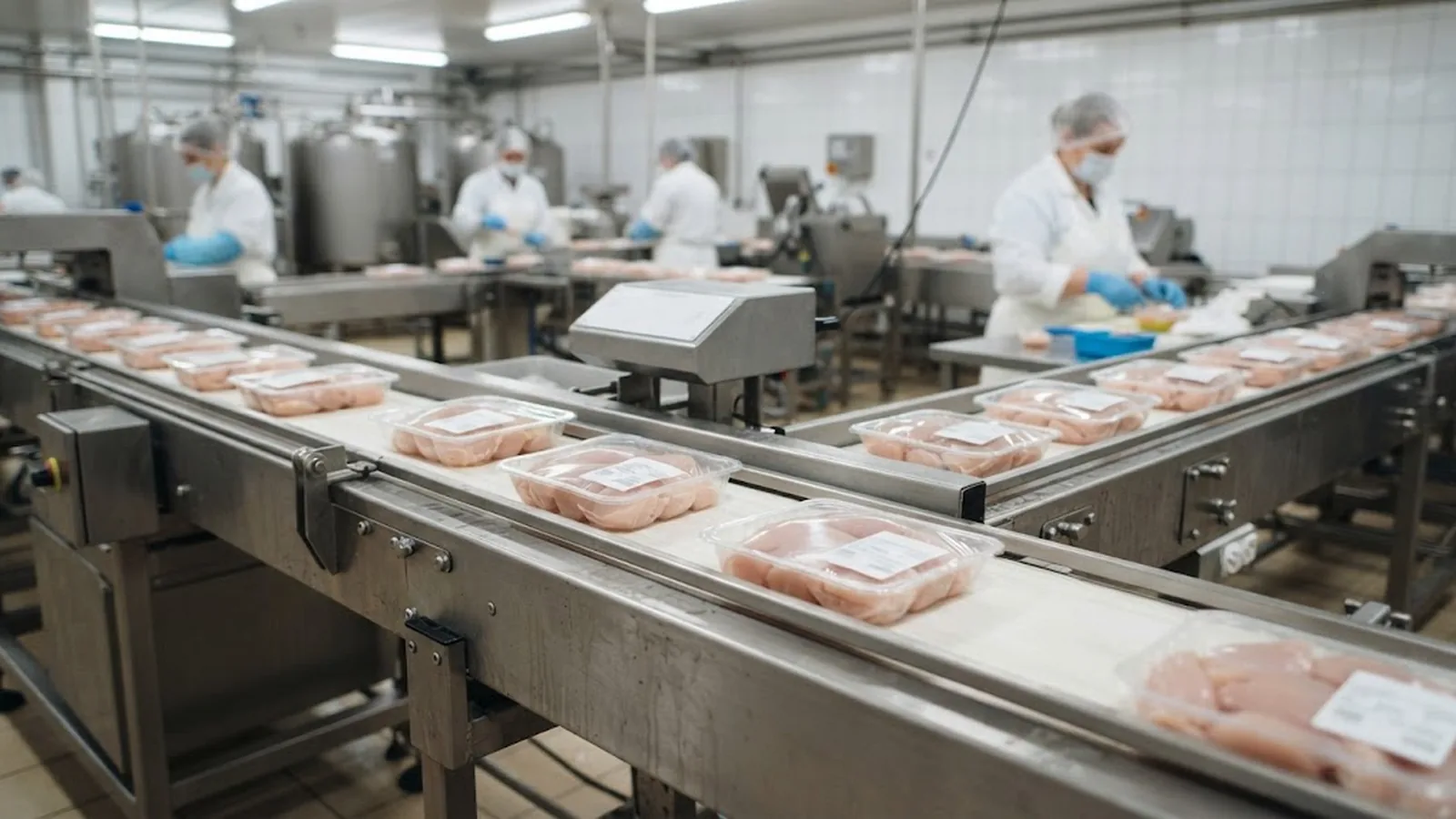
A direct thermal label must meet food contact rules whenever it touches food, or touches packaging in a way that lets substances migrate into the food. In the EU this means the Framework Regulation (EC) No 1935/2004, the GMP Regulation (EC) No 2023/2006 and, for the plastic layers and adhesives, Regulation (EU) No 10/2011, with national rules for paper such as the German BfR recommendation. In the US, the FDA regulates food contact substances, including adhesives under 21 CFR Part 175 and paper components under Part 176. Suppliers support compliance with a Declaration of Compliance, migration test reports and, for direct thermal media, a phenol-free developer so that bisphenols are not part of the migration question at all.
Weighing, price and date labels increasingly touch food directly, and regulators treat that as contact between the food and the label material. Once a label touches food — or sits on a packaging layer where substances can migrate through — it stops being decoration and becomes a food contact material with its own compliance obligations.
Direct thermal media makes this a live question because its imaging chemistry deliberately involves reactive substances in the coating, while the adhesive is a polymer system in its own right. Both must be assessed for migration rather than assumed safe because they are 'paper'.
This guide sets out when a thermal label is a food contact material, which frameworks apply in the EU and the US, what can migrate, how bisphenol restrictions shape the direct thermal market, and how declarations of compliance and migration testing qualify a supplier. It is not legal advice: confirm the applicable rules for your market and, where needed, consult a compliance specialist.
- A direct thermal label is a food contact material whenever it touches food, or touches packaging in a way that allows migration into the food.
- In the EU, Framework Regulation (EC) No 1935/2004 and GMP Regulation (EC) No 2023/2006 apply, with Regulation (EU) No 10/2011 for plastic layers and adhesives and national rules for paper.
- In the US, food contact substances are regulated by the FDA, including adhesives under 21 CFR Part 175 and paper components under Part 176.
- Bisphenol restrictions have pushed food packers toward phenol-free direct thermal grades, which remove the bisphenol question from migration testing.
- Qualify suppliers with a Declaration of Compliance, migration test reports and a certificate of analysis rather than a marketing claim.
When does a thermal label count as a food contact material?
The rule of thumb is contact plus transfer. A label applied to the outside of a sealed box that never touches food is not a food contact material. A weighing label pressed onto a cheese rind, a price label on loose produce, or a label on a tray where the adhesive face sits against a permeable inner bag is a different matter: substances from the label can migrate into the food, so the label is regulated accordingly.
Regulators draw a line between direct and indirect contact. Direct contact means the label face or adhesive touches the food — the strictest case, where a food-contact grade with a supporting declaration is normally expected. Indirect contact means a functional barrier such as a sealed film sits between label and food and prevents migration under the intended conditions of use; that barrier claim must hold for the food type, temperature and contact time involved.
The practical work for a buyer is to map every label application on the line and mark it direct contact, indirect contact, or no contact. That map decides which labels need food contact documentation, and it is the first thing a retailer or auditor will ask to see.
The regulatory frameworks that apply
In the European Union, the Framework Regulation (EC) No 1935/2004 sets the general requirement: food contact materials must not transfer constituents into food in quantities that could endanger health, unacceptably change the food's composition, or spoil its taste and odour. The GMP Regulation (EC) No 2023/2006 requires good manufacturing practice across the chain, making compliance a production discipline rather than only a material property. Regulation (EU) No 10/2011 governs the plastic elements — adhesive and film liner — with migration limits. Paper and board are not harmonised at EU level, so national measures matter, and the German BfR recommendation for paper is widely used as a benchmark.
In the United States, the FDA regulates food contact substances. Adhesives and components of coatings are addressed in 21 CFR Part 175, paper and paperboard components in Part 176, and polymers in Part 177. A supplier will typically provide a compliance statement citing the relevant sections for the facestock, coating and adhesive.
The structural point for buyers is that these frameworks place documentation on the supplier and verification on the buyer. Requesting the right paperwork at specification stage is far cheaper than discovering a gap mid-programme.
| Framework | Market | What it covers on a label |
|---|---|---|
| Framework Regulation (EC) No 1935/2004 | EU | General safety, composition and organoleptic requirements |
| GMP Regulation (EC) No 2023/2006 | EU | Good manufacturing practice across production |
| Regulation (EU) No 10/2011 | EU | Adhesive and plastic layers, migration limits |
| National paper rules (e.g. BfR recommendation) | EU national | Paper and board components where EU rules are not harmonised |
| 21 CFR Parts 175, 176, 177 | US | Adhesives, paper and paperboard components, polymers |
Regulatory responsibility sits on both sides — suppliers document the materials, buyers verify that the grade matches the actual contact scenario on their line.
What can migrate from a direct thermal label
A direct thermal label is a stack of chemical systems held together in thin layers, and each layer is a potential source of migration. The imaging layer contains a leuco dye and a developer, together with binders and additives. The adhesive is a polymer system with tackifiers and, in some technologies, plasticisers. The liner is coated with silicone. Where a label touches food directly, all of these deserve consideration.
How much migrates depends on the contact scenario, not the material alone. Temperature speeds migration, so a chilled or hot-filled application behaves differently from room temperature. Contact time matters, and fatty, oily and acidic foods are more aggressive extractants than dry goods. Surface area relative to food volume also counts, which is why a small label on a large pack presents a lower migration load than the reverse.
This is why migration testing, rather than a general safety statement, is the evidence regulators and retailers expect. Test conditions are selected to represent the intended use, so the specification must state the food type, the contact temperature and the duration honestly — testing against a milder scenario than the real one leaves the compliance claim exposed.
Bisphenols and the shift to phenol-free media
Bisphenol A was historically the developer used in most direct thermal paper, and because receipts and labels handled by consumers are a familiar route of exposure, regulators acted on it. The EU has moved to restrict bisphenol A in food contact materials, following the earlier REACH restriction that banned BPA in thermal paper at or above 0.02 percent from January 2020. A banning of BPA inevitably pushed the market toward substitutes, and bisphenol S became common — but BPS is itself under increasing regulatory and scientific scrutiny.
For food applications, the durable answer has been to remove bisphenols altogether. Phenol-free developer systems — including ascorbic acid and urea-based chemistry — image reliably and carry no bisphenol content, so the developer simply drops out of the migration question. Food packers increasingly specify phenol-free grades as standard, and label converters are expected to know the developer system behind their facestock.
When a supplier offers a 'BPA free' grade, ask for the developer system by name. BPA-free does not automatically mean bisphenol free, and the distinction matters more in food contact than anywhere else.
- Ask which developer system the facestock uses, by name, not just whether it is BPA free.
- Prefer phenol-free (BPA and BPS free) grades for direct food contact applications.
- Confirm the requirement appears on the grade datasheet and the per-lot certificate of analysis.
- Re-check the specification when a supplier changes grade or source, since substitutions are common.
Declarations of compliance and migration testing
Compliance is documented, not asserted. In the EU, a food contact material is supported by a Declaration of Compliance naming the material, substances, conditions of use and regulatory basis. It must match your real use — food types, contact temperatures and duration; a declaration listing other conditions does not cover your application.
Behind the declaration sit test reports. Migration testing uses food simulants representing the food types in question, under time and temperature conditions that mirror real use, and reports name the method, simulant, conditions and result — that traceable detail is the value. A general statement that a product 'meets food contact requirements', with no method or conditions, is not a usable answer to a retailer audit.
The practical document pack for a food-grade direct thermal label therefore has four parts: a Declaration of Compliance covering your actual contact scenario, migration and analytical test reports, a certificate of analysis for each production lot, and the manufacturer's quality system documentation. Requesting these once and keeping them current is the cheapest compliance programme available.

Specifying a food-safe direct thermal label
A food-contact specification should be written before the first order and re-checked whenever the application changes. These are the items that make a label defensible in front of an auditor:
- Map each label application as direct contact, indirect contact or no contact.
- Name the contact scenario: food type, surface temperature, contact duration and whether fatty or acidic foods are involved.
- Specify a phenol-free developer and confirm it on the datasheet and per-lot certificate of analysis.
- Require a Declaration of Compliance that matches your actual conditions of use, not a generic statement.
- Request migration test reports with the method, simulant and test conditions named.
- Confirm the adhesive is rated for food contact where the adhesive face can touch food.
- Confirm the liner and any functional barrier claim are valid for the food, temperature and time involved.
Frequently asked questions
Are direct thermal labels food safe?
They can be, if the construction is qualified for the contact scenario: a Declaration of Compliance covering your food type, temperature and contact time, migration test reports and, for direct contact, a phenol-free developer. Assess the label as a whole — facestock, coating, adhesive and liner — not as paper alone.
Does a label on food packaging need a Declaration of Compliance?
If it touches food, or touches packaging where substances can migrate into it, yes — in the EU a Declaration of Compliance is expected. If the label sits outside a genuine functional barrier no migration route exists and the requirement usually falls away, but the barrier claim must be defensible.
Why do food labels need to be phenol free?
Bisphenol A has been restricted in food contact materials in the EU, following the earlier ban on BPA in thermal paper, and bisphenol S is under increasing scrutiny. Phenol-free developers such as ascorbic acid and urea-based systems contain no bisphenols, so the developer drops out of the migration assessment entirely.
What tests prove a thermal label is safe for food contact?
Migration testing with food simulants that represent your food types, under time and temperature conditions mirroring real use, reported with the method, simulant and conditions named. Analytical test reports confirming the developer chemistry and a per-lot certificate of analysis complete the evidence pack.
Does the adhesive have to be food contact approved too?
Where the adhesive face can come into contact with food — for example on a wrap-around label or an exposed edge — the adhesive is part of the food contact assessment, and in the EU it falls under the plastics rules for migration. If the adhesive is fully separated from the food, its migration risk is much lower, but the construction should still be documented honestly.