
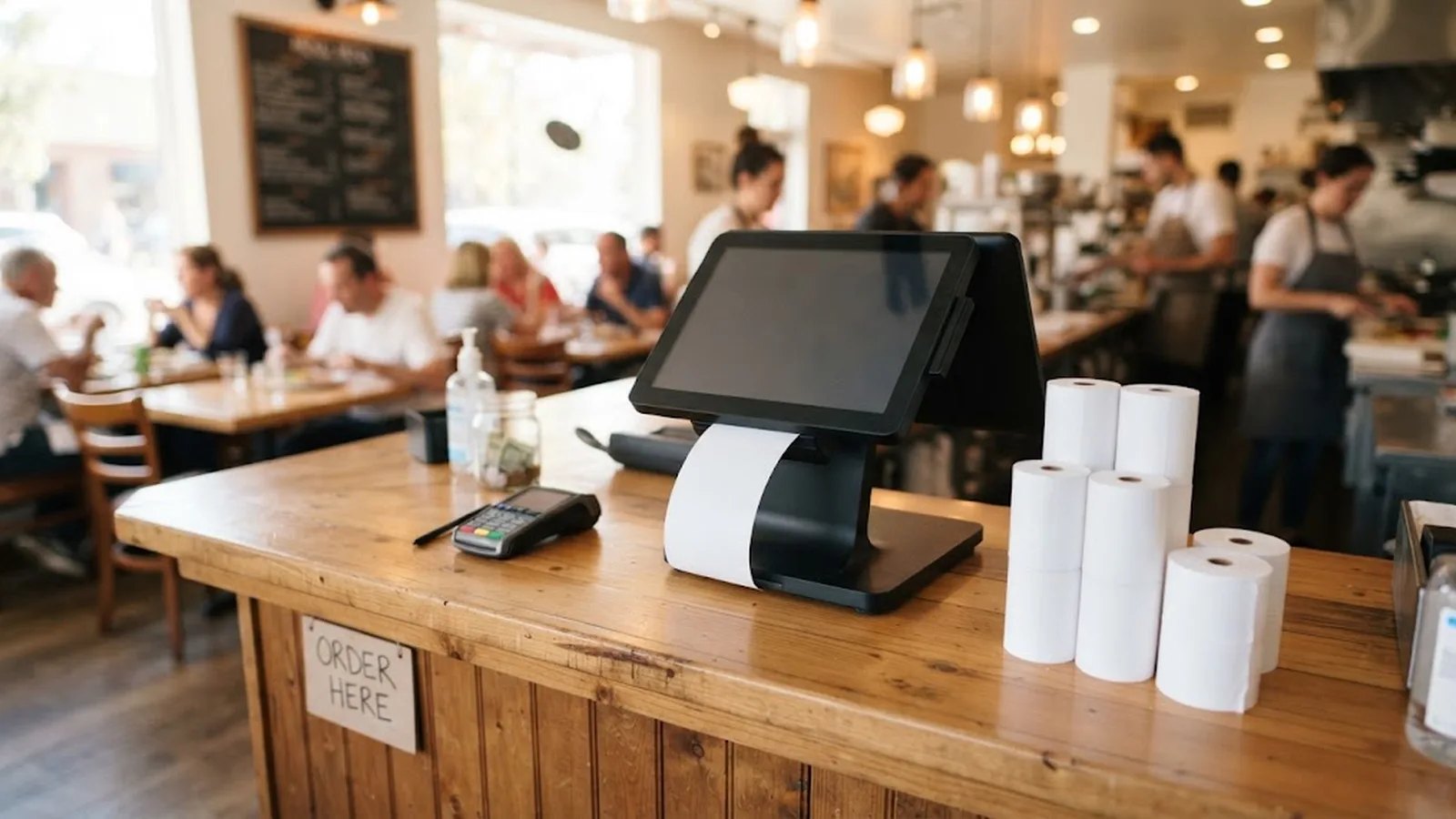
Restaurant thermal paper rolls are direct thermal rolls specified per station rather than bought as one SKU: front-of-house dining receipts run best on 48-55 gsm lightweight stock in 80 mm or 3-1/8 inch widths, compact countertop card terminals take 57 mm or 2-1/4 inch narrow rolls, and kitchen order tickets need 55-65 gsm — often top-coated — because heat, steam, grease and handling near the line attack uncoated thermal images far faster than dining-room conditions ever will. A restaurant group that specs one paper for every station usually overpays on the dining room and replaces faded kitchen tickets; the fix is a two- or three-grade programme with defined widths, cores and developer class, quoted per case with franchise-compatible packaging.
Restaurants burn through thermal paper faster than almost any other retail format — a single busy counter can cycle through receipts all day, every ticket in the kitchen is consumable, and drive-thru and card-terminal slips add a third and fourth stream that rarely appears in the same specification. Yet foodservice buyers most often order one roll size in one grade for everything, usually whatever the local dealer has in stock.
That habit costs twice. Lightweight paper is wasted on applications that never stress it, while the same thin stock dies on the kitchen rail where steam, splashed oil and a hot pass printer strip the image off an uncoated surface within weeks. Specifying restaurant thermal paper rolls station by station is not over-engineering; it is the difference between a consumable that staff never think about and a weekly complaint about unreadable order tickets.
Where a programme needs several formats from one supplier, our POS and receipt paper rolls cover width, core, roll diameter and developer class in a single specification sheet, so front-of-house and kitchen grades can be quoted together.
This guide walks through the paper streams in a typical restaurant, the GSM and width that suit each, what the kitchen environment does to thermal images, and how multi-site groups structure supply, packaging and chemistry compliance into one repeatable programme.
- A restaurant has two to four distinct paper streams — dining receipts, card-terminal slips, kitchen order tickets and sometimes drive-thru or queue media — and each deserves its own width and grade line.
- Front-of-house receipts suit 48-55 gsm lightweight stock; kitchen order tickets need 55-65 gsm and frequently a top-coated construction to survive heat, steam and grease.
- Kitchen fade is environmental, not mysterious: uncoated thermal images degrade quickly near cooking lines, and construction choice beats brand choice.
- Customer-handled receipts increasingly require BPA-free or phenol-free developer systems; the chemistry declaration belongs on the datasheet and the shipment paperwork.
- Multi-site buying works best as a documented programme — case quantities per site, private-label cartons for franchise compliance, and one QC standard across every roll.
The four paper streams inside a restaurant
Front-of-house dining receipts are the volume leader. They print on countertop point-of-sale units at the register or the service station, are handed to the guest, and live for minutes in a wallet or the bin. Nothing in that journey stresses the image, so the specification driver is economy and machine fit: correct width, correct core, a roll diameter that maximises length per change, and a lightweight grade that keeps cost per receipt down.
Payment terminal slips are the second stream. Compact countertop and handheld card machines take narrow rolls — 57 mm and 2-1/4 inch families — with tight roll diameters and small cores that larger receipts never use. Because terminals are supplied by acquirers and swapped on refresh cycles, the paper spec must match the installed fleet, not a generic catalogue line; buyers should keep a width-by-terminal list updated alongside the station map.
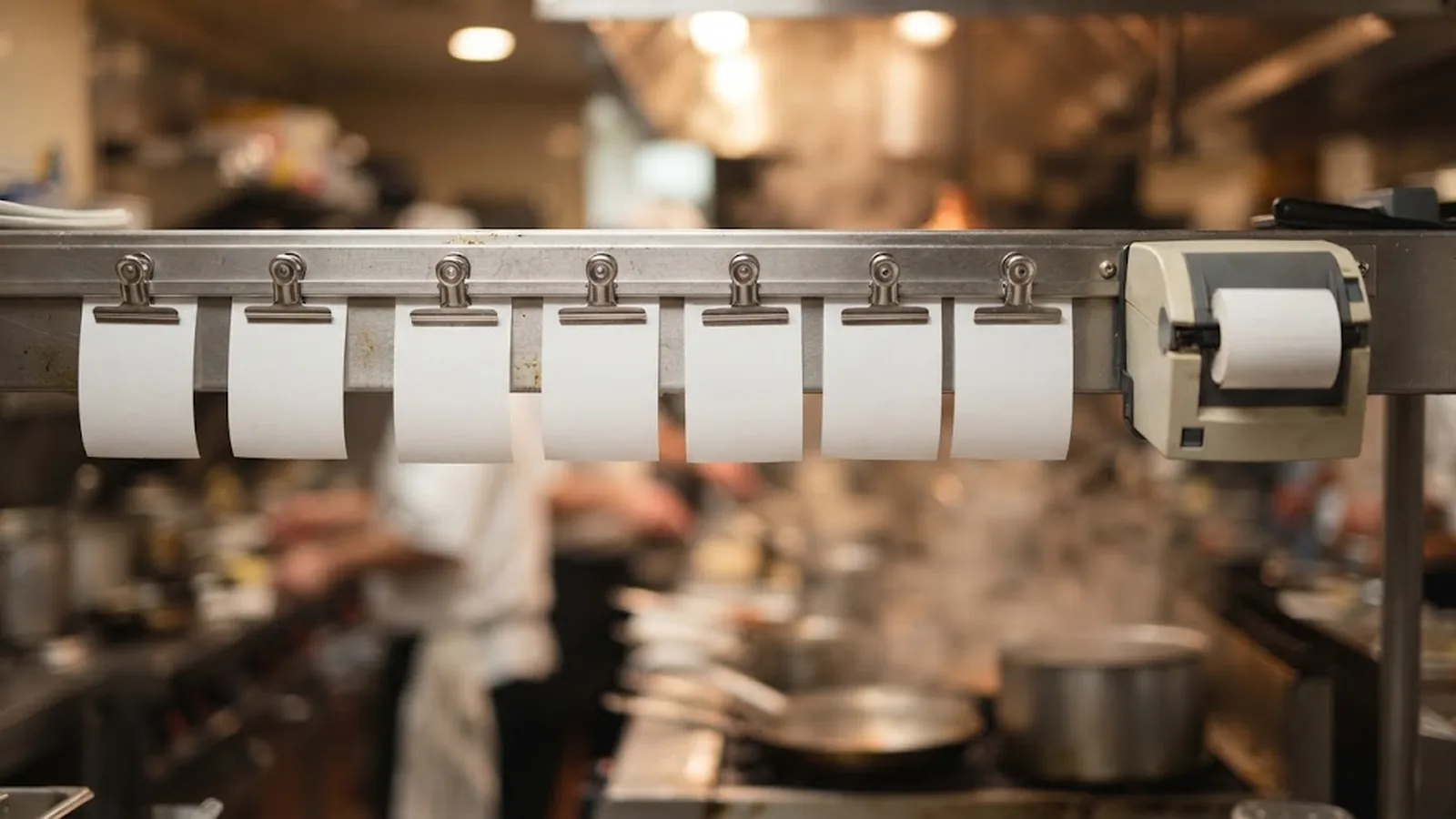
Kitchen order tickets behave differently. Printed at the pass or on the line, handled with wet or greasy fingers, clipped to rails above hot equipment and re-read hours later during a shift or a dispute, these tickets see the worst conditions in the building. Image survival here is a real operating requirement: a faded or blank ticket means re-fires, voids and reconciliation arguments. The fourth stream — drive-thru order-confirm receipts, queue or number tickets, and back-office copies — is usually small but often needs a pre-printed or black-mark variant that standard stock cannot serve.
Specifying by station: width, GSM and construction
The practical specification exercise starts from the machine list, not the catalogue. Dining-room printers in the 80 mm class run 80 mm-wide rolls in depths from 60 to 80 mm; card terminals in the 57 mm and 2-1/4 inch class need narrow rolls with the correct core — usually 12.7 mm on compact units — and a diameter that clears the door. Buying to the machine list prevents the most common failure in foodservice supply: rolls that fit the diameter but jam on the core or the spindle.
Grade follows the environment. Dining receipts print crisply and permanently enough on 48-55 gsm lightweight stock, which also maximises metres per roll and cuts change-outs during service. Kitchen tickets justify 55-65 gsm: the extra substance resists curl near steam and gives the ticket enough stiffness to sit in a rail, and the heavier coating weight holds density after handling. Where the pass sits close to cooking equipment or tickets must stay legible through a long shift, a top-coated construction is the reliable answer — the protective topcoat shields the image from moisture, oils and contact, which uncoated chemistry cannot match.
A workable starting matrix for a mid-size restaurant group looks like this:
| Station | Typical width | GSM range | Construction | Notes |
|---|---|---|---|---|
| Dining-room receipts | 80 mm (60-80 mm depth) | 48-55 gsm | Non-top-coated, BPA-free | Economy driver; maximise roll length |
| Card terminal slips | 57 mm / 2-1/4 inch | 48-55 gsm | Non-top-coated, BPA-free | Match core and OD to installed terminals |
| Kitchen order tickets | 80 mm or 76 mm | 55-65 gsm | Top-coated where near heat/steam | Density after handling is the KPI |
| Drive-thru / queue media | Varies by unit | 55-65 gsm | Black-mark or pre-print as needed | Sense-mark position per equipment spec |
What the kitchen does to a thermal image
Direct thermal images are developed by heat, so every additional heat source near the ticket competes with the printed record. Above a pass or beside a fryer, ambient temperatures, steam plumes and splashed oils attack the image chemistry from two sides: heat fogs uncoated backgrounds grey while moisture and fat leach the developed dye. Friction does the rest — tickets rubbed against rails, clips and aprons lose contrast at the folds first. Where image life is the deciding factor, our top-coated vs non top-coated guide compares the two constructions on retention, cost and machine behaviour.
The countermeasures are structural, not behavioural. Shorter ticket paths and printer covers help at the margin, but the decisive choice is coating construction: a top-coated grade puts a barrier layer over the image-forming layer, and in side-by-side kitchen trials the difference after a week on the rail is plainly visible. Buyers evaluating the trade should test in their own environment — a two-week A/B trial with the same design printed on both constructions settles the question faster than any datasheet. For production volumes, the same construction logic applies to our 48 gsm lightweight thermal paper and its heavier siblings, quoted per jumbo roll, slit reel or finished format.
Storage discipline closes the loop. Rolls staged near the line should sit in closed cartons away from steam and direct heat, opened only for the shift; cartons stored in dry, room-temperature space keep their full shelf life. Most 'bad paper' complaints in foodservice trace back to storage beside dishwashers or under heat lamps rather than to the roll itself.
Chemistry compliance for guest-handled receipts
Dining-room and card-terminal receipts pass through guests' hands, which puts them inside the bisphenol conversation that regulators and retail customers have been running for years. The EU restricts BPA in thermal paper; several US states have followed with their own rules; and brand-led restaurant groups increasingly specify phenol-free developer systems across their estate so the answer never depends on which site a guest visits. For a franchise network the practical requirement is uniformity: one declared chemistry, one evidence pack, every site.
The procurement discipline is document-based. The datasheet should name the developer system explicitly — BPA-free, BPS-free or phenol-free — and the shipment should carry a COA stating the same, so the claim travels with the goods rather than living in a brochure. Buyers consolidating foodservice supply should also normalise the declaration format across grades; a programme where the receipt grade is declared but the ticket grade is silent will fail the first brand audit that checks both streams.
Procurement teams standardising on one supplier can review our custom thermal paper programme alongside the comparisons in this guide, where developer class, certification status and packing are documented per grade before an order is placed.
Structuring a multi-site programme: counts, packaging and QC
Restaurant groups buy paper on rhythm, not on project — weekly or monthly case counts per site, driven by transaction volume and ticket length. The useful planning unit is consumption per site per week by stream, which converts directly into case configurations: a standard case that holds one month of dining receipts, a narrow-roll case for terminals, and a kitchen case with the heavier grade. Consistent case quantities make franchise reordering automatic and keep every site on the same specification without depending on local judgement.
Private-label packaging earns its place at franchise scale. Cartons printed with the group's own branding, site codes and grade labels turn a commodity consumable into a controlled item — staff can verify the right roll went into the right unit, and the carton itself advertises the programme's discipline. Converters serving foodservice should be able to quote the packaging tier alongside the paper, since carton printing and case packing affect both cost and lead time.
Quality agreement closes the programme. The checks that matter for restaurant rolls are practical: width and core tolerance, roll roundness (out-of-round rolls jam mid-service), print density against a reference, curl after print, and the declared developer chemistry. A one-page QC standard agreed at onboarding — with the supplier's COA per batch — prevents most disputes and gives every site the same expectation. Where container planning is the next step for imported supply, our export shipping guide covers pallet standards, moisture-barrier packing and the document set for ocean freight.
Programme shorthand: '80 mm dining receipts 55 gsm BPA-free non-top-coated; 57 mm terminal rolls to fleet list; kitchen tickets 65 gsm top-coated; private-label cartons, site-coded; COA per batch with declared developer system.'
Frequently asked questions
What GSM thermal paper is best for restaurant receipts?
Dining-room and card-terminal receipts run well on 48-55 gsm lightweight stock — it keeps cost per receipt low and maximises roll length. Kitchen order tickets justify 55-65 gsm, and near cooking lines a top-coated construction in that range holds the image far better through heat, steam and grease.
Why do kitchen order tickets fade faster than dining-room receipts?
Heat, steam and oils around the cooking line attack the thermal image directly — ambient heat fogs uncoated backgrounds and moisture and fat break down the developed dye. A top-coated grade adds a barrier layer over the image, which is the structural fix; storage beside dishwashers or heat lamps makes the problem worse.
What roll sizes do restaurant card terminals use?
Compact countertop and handheld terminals take the 57 mm and 2-1/4 inch width families with small cores, typically 12.7 mm, and roll diameters matched to the machine's paper door. Because acquirers swap terminal models on refresh cycles, buyers should maintain a width-by-terminal list and spec paper against the installed fleet.
Do restaurant receipts need to be BPA-free?
Guest-handled receipts sit inside the bisphenol regulatory conversation — the EU restricts BPA in thermal paper and several US states have their own rules. Most brand-led restaurant groups now specify BPA-free or phenol-free developer systems across every site, with the declaration stated on the datasheet and the batch COA.
Can restaurant paper rolls be supplied with our logo and site codes on the cartons?
Yes. Private-label cartons with group branding, site codes and grade labels are a standard converting service, usually quoted alongside the paper. Consistent case quantities per site make franchise reordering automatic and help staff verify the right roll goes into the right unit.