
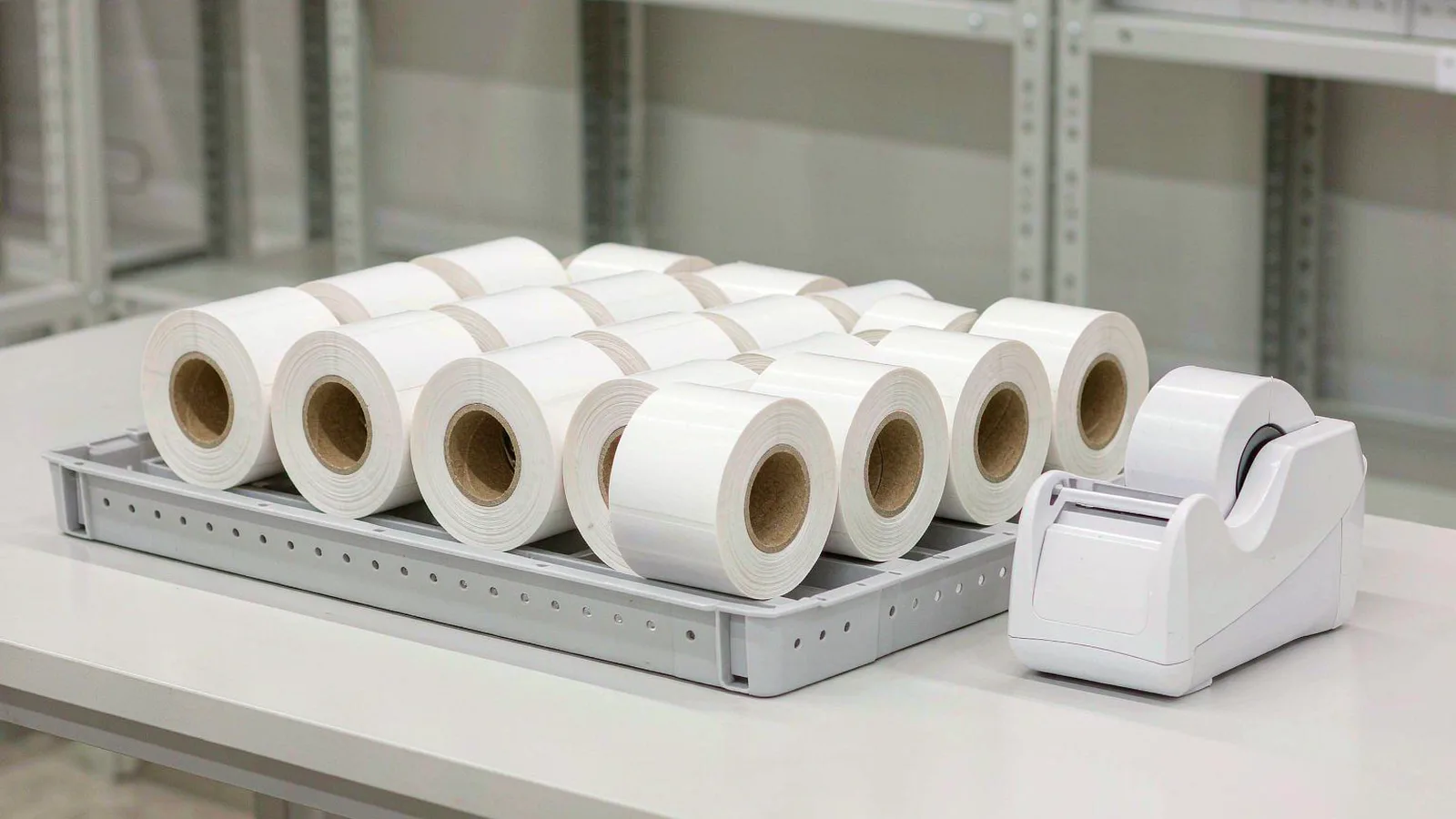
Thermal price labels are direct thermal labels printed at the point of sale or in the back room to carry a price, an article number and usually a barcode at the shelf edge or on the product. The category spans three practical formats — price-gun rolls for hand-applied labels, printer rolls for shelf-edge and item tags, and bulk stock for central printing — and the buying decision is really four decisions made together: label size matched to the dispenser, direct thermal facestock with enough contrast for first-pass barcode scanning, an adhesive matched to the surface the label meets, and a supply format that fits the store's replenishment rhythm.
Walk any supermarket aisle and you are looking at a labelling programme: a price and a barcode on every shelf edge, a label on every pack, all of it printed, applied and replaced on a rhythm most shoppers never notice. Thermal price labels are the consumable underneath that rhythm — small, inexpensive per piece, and unforgiving when the specification is wrong. A label that will not feed, a barcode that scans on the third attempt, an adhesive that lets go in the chiller: each failure is small, and each one repeats thousands of times a week.
That is what makes price labels a specification purchase rather than a stationery order. The label stock is a direct thermal construction — a facestock, a thermal coating and an adhesive on a liner — and every element interacts with the dispenser, the printer and the surface it lands on.
Procurement teams standardising on one supplier can review our top-coated thermal label stock alongside the comparisons in this guide, where facestock, coating construction and liner options are documented per grade before an order is placed.
This guide walks through the category from the retail buying side: the three formats and where each fits, the size and roll-format decisions behind dispensers and printers, the print-quality factors that decide first-pass scan rates, the adhesive choices for chilled and frozen environments, and how to structure supply for a multi-store programme.
- Price labels are bought as a system: label size, dispenser, printer and adhesive must be specified against the store's actual fixtures, not from a catalogue page.
- Price-gun rolls live or die by roll geometry — core, outside diameter and rewind tolerance decide whether the gun feeds cleanly at speed.
- Barcode contrast is the quality metric that matters: direct thermal facestock and coating choice should be validated against the store's scanner fleet.
- Adhesive class follows the surface — general shelving, chilled cases and frozen film each need a different tack profile.
- Multi-store programmes save through consolidation: one label family, predictable roll formats and scheduled replenishment beat chase-the-cheapest buying.
What thermal price labels cover in a retail programme
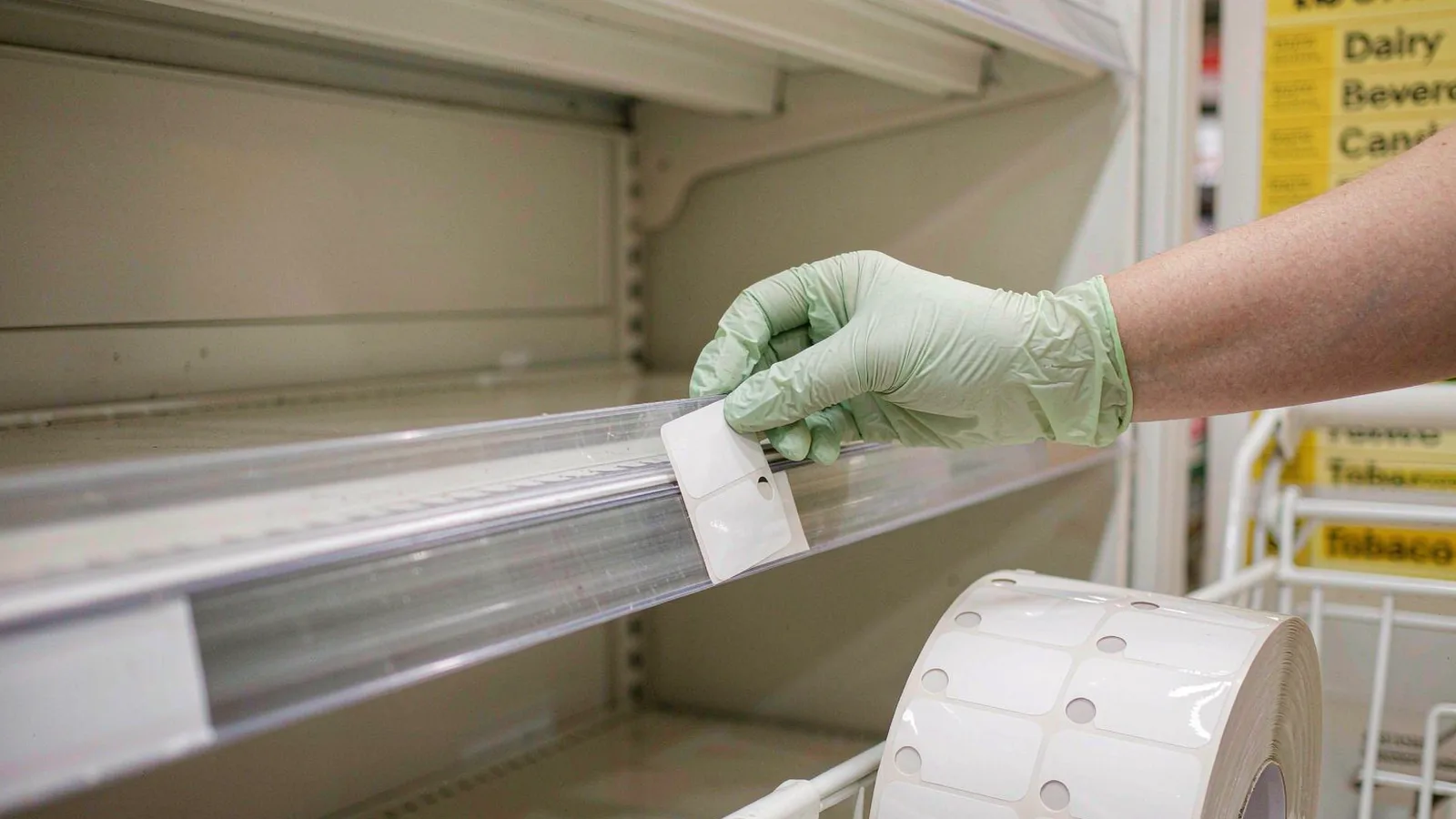
The category is broader than the name suggests. At the shelf edge, thermal price labels carry the unit price, article description and the barcode the shelf scanner reads; on the product, item labels carry the same data plus batch or date information where the category requires it. In fresh departments, weighed-item labels join the family — printed at the scale, carrying weight, unit price and total. What unites them is the printing method: direct thermal, which needs no ribbon or ink, suits high-turnover back rooms, and images at the speed the store works.
The buying consequence is that price labels should be selected per environment, not chain-wide as one SKU. A label family that shares facestock and adhesive platform but varies in size and coating class covers the whole store more economically than a single label forced to serve the dry grocery aisle and the freezer case alike.
Formats and sizes: from price-gun rolls to shelf-edge tags
Three supply formats dominate retail buying. Price-gun rolls are small-diameter rolls of narrow labels loaded into hand-held applicators; their defining specification is roll geometry — the core, the outside diameter and the label pitch must match the gun model exactly, or the feed jams. Printer rolls feed shelf-edge and item label printers, where the width and the core matter more than the diameter. Bulk stock — wide jumbos and fanfold packs — serves central print rooms that produce labels for distribution to stores.
Size selection follows the fixture and the task: shelf-edge strips sized to the rail, square item tags sized to the pack, narrow gun labels sized to the price field. The practical discipline is to audit the store's dispensers and printers first and buy to that list, because a size that misses the installed hardware is a size that cannot be used at any price.
| Format | Typical use | Deciding specifications |
|---|---|---|
| Price-gun rolls | Hand-applied price and item labels | Label size, pitch, core, roll OD matched to gun model |
| Printer rolls | Shelf-edge rails, item tagging | Label width, core, facestock class matched to printer |
| Jumbo / fanfold stock | Central print rooms, distribution | Web width, liner type, winding for the print room's equipment |
Print contrast and scan-ability at the shelf edge
A price label has one job that outranks all others: the barcode scans first time. Scan performance is a print-contrast question — the darker and crisper the thermal image against the label surface, the higher the first-pass read rate at the scanner. Facestock smoothness, coating sensitivity and printer head condition all feed the same number, which is why label quality complaints in retail usually surface as 'the scanner is slow' rather than 'the paper is wrong'.
The buying defence is to test labels on the store's own printers and scanners before committing volume. A grade that images crisply on one printer model can look grey on another, and a label that scans reliably in a dry back room can soften in a humid one. The sample sequence is cheap; the alternative is store-level productivity losses that dwarf the label price.
Coating class also earns its place here. Top-coated constructions protect the image against moisture, abrasion and handling — the difference shows up when labels are applied to chilled packs or handled by staff all day. For high-volume price labelling, the top-coated premium is usually justified by fewer reprints and fewer rescans rather than by image life alone.
For production volumes, the same construction logic applies to our thermal paper jumbo rolls, quoted per jumbo roll, slit reel or finished format — the supply route that keeps a growing label programme's cost per thousand under control.
Adhesives and surfaces: shelving, chilled and frozen
The surface decides the adhesive. Dry shelving and packaging film accept a general-purpose acrylic adhesive without drama. Chilled cases are the first step up: condensation and cold surfaces weaken tack, and labels applied straight from a cold room need an adhesive rated for low-temperature application, not merely low-temperature service. Frozen film is the demanding end — labels applied to frosted, flexible surfaces need an aggressive-tack adhesive and a facestock that tolerates flexing at freezer temperatures without cracking the thermal image.
Application practice matters as much as adhesive chemistry. Labels applied to cold, wet surfaces fail faster than the same labels applied correctly — which is why the buying conversation with a supplier should include where the label is applied and by whom. A supplier who knows the labels go onto frozen film will recommend a different construction than one who hears only 'price labels'.
Liner choice completes the adhesive decision. Glassine liners suit most price-gun and printer applications; thicker liners stabilise die-cutting on small formats. Release properties affect feeding reliability in guns and printers — another reason the installed-hardware audit comes before the specification.
Building the supply programme: MOQ, private label and replenishment
Price labels are consumed continuously, so the buying question is not a single order but a programme. The levers are the same as any consumable: consolidate the label family so fewer constructions cover more sizes, fix roll formats to the installed hardware so replenishment never needs re-engineering, and schedule deliveries against the store's usage rather than emergency ordering. Chains that buy this way typically see unit prices settle and stock-outs disappear together, because both come from the same consolidation.
Private label adds a branding option without a printing obligation: rolls can carry the chain's mark on the liner or the label face in preprint, produced under the same direct thermal constraints as any preprinted roll. The artwork economics follow label-industry rules — one design family across sizes amortises the plate cost over the whole programme.
Requests that combine several formats can be quoted together; see POS and receipt paper rolls for the construction options behind each one — the same supplier logic that governs receipt consumables usually extends to the label programme, and consolidating both with one mill simplifies compliance paperwork and freight alike.
Where image life is the deciding factor, our top-coated vs non top-coated guide compares the two constructions on retention, cost and machine behaviour — the decision that sits underneath every chilled-case and long-shelf-life label choice in the programme.
Programme shorthand: 'Label family audited to installed guns and printers, size set per fixture, facestock and coating per environment, adhesive per surface, roll formats fixed, replenishment scheduled, private-label artwork amortised across the family.'
Frequently asked questions
What sizes do thermal price labels come in?
Common shelf-edge and item formats range from narrow strips sized to shelf rails up to square tags for pack labelling, and price-gun sizes are dictated by the gun model. The reliable method is to audit the store's dispensers and printers first and buy label sizes to that hardware list.
Do price labels need a top coating?
Not everywhere. Dry-grocery shelf labels on short promotion cycles perform well on economical non-top-coated stock, while chilled, frozen and long-life applications justify the top-coated construction for moisture and abrasion resistance. Splitting the programme by environment is usually cheaper than upgrading everything.
Why do barcodes on some price labels scan poorly?
Scan performance tracks print contrast: a grey image from a low-sensitivity coating, a worn printer head or a rough facestock lowers first-pass read rates. Testing the label on the store's own printers and scanner fleet before volume purchase isolates the cause before it reaches the aisle.
Which adhesive works on frozen packaging?
Frozen film needs a high-tack adhesive rated for low-temperature application and a facestock that flexes without cracking the image. Labels applied to cold, frosted surfaces also depend on application practice — the supplier should be told exactly where and how the label is applied.
Can price label rolls be preprinted with the store's brand?
Yes. A mark on the label face or the liner prints under the same flexo and thermal-compatibility rules as any preprinted thermal product, and one design family across the label sizes amortises the plate cost across the whole programme.