
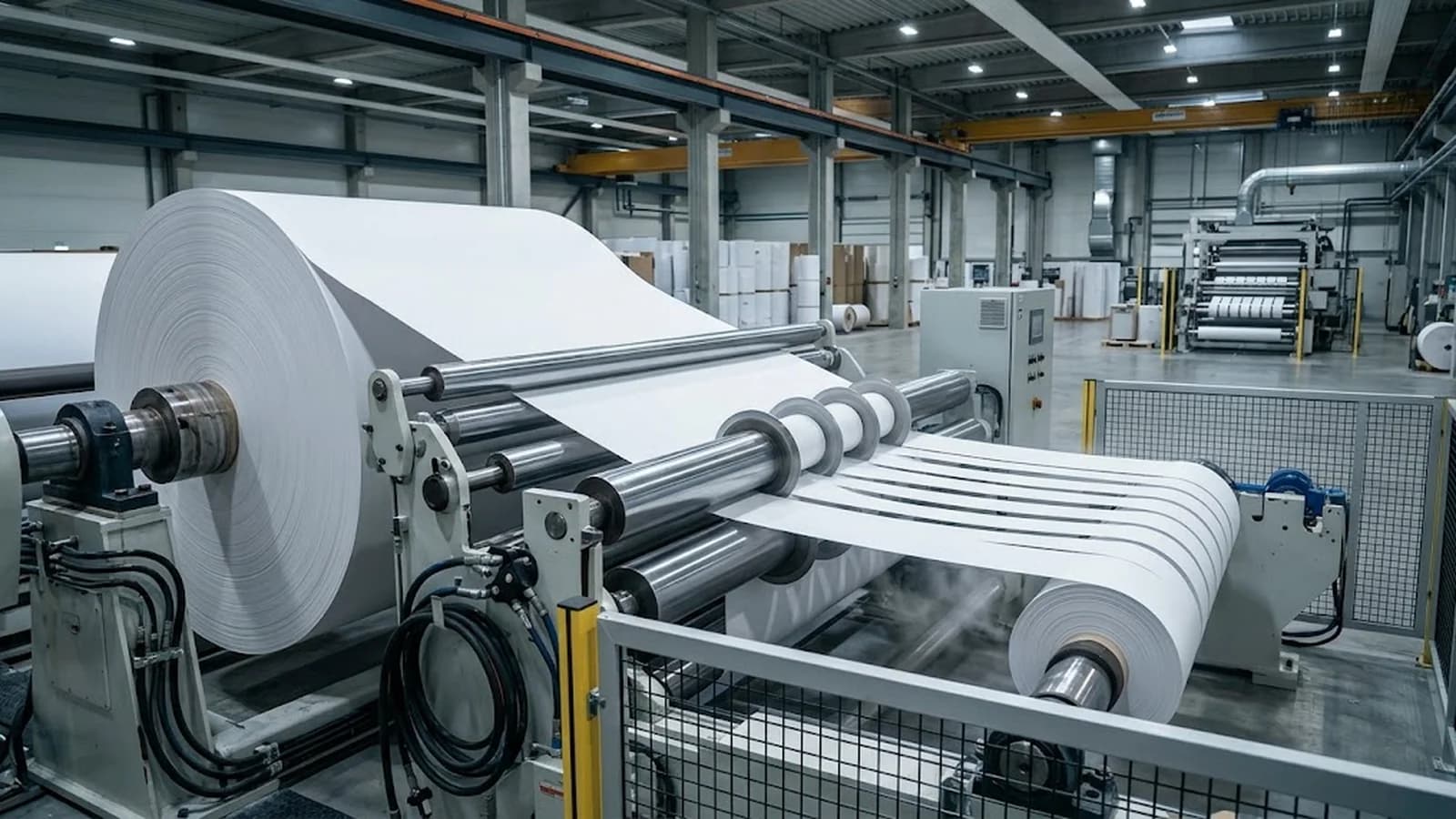
The thermal paper slitting process converts a coated jumbo parent roll into finished rolls in four stages: unwind (jumbo loaded and tension-controlled), slitting (the web is cut to width by shear, crush or laser blades), rewinding (narrow webs wound onto cores under a programmed tension profile) and finishing (trim inspection, core removal control, wrapping and cartoning). Thermal paper adds two constraints that ordinary paper converting does not have: the coated surface is scored permanently, so blade condition and dust control directly become print defects, and winding must stay cool and even, because pressure and friction can develop the image layer. Width tolerance of ±0.5 mm, clean-cut edges with no dust, and a controlled hardness taper from core to rim are the three specifications to demand from any slitting supplier.
Ask for a quotation on thermal paper rolls and you will receive prices per roll, per metre or per tonne — but the difference between a good quotation and a good shipment is decided in one room: the slitting hall. There, rolls of paper up to 1.2 metres across are unwound, cut into webs as narrow as 30 millimetres, and rewound onto the cores your machines accept. Everything a buyer cares about — width accuracy, roll roundness, paper length, clean edges, freedom from dust — is created or destroyed in those few minutes of converting.
Thermal paper makes this process harder than ordinary bond or art paper converting. The heat-sensitive coating sits on the outside of every web, exposed to every blade, roller and wrap point. A dull cutter does not merely leave a rough edge; it sheds coating dust that later lands on printheads and shows up as white streaks in printed receipts. A winding stand that pulls too hard can pre-develop the coating. The thermal paper slitting process is therefore a controlled set of compromises, and buyers who understand it write better specifications and audit suppliers more effectively.
This guide walks through the process stage by stage as a converter runs it — unwind, slit, rewind, finish — with the tolerances and quality checkpoints that matter at each stage, and closes with the inspection list procurement teams can apply to incoming rolls.
Procurement teams standardising on one supplier can review our 75 gsm heavyweight thermal paper alongside the comparisons in this guide.
- Slitting is four controlled stages — unwind, slit, rewind, finish — and each stage maps to a specific roll defect buyers can inspect for.
- Width tolerance of ±0.5 mm (±1 mm as an agreed relaxed limit) is the industry norm; under-width rolls cause slipping and misfeeds, over-width can jam compartments.
- Shear cutting gives the cleanest edges on coated thermal stock; crush cutting is faster but generates the dust that becomes printhead streaks.
- Wound-in tension must taper from core to rim: hard cores give smooth payoff, over-hard rims glaze the coating and can pre-develop the image.
- Dust, edge quality and length verification are the three highest-value incoming QC checks — all three are testable without laboratory equipment.
Stage 1 — Unwind: loading the jumbo and controlling tension
The process starts with the jumbo parent roll — typically 405 to 844 mm wide, 600 to 1,200 mm in outer diameter, weighing several hundred kilograms — mounted on a shaft through its 76.2 mm core. Modern slitter rewinders are centreshaft or duplex machines: a centreshaft machine slits and rewinds in one pass, while a duplex machine winds the slit webs onto two rewind shafts alternately, which lets operators keep web tension lower and softer. For thermal paper, lower tension is a feature, not a compromise.
Unwind tension is the first process variable. The web must be taut enough to track straight through the cutter — a slack web wanders and the slit widths drift — but high tension stretches the paper and can mark the coated face wherever it passes over a nicked idler roller. Converters running thermal grades typically hold unwind tension far below what the same machine would apply to kraft or label stock, and they keep the web path short: fewer rollers means fewer chances to scratch or pre-develop the coating.
Jumbo quality determines the ceiling of everything downstream. Parent rolls with damaged edges, soft shoulders or core-telescoping cannot be rescued by a good slitter — they arrive with defects already built in. Serious converters therefore inspect every jumbo at mount-up, recording outer diameter, width and any edge damage before the first web is cut, because that record is what allows a finished-roll complaint to be traced back to the parent roll or to the converting step.
Buyer takeaway: when a supplier audits well at slitting but ships short lengths, the root cause is often jumbo yield loss that was never measured — ask how parent-roll metres are reconciled against finished-roll metres.
Stage 2 — Slitting: how the web is cut to width
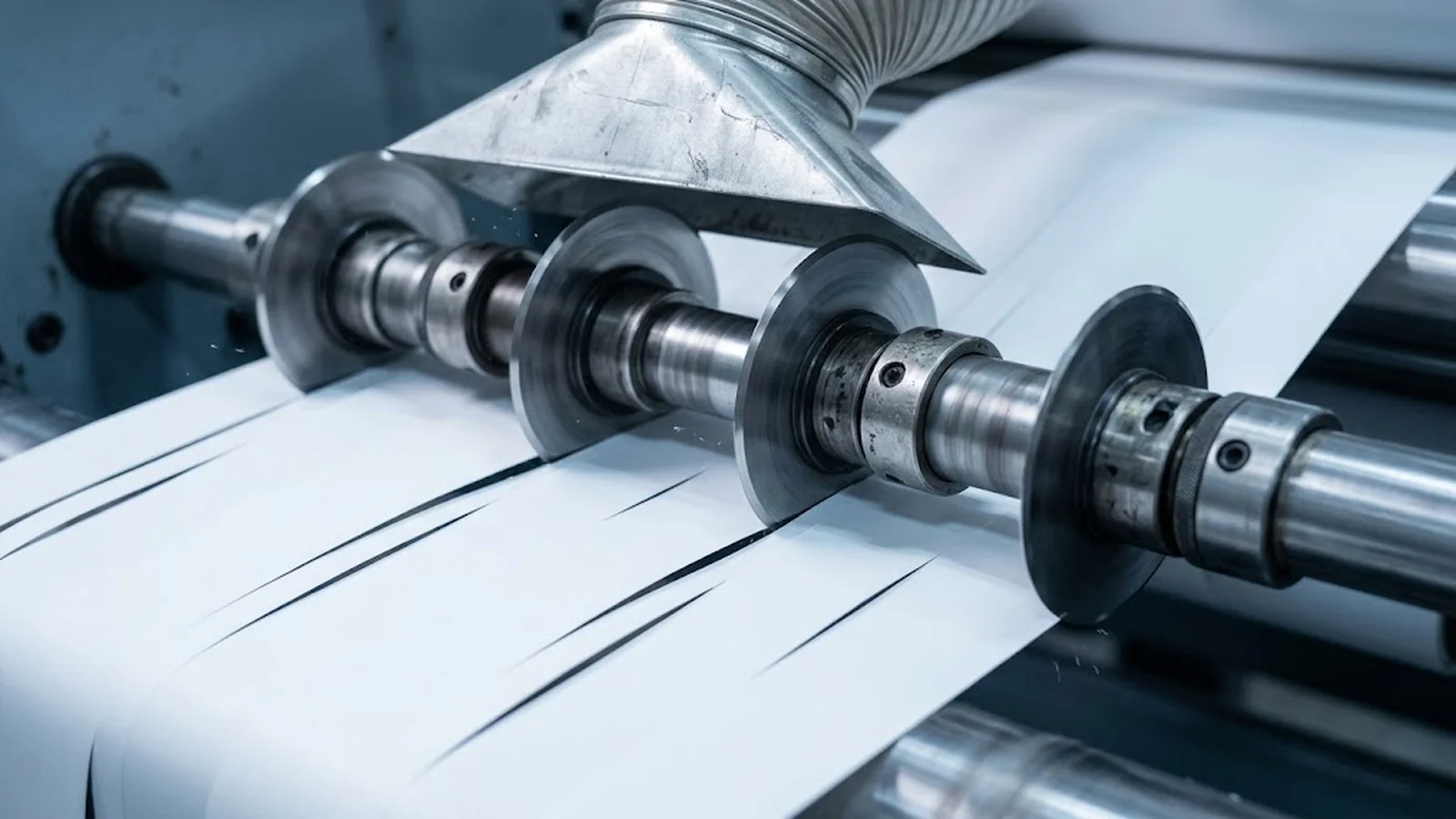
Slitting is the defining step of the thermal paper slitting process. The jumbo web passes over a driven roller while circular knives cut it lengthwise into narrow webs. Three cutting methods dominate. Shear cutting uses two opposing blades — a male and female cutter — working like scissors; it produces the cleanest edge on coated grades and is the standard for thermal receipt and label stock. Crush cutting presses a rotating blade against a hardened anvil roller; it is faster and simpler to set but compresses the edge and sheds more coating dust. Laser and waterjet methods exist for niche work but are uncommon in thermal roll converting.
Blade geometry and sharpness are maintained on a schedule measured in linear metres, not in days. A shear blade pair on thermal paper is typically reground after a set run length, because a blade that is still 'good enough' on bond paper is already dusty on thermal stock. Operators verify edge quality visually against a standard: a good thermal slit edge is square, shows no burr on the coating side, and leaves no visible white powder when wiped with a dark cloth.
Width setting is where buyer specifications are enforced. The slitter is set so each web measures nominal width plus a small positive allowance — the industry works to ±0.5 mm on receipt and label widths, with some agreements relaxing to ±1 mm. Positive bias matters: machines accept a roll slightly wider than nominal because guides compress the paper, but an under-width roll slips in the paper path and misfeeds. When a buyer specifies '57 mm width tolerance ±0.5, never under nominal', the slitting plan and the QC plan both become unambiguous.
For production volumes, the same construction logic applies to our custom thermal paper programme, quoted per jumbo roll, slit reel or finished format.
- Shear cutting — scissor action between opposed blades; cleanest edge, standard for coated thermal grades.
- Crush cutting — blade against anvil roller; faster, but edge dust and coating damage are harder to control.
- Blade regrind is scheduled by metres run, with edge quality verified against a wiped-cloth dust standard.
- Width is set with positive bias to nominal; ±0.5 mm is the common specified tolerance for receipt and label rolls.
| Method | Edge quality | Dust generation | Typical use |
|---|---|---|---|
| Shear (opposed blades) | Clean, square, burr-free | Low | Receipt rolls, label stock, ticket grades |
| Crush (blade on anvil) | Compressed edge, slight burr | High | Short runs, non-critical widths |
| Laser / waterjet | Excellent, sealed edge | None to low | Niche converting, specialty webs |
Stage 3 — Rewind: tension profile, hardness taper and roll geometry
After slitting, each narrow web is wound onto a core — 12.7 mm for receipt rolls, 25.4 mm or 76.2 mm for label and jumbo formats — and here the rewinder does the work that decides how the roll behaves in the customer's machine. The controlling concept is the tension profile: tension must be highest at the core and taper down as diameter grows. A hard core anchors the roll and gives the paper path a firm start; a progressively softer wrap prevents the outer layers from crushing the inner ones. Converters measure this as roll hardness with a press-foot or graduated-shore gauge and check the taper at defined diameters.
For thermal grades, the rewind stage carries an extra risk: pressure and friction can develop the heat-sensitive coating. A roll wound too hard, or wound with a web that is drifting and rubbing a flange, shows grey pressure marks when unwound — visible as bands or scuffing before any printing happens. Skilled operators set rewind tension per grade, keep the web aligned, and pull sample rolls at start-up and at defined intervals, unwinding a metre to check for pressure develop, wrinkles and interlayer sticking.
Roll geometry is verified at rewind as well. Outer diameter is measured directly (it decides paper length and the fit of the customer's compartment), and concentricity — how true the roll runs on its core — is watched because an eccentric roll prints with visible speed fluctuation. Where machines are direction-sensitive, winding direction (paper-out versus paper-in) is set per order; the finished carton then carries the winding code so warehouse and end users never have to guess.
- Tension profile: highest at core, tapering to the rim; verified with hardness readings at set diameters.
- Pressure develop check: sample rolls are unwound and inspected for grey friction marks before release.
- Outer diameter measured per roll — it is the buyer's proxy for paper length and machine fit.
- Winding direction set per order and marked on the carton; wrong wind equals no print on paper-in mechanisms.
Stage 4 — Finishing: trim, wrap and length assurance
Between rewinding and cartoning sits the finishing work that buyers rarely see but always receive. Trim inspection removes any web sections flagged at start-up or in-process checks. Each roll is end-taped to prevent telescoping in transit, weighed when the specification calls for length assurance, and wrapped — in paper, or in film where humidity protection matters. Carton packing follows the agreed pattern, and every carton carries a batch code that ties the finished rolls back to the jumbo batch and the coating run behind them.
Length assurance deserves specific attention because it is the most common hidden variable in roll purchasing. Two rolls with the same outer diameter can differ in paper length by several percent depending on paper caliper and how tightly they were wound. Suppliers who verify length do it one of two ways: by metrology (measured length counters on the rewinder) or by weight correlation — weighing a roll and converting to length using the grade's grammage. Either method works; the buyer's protection is simply to require that one of them is applied and recorded.
Dust management runs through the whole finishing chain. Good converting lines keep slitter enclosures cleaned on schedule, apply web cleaners or vacuum extraction near the knives, and handle slit rolls with the same care as finished goods. Residual dust is checked by wiping a defined length of the outer wrap of a sample roll; the result belongs in the batch record, because 'no visible dust on dark cloth' is a pass/fail test any customer can replicate on receipt of goods.
| Parameter | Typical specification | Verified by |
|---|---|---|
| Width | Nominal +0.5 / -0 mm | Caliper check per roll or per sample plan |
| Outer diameter | Per order (e.g. 80.0 mm max) | Diameter gauge, each roll |
| Core | 12.7 / 25.4 / 76.2 mm, per order | Visual plus fit check |
| Length | Per order, tolerance agreed | Counter record or weight correlation |
| Hardness taper | Core harder than rim, agreed profile | Hardness gauge at set diameters |
| Edge / dust | Clean square edge, no visible dust | Dark-cloth wipe test |
| Winding | Paper-out or paper-in, per machine | Carton marking, sample unwind |
A specification line this complete quotes accurately on the first pass; a request for just '80 x 80 rolls' invites whatever the supplier happens to stock.
The QC checkpoints that predict field performance
Every converting defect eventually becomes a complaint in the customer's hands — so the useful question for buyers is which slitting-stage checkpoints actually predict field performance. Width is the first: misfeeds and paper jams in terminals are most often a tolerance problem, not a paper-quality problem. Edge quality and dust are second: white streaks on printed receipts and premature printhead cleaning cycles trace directly to slit-edge dust. Roundness and hardness taper are third: vibration, drift and wrinkling at the mechanism come from eccentric or soft-wound rolls.
A practical incoming inspection for a distributor or large end user takes minutes per lot. Sample a few rolls per pallet: measure width with a caliper at three points around the roll; wipe the outer wrap with a dark cloth and look for coating powder; unwind half a metre and check for pressure marks, wrinkles and edge burrs; weigh one roll against the declared length; and load one roll into a representative machine if one is available. Batch codes let any failure be reported against a specific production run instead of a vague 'the last shipment'.
Suppliers, for their part, should be able to show the mirror-image records: jumbo inspection at mount-up, blade regrind log, in-process width and hardness checks, dust wipe results and length records per batch. The thermal paper slitting process is mature and well understood — what separates converters is not the machinery they own but the discipline with which they measure and record these variables. Buyers who ask for those records buy fewer problems.
Where container planning is the next step, our export shipping guide covers pallet standards, moisture-barrier packing and the document set for ocean freight.
Frequently asked questions
What width tolerance should I specify for thermal paper rolls?
Specify nominal width with a tolerance of +0.5 / -0 mm where possible — meaning the roll may be up to half a millimetre over but never under nominal. Machines tolerate slight over-width because paper compresses in the guides, but under-width rolls slip and misfeed. As a relaxed commercial standard, ±0.5 mm both sides is common; ±1 mm should be treated as the outer limit for receipt and label widths.
Why do some thermal rolls leave dust in the machine and others do not?
Dust comes mainly from the slitting edge. Crush cutting and worn shear blades compress and abrade the heat-sensitive coating, shedding fine powder that deposits on the paper path and printhead. Shear-cut rolls made with sharp, regularly reground blades and extraction at the knife produce far less dust — which is why edge quality and a dark-cloth wipe test are reliable incoming checks.
Does slitting damage the thermal coating?
It can, if the process is poorly controlled. The coated face is exposed at every roller and wrap point, so high tension, drifting webs, dirty idlers and over-hard winding can cause pressure develop — grey marks visible before printing. A disciplined process keeps tension low and tapering, the web path short and clean, and verifies sample rolls by unwinding and inspecting for pressure marks.
How is paper length verified on finished rolls?
Two methods are standard: length counters on the rewinder that record metres wound per roll, or weight correlation — weighing the roll and converting to length using the grammage of the grade. Outer diameter alone is not proof of length, because caliper and wind tightness shift the metres hidden inside the same diameter. Ask which method the supplier applies and require it on the batch record.
What is roll hardness taper and why does it matter?
Taper is the deliberate hardness gradient across a roll: firmest at the core, progressively softer toward the rim. It prevents outer layers from crushing inner ones and gives smooth payoff in the machine. A roll wound uniformly hard can glaze or pre-develop the coating; a soft roll telescopes and prints with slack. Hardness readings at set diameters verify the profile per batch.