

An EFTPOS paper roll is a narrow direct thermal roll, most commonly 57mm wide by 40mm or 50mm in diameter, that feeds payment terminals in Australia, New Zealand and comparable markets. A retail procurement specification should fix five things: the width-by-diameter format per terminal model, wound length rather than nominal size, core type (12.7mm paper core or coreless), BPA-free thermal chemistry with documentation to match, and packing that suits multi-site replenishment.
In Australia and New Zealand the payment terminal is the busiest piece of paper-handling equipment in the country — and the rolls that feed it are bought on a rhythm that most retail procurement teams would rather never think about. That is exactly why they should be specified once, precisely, and then never re-litigated: an EFTPOS roll that jams, fades or arrives too big for the compartment costs more in staff time than the entire roll budget.
The category looks commodity, but the fit decisions are surprisingly specific. Two rolls both sold as '57mm' can differ in wound length, core type and roll hardness — and only one of them will feed cleanly through a given terminal model for its full length.
Procurement teams standardising on one supplier can review our POS and receipt paper rolls alongside the comparisons in this guide, where width, core, roll diameter and developer class are documented per grade before an order is placed.
This guide covers the formats that dominate EFTPOS terminals, the wound-length detail that nominal sizes hide, BPA-free expectations and the paperwork behind them, and a one-page spec sheet structure for multi-site retail programmes.
- 57x40 and 57x50 cover most payment terminals, but the two are not interchangeable — diameter is a fit decision per terminal model.
- Buy on wound length, not nominal size: metres per roll is the honest unit of comparison across suppliers.
- Core type matters: 12.7mm paper cores are the default, some terminals expect coreless, and the wrong core stalls the feed.
- BPA-free is the market expectation in Australia and New Zealand — buy against documented chemistry, not against a logo on a carton.
- A one-page spec sheet per terminal fleet turns roll buying from a recurring negotiation into a standing order.
What an EFTPOS roll is — and why fit beats price
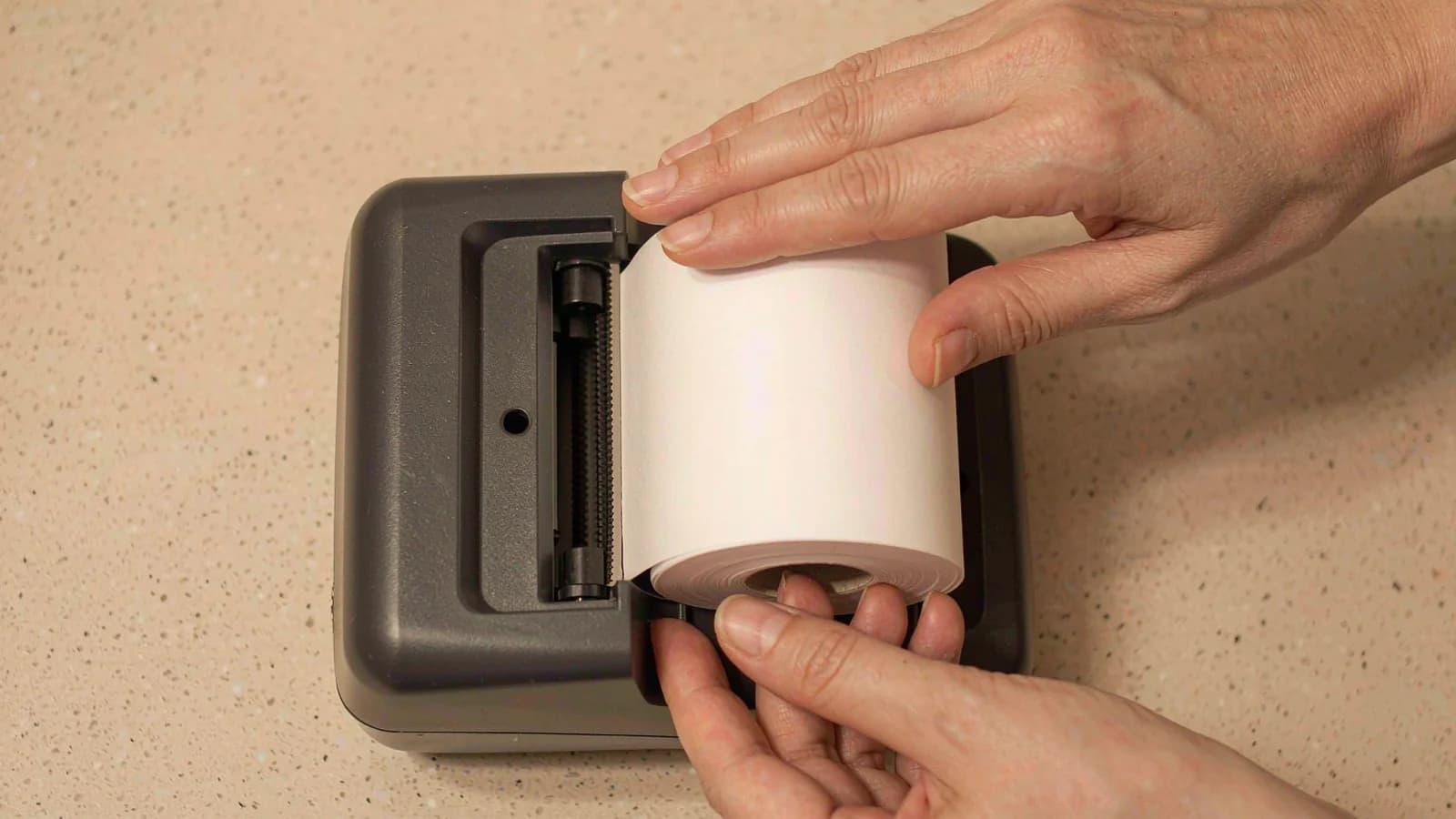
An EFTPOS paper roll is a narrow direct thermal roll that images inside a payment terminal: no ribbon, no ink, just a heated head printing onto a sensitised coating. The format envelope is tight by design — the roll must sit inside a compartment engineered to the millimetre, feed under consistent tension, and present a flat leading edge to the head every time the terminal wakes.
That tight envelope is why fit outranks price. A roll that is fractionally over-diameter fouls the compartment lid; a soft-wound roll telescopes and jams at the feed path; a roll with the wrong core inner diameter wobbles on the spindle and drags the feed. Retail staff experience all of these as 'the terminal is broken' — and none of them show up in the unit price.
The procurement discipline is therefore to specify against the terminal fleet, not against a generic receipt category. One list of terminal models, one format per model, one wound-length minimum per format — and the cheapest conforming supplier wins on merit rather than on shortcut.
The standard formats: 57x40, 57x50 and what diameter really decides
Two formats dominate payment terminals in Australia, New Zealand and similar markets. The 57x40 roll — 57mm wide, 40mm in diameter — fits the compact terminal bodies that populate counters and handheld fleets. The 57x50 roll adds 10mm of diameter and correspondingly more metres, suiting terminals with deeper compartments and sites that would rather change rolls less often. Both typically run a 12.7mm core; a growing subset of terminal models expects coreless finals, which remove the core entirely and gain a few extra metres per roll.
Width is the constant, but the honest comparator is wound length. A 57x40 roll can hold anywhere from roughly 12 to 18 metres depending on paper thickness and winding; a 57x50 correspondingly more. Nominal size tells the buyer whether the roll fits; wound length tells the buyer what the roll costs per transaction. Supplier quotations that quote metres alongside dimensions are the ones worth comparing line by line.
Buyers comparing these specifications can review our 75 gsm heavyweight thermal paper, where basis weight, coating construction and packing are documented per grade before an order is placed — heavier constructions trade metres for feel where a market demands it.
| Format | Typical wound length | Deciding details |
|---|---|---|
| 57 x 40 mm | Approx. 12–18 m | Compact terminal bodies; core 12.7mm or coreless per model |
| 57 x 50 mm | Approx. 18–25 m | Deeper compartments; fewer roll changes per site |
| Coreless variants | Slightly more than cored equivalents | Terminal must specify coreless feed; gains metres, removes core waste |
BPA-free expectations and the paperwork behind them
Bisphenol A has largely left the thermal receipt supply chain, and Australia and New Zealand sit squarely inside that expectation: major retail chains and pharmacy groups specify BPA-free rolls as a condition of supply, and councils and health services have followed. The chemistry that replaced it matters as much as the label — phenol-free constructions based on alternative developers carry a premium, while other BPA-free grades use different developers with their own cost and image-life profiles. A buyer does not need to be a chemist, but does need to know which class is being quoted.
The paperwork is part of the product. A conforming supply should carry a current safety data sheet naming the developer system, and on request a test or compliance statement for the shipped batch. Buying against documents rather than against a carton claim is what keeps the BPA-free promise auditable when a retail chain's own compliance team — or a regulator — asks.
Where developer compliance is part of the specification, our BPA-free vs phenol-free guide documents the chemistry, the regulations and the paperwork behind each class — the companion read to the procurement spec in this article.
Writing the retail procurement spec sheet
A useful EFTPOS roll spec sheet fits on one page and answers five questions. Format: width by diameter per terminal model, with core type stated. Length: minimum wound metres per format, so quotations compare like with like. Chemistry: BPA-free with named developer class and documentation requirements. Quality: image density and retention expectations, plus a retained reference sample as the physical standard. Packing: carton quantities per terminal site, roll orientation in the carton, and a carton weight staff can handle at replenishment pace.
Two operational details earn their line on the sheet. First, image retention: receipts that customers need for warranties or expense claims should stay legible long enough to matter, which is a coating-class question. Second, end-of-roll behaviour: a clean tear and a visible end-of-roll stripe save seconds at every terminal, thousands of times a year.
Where a programme needs several formats from one supplier, our custom thermal paper programme covers width, core, roll diameter and developer class in a single specification sheet — the mechanism that turns a per-terminal spec into one consolidated supply line.
Structuring the supply programme across sites
Multi-site roll programmes reward consolidation. One coating family across every terminal format, carton configurations matched to each site's storage, and a delivery rhythm tied to site-level consumption rather than ad-hoc top-ups: each of these removes a small recurring cost, and together they compound. Chains that consolidate typically see fewer stock-outs and a lower landed cost per roll in the same quarter, because both come from the same standardisation.
Replenishment forecasting is straightforward arithmetic once the fleet is standardised: rolls per terminal per week, sites per region, weeks of cover per delivery. The spec sheet makes the arithmetic possible — without fixed wound lengths, consumption per roll is a guess and the forecast inherits the guess.
The final habit is the periodic audit: pull rolls at random from a site's storeroom, check them against the retained reference sample, and confirm the documentation trail is current. Suppliers keep the discipline that buyers inspect.
Programme shorthand: 'Format per terminal model fixed, wound-length minimum set, BPA-free chemistry documented, reference sample retained, carton and delivery rhythm matched to site consumption, periodic audit against the standard.'
Frequently asked questions
What size paper roll does an EFTPOS terminal use?
Most payment terminals in Australia and New Zealand use 57mm-wide rolls, most commonly 57x40mm or 57x50mm in diameter, on a 12.7mm core — with some models expecting coreless rolls. The reliable method is to list the terminal models in the fleet and specify one format per model rather than buying a generic size.
What is the difference between 57x40 and 57x50 EFTPOS rolls?
Both are 57mm wide; the difference is diameter, which decides both fit and capacity. A 57x50 roll holds more metres than a 57x40 and suits terminals with deeper compartments. They are not interchangeable — a roll that is too large for the compartment will foul the lid or jam the feed.
Are EFTPOS rolls BPA-free?
The market expectation in Australia and New Zealand is yes, and most major retail and health-sector buyers specify BPA-free as a condition of supply. Buy against documentation — a current safety data sheet naming the developer system and, ideally, batch-level compliance statements — rather than against a claim printed on a carton.
Why do rolls of the same nominal size hold different amounts of paper?
Wound length depends on paper thickness, winding tension and core type, so two rolls with identical dimensions can differ by several metres. Quoting minimum wound metres per format is the honest basis for comparison and makes consumption forecasting possible.
How should a multi-site chain buy payment terminal rolls?
Consolidate: one coating family across all terminal formats, a one-page spec sheet per fleet, carton configurations matched to site storage and a delivery rhythm tied to site consumption. Then audit periodically against a retained reference sample to keep the specification honest.