
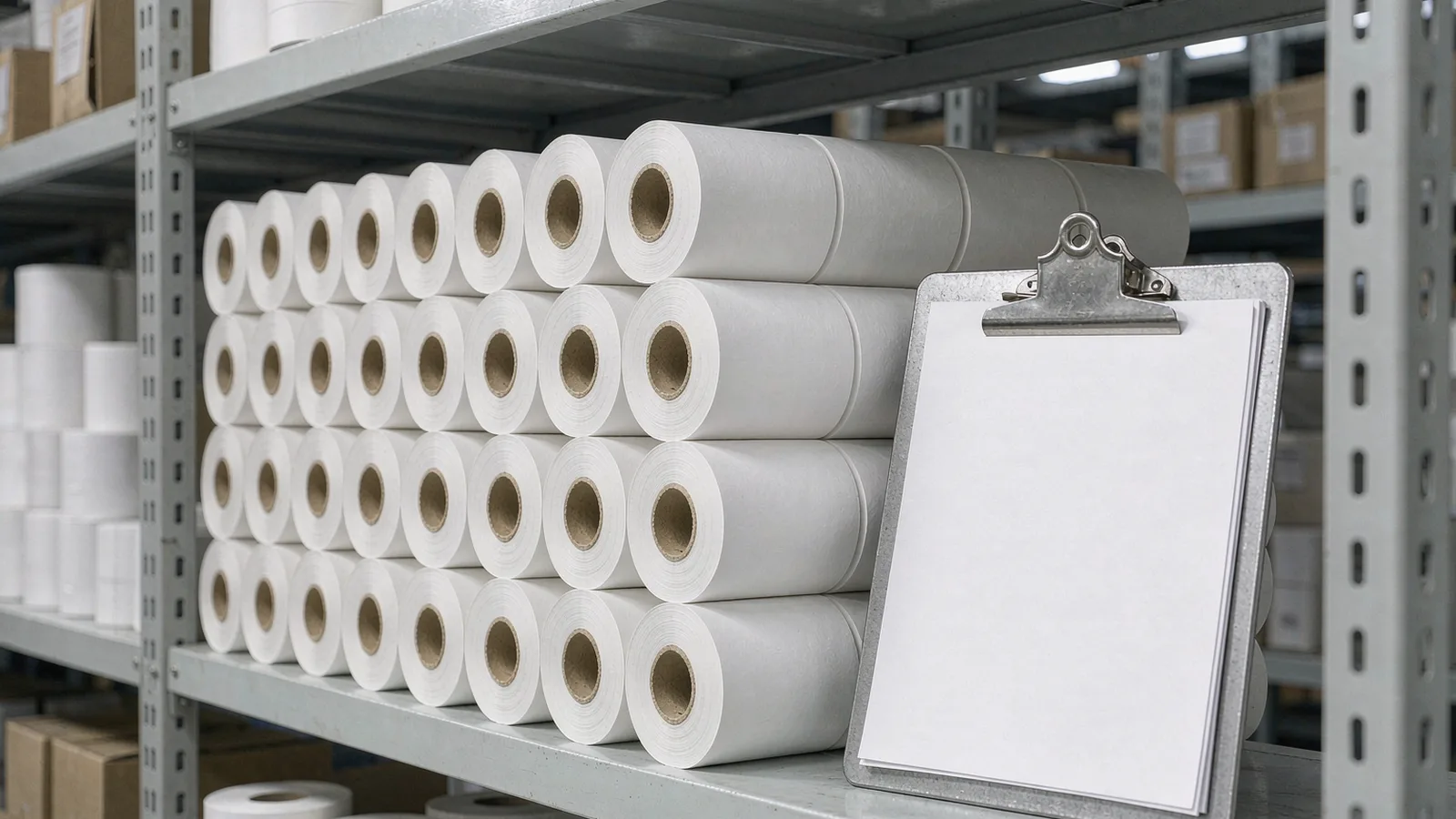
A BPA free POS paper roll is a receipt roll whose thermal coating uses a developer system that does not contain bisphenol A — and, on better specifications, no bisphenol S or any phenolic developer at all. The claim matters because receipt paper is a hand-held, skin-contact consumable regulated in the EU and watched closely by retail chains worldwide. For a buyer, though, the phrase on the carton is only the start: what makes a compliant programme is the declared developer class on the specification sheet, a COA per production batch, an SDS that names the chemistry and, where the channel demands it, migration test reports against the relevant limits. Price comparisons between compliant and non-compliant rolls are only meaningful once the developer class, the documentation set and the packing are quoted together.
Few consumables are handled by as many people as the POS receipt. Supermarket checkouts, pharmacies, quick-service restaurants and banking counters hand out slips to customers all day, and the paper they print on has become a compliance topic in its own right. The thermal coating that makes direct thermal printing work has historically relied on phenolic developers — bisphenol A among them — and regulators, retailers and consumers have steadily pushed the industry toward coatings that leave those chemistries out.
For a buyer sourcing receipt rolls at volume, the result is a specification question that sits upstream of price: what exactly does the supplier mean by BPA free, which chemistry replaces the bisphenol, and what documentation proves it? A roll can carry a BPA-free sticker and still use a developer the buyer's channel will not accept next year — which is why the declaration on the spec sheet matters more than the claim on the carton.
Requests that combine several formats can be quoted together; see POS and receipt paper rolls for the construction options behind each one, including the developer classes available per width and gsm.
This guide sets out what BPA free means in thermal coating chemistry, how the classes differ, which regulations and channel policies drive the requirement, and how a buyer verifies the claim with documents and testing before awarding a volume contract.
- 'BPA free' is a negative claim — the buying decision turns on what the developer actually is, so the spec sheet must name the chemistry class, not just deny BPA.
- BPA-free, BPS-free and phenol-free are three different declarations; retail and food-contact channels increasingly ask for the strongest of the three.
- EU REACH restrictions and major retailer sourcing policies are the drivers most cited in tenders; both expect documentation, not assurances.
- A COA per batch, an SDS naming the developer system, and migration test reports where required are the verification baseline.
- Compliant coatings carry a modest cost premium — comparing prices without holding developer class, gsm and packing constant produces false savings.
What “BPA free” means on a POS paper roll
Thermal paper images when heat triggers a reaction between two components in the coating: a leuco dye and a developer. The developer mobilises at print-head temperature to protonate the dye and produce the black image. Bisphenol A was for decades the most economical developer for receipt grades, which is why it became the industry default — and why its replacement is a supply-chain decision rather than a technical footnote.
A BPA free declaration says only that the developer is not BPA. It does not say what the developer is, and that gap is where procurement problems live. The industry's migration path has moved through substitute bisphenols — bisphenol S most prominently — toward non-phenolic developer systems that avoid the bisphenol family altogether. A buyer who accepts 'BPA free' as the end of the conversation may simply be buying the next chemistry on the regulator's watch list.
The practical rule for tenders and RFQs: require the developer class to be named on the specification sheet. 'BPA free, BPS-free, phenol-free developer system declared' is a complete sentence; 'BPA free' alone is not.
The chemistry classes behind the label
Three declarations circulate in the market, and they are not interchangeable. BPA free excludes bisphenol A only. BPS free excludes bisphenol S — often claimed alongside BPA free, since BPS was the first mass-market substitute. Phenol-free is the broadest class: the developer system contains no phenolic compounds at all, which future-proofs the roll against the regulatory pattern of one bisphenol being restricted after another.
The choice between classes is usually set by the buyer's channel. Food-adjacent retail, pharmacy and nursery-adjacent categories tend to require phenol-free outright; general retail and hospitality often accept BPA-free with a documented non-BPS developer. Multinational chains increasingly harmonise on the strictest class across markets to avoid running different papers in different countries.
Cost follows the chemistry. Non-phenolic developer systems are more expensive at the mill, and the premium flows through to the finished roll — typically a modest percentage, but large enough that a quote for a phenol-free grade should never be compared against a BPA-containing price without the difference being acknowledged. Buyers who hold the developer class constant across quotes find the comparison collapses to the usual variables: gsm, width, packing and freight.
Where developer compliance is part of the specification, our BPA-free vs phenol-free guide documents the chemistry, the regulations and the paperwork behind each class.
Verifying the claim: COA, SDS and migration testing
A compliance claim is only as good as its paperwork, and the paperwork for thermal paper is well standardised. The certificate of analysis should accompany each production batch and reference the grade's developer system. The safety data sheet must name the chemistry in the coating — an SDS with an opaque 'proprietary' entry for the developer layer is a legitimate reason to pause.
Where the channel requires it, migration testing adds the quantitative layer: accredited laboratory reports measuring how much of the developer transfers from paper to skin surrogate under defined conditions, assessed against the limits the buyer's market applies. Buyers in the EU commonly anchor on REACH entry restrictions and the FPF-derived limits referenced in tenders; retailers with private compliance standards publish their own thresholds.
The verification habit that separates professional buyers from hopeful ones is anchoring documents to batches. A COA from last year's trial does not describe this season's production. The purchase order should require the COA to travel with each lot, the SDS to be current, and any migration report to cite the production period it covers.

Cost, performance and the real trade-offs
Compliant coatings were once accused of printing lighter and fading sooner; on modern grades that gap has largely closed. What remains true is that developer class interacts with the rest of the construction — a phenol-free coating on a lightweight base paper behaves differently from the same chemistry on a heavier, top-coated stock, and the differences show up in image density and storage life rather than in the compliance column.
The honest trade-offs a buyer should test on their own printers are image density at the checkout's printer model, scan-ability of barcodes on the slip, and archival behaviour in the environments the receipt actually lives in — wallets, hot delivery vans, chiller counters.
Buyers comparing these specifications can review our 48 gsm lightweight thermal paper, where basis weight, coating construction and packing are documented per grade before an order is placed — the lightweight grades most POS fleets run are fully available in declared developer classes.
| Class | What it excludes | Typical channel requirement | Documentation baseline |
|---|---|---|---|
| BPA free | Bisphenol A only | General retail, hospitality | COA per batch + SDS naming developer |
| BPS free | Bisphenol S (usually with BPA free) | Chains harmonising across markets | COA + SDS + supplier declaration |
| Phenol-free | All phenolic developers | Food-adjacent retail, pharmacy | COA + SDS + migration reports where tendered |
Structuring a compliant POS consumable programme
A compliant programme locks four things in writing before volume: the developer class on the specification sheet, the documentation set that travels with each batch, the test sequence that approved the grade, and the packing standard that protects it. Our custom thermal paper programme publishes the test data behind each grade, so specifications can be verified against the mill's own measurements rather than a catalogue claim — and the same programme structure carries compliant chemistry across widths, gsm levels and finished formats.
With those anchors in place, replenishment becomes routine: the class is cited on every PO, COAs arrive with the lots, and an annual review of the SDS keeps the declaration current against regulatory movement. When a market tightens its rules, the buyer's response is a document update, not a scramble for new supply.
The final discipline is to keep compliance and print quality in one approval. A grade change that adjusts the developer system re-enters the print test — density, scan-ability, head behaviour — exactly as a gsm change would, so the compliant roll the buyer approves is also the roll that prints cleanly at the checkout.
Specification shorthand: 'POS receipt rolls, developer class declared (BPA-free / BPS-free / phenol-free), COA per batch, SDS naming the chemistry, migration reports where tendered, print test on buyer fleet before award.'
Frequently asked questions
Is BPA free the same as phenol-free?
No. BPA free excludes only bisphenol A, while phenol-free excludes the entire phenolic developer family — including BPA and BPS. Channels with strict compliance requirements typically demand the phenol-free declaration; the spec sheet should state which class the grade actually is.
Do BPA free POS rolls cost more?
Compliant developer systems carry a modest premium over legacy BPA chemistry, and phenol-free sits above BPA-free. The comparison that matters holds developer class, gsm and packing constant across quotes — otherwise the price difference is measuring the chemistry, not the supplier.
What documents should accompany each shipment?
A certificate of analysis for the production batch, a current SDS naming the developer system, and any migration test reports the channel requires. Citing the document set on the purchase order turns compliance from a promise into a deliverable.
Does the developer class affect print quality?
Modern compliant grades print at full density on standard POS printers, but the chemistry interacts with gsm and topcoat construction. The grade should be print-tested on the buyer's own fleet — density, barcode scan-ability and head behaviour — before a volume award, exactly as any other grade change would be.
Which regulations drive the BPA-free requirement?
EU REACH restrictions on BPA in thermal paper are the most cited driver, and major retail chains layer their own sourcing standards on top, frequently requiring phenol-free across all markets. Buyers should match the declaration class to the strictest market their rolls will ship into.