
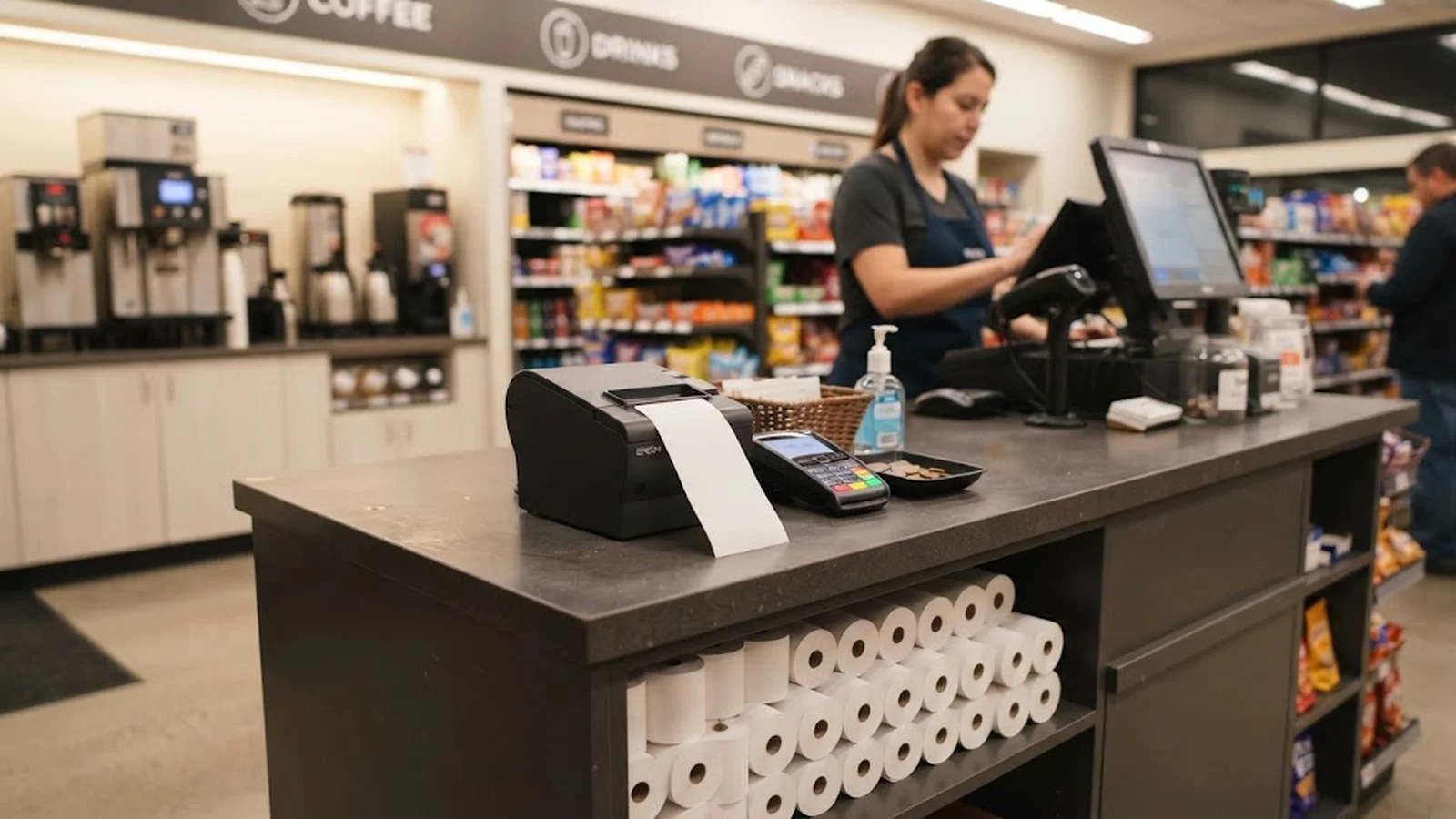
Convenience store thermal paper is the roll programme behind a small-format, high-transaction counter: till receipts in 80 mm and 76 mm widths, narrow payment terminal rolls around 57 mm, hot-food and kitchen printer stock, and the ticket rolls that keep self-service terminals running. What makes the c-store specification different from a supermarket's is environment and tempo — compact counters place printers beside heated food cases and windows, so heat and daylight fade uncoated receipts faster; transaction counts are high relative to store size, so cost per receipt and roll-change frequency both matter; and the store footprint favours a small, standardised SKU set bought on a replenishment rhythm rather than ad-hoc cartons. Chains that win on paper specify per station, standardise chemistry declarations fleet-wide, and buy on a documented programme instead of one-off cases.
A convenience store is small, but its paper workload is not. Between the till, the payment terminal, the hot-food counter, the self-service kiosks and the lottery terminal, a single c-store can run four or five distinct thermal printers — each with its own width, core and duty cycle, each demanding a fresh roll at its own rhythm. Multiply that across a chain of a few hundred compact stores, and paper becomes a logistics line item that deserves the same specification discipline as any other replenished category.
The environment stresses the media in ways bigger stores do not. C-store counters are tight, so printers sit close to heated display cases, coffee machines and sunlit windows; receipts that would survive a month in a wallet can fade in days on a dashboard or a warm countertop. High transaction counts mean roll changes several times a day on the busiest stations, and every roll change is a small service interruption at the point of sale.
Buyers mapping these stations to formats can review our POS and receipt paper rolls, where width, core, roll diameter and developer class are documented per grade before an order is placed.
This guide maps the paper streams in a c-store, explains how heat and tempo shape the specification, sets out the width and grade matrix most chains land on, and covers the preprint, buying-structure and replenishment decisions that turn scattered carton purchases into a managed programme.
- A c-store runs several paper streams — till, payment terminal, kitchen, kiosk and lottery — each with its own width and duty cycle; one SKU per store is a false economy.
- Heat and daylight are the c-store's fade accelerants: printer placement near hot cases and windows pushes the specification toward documented image life.
- 80 mm till rolls and 57 mm terminal rolls are the backbone widths; core size and roll diameter decide both machine fit and roll-change frequency.
- Guest-handled slips carry the chemistry conversation — declared BPA-free or phenol-free constructions, uniform across the fleet, are the audit-ready default.
- Chains save through programme buying: standardised SKUs, case configurations sized to store volume, and replenishment rhythms tied to transaction counts.
The paper streams behind a c-store counter
The till receipt is the anchor stream. C-store point-of-sale units overwhelmingly run 80 mm rolls, with 76 and 76.2 mm legacy widths persisting in some markets and fleets; duty cycles are high, so roll length — metres per roll at a given diameter — decides how often cashiers change stock during a shift. Where the store runs a back-office or journal printer, that stream inherits the till width and can run a lighter grade.
Payment terminals take the second stream: narrow rolls in the 57 mm and 2 1/4 inch families, short cores and compact diameters that fit the terminal's bay. The third and fourth streams vary by banner — kitchen and hot-food printers behind the counter, typically 80 mm, running in the heat zone of the foodservice equipment; and self-service terminals, lottery and pay-at-pump units that consume narrow rolls with the same tempo as the till but on service routes rather than cashier replenishment.
The programme view matters because the streams are bought differently: till and terminal rolls are store-level replenishment, kitchen stock is often a facilities or foodservice line, and self-service media follows the terminal fleet's maintenance contract. Chains that consolidate all of them under one paper specification get fleet-wide chemistry consistency for free — and one document to audit.
Heat, daylight and the fade problem
Direct thermal images are developed by heat, so they remain vulnerable to it: a receipt left on a counter above a heated case, tucked under a car's sun visor, or stored in a back office without climate control will lose density far faster than the same slip kept cool and dark. C-stores concentrate all three exposures — compact counters put printers beside hot food equipment, storefront glazing floods the till area with afternoon sun, and the customer's car is the receipt's first destination.
Construction choices push back. Higher-sensitivity coatings develop full density at lower head energy and generally retain it better; protective topcoats shield the image from humidity and slow environmental attack; and heavier grades resist the curl that heat accelerates. None of this turns a receipt into an archival document, but it decides whether the slip is scannable and readable when a customer returns for a refund or the store reconciles a disputed transaction days later.
The practical test is placement-specific: print identical samples, then file one set in the coolest spot available and one beside the actual printer in the actual store, and compare density after a week. The grade that wins that test is the grade to specify — construction differences that look marginal on a datasheet decide whether the slip survives its first week in the real counter environment.
Widths, cores and the two-roll reality
Most c-stores run a two-width reality: 80 mm at the till, 57 mm at the terminal, with kitchen printers sharing the till width and special terminals taking their own formats. Within each width, the specification that matters daily is roll geometry — outer diameter and core size decide metres per roll, and metres per roll decide roll-change frequency at the counter. A till roll with more metres per shift is not a procurement nicety; it is fewer interruptions in front of a queue.
Grade selection follows the stream. Till receipts in high-turnover stores are the volume line, where cost per receipt is negotiated against documented print density; guest-handled terminal slips and any slip the customer keeps justify the better construction; kitchen stock trades image life for speed since the ticket is read once and discarded. Running a lighter 48 gsm stock on the right streams trims cost without touching the customer experience — for the volume lines, our 48 gsm lightweight thermal paper programme publishes the test data behind each grade, so the trade-off is verified rather than assumed.
Where a programme needs several formats from one supplier, our custom thermal paper programme covers width, core, roll diameter and developer class in a single specification sheet — the format most chains adopt once the station-by-station matrix below is agreed.
| Station | Typical width | Grade line | Key requirement |
|---|---|---|---|
| Till receipts | 80 mm (76 mm legacy) | 55-65 gsm, BPA-free | Metres per roll; density for scans |
| Payment terminals | 57 mm / 2 1/4 in | 55-58 gsm, BPA-free | Compact diameter; guest-handled image life |
| Kitchen / hot food | 80 mm | 48-55 gsm economy | Speed and cost; single-read tickets |
| Self-service / lottery | Per terminal fleet | 55 gsm, mark variants | Fleet fit; service-route replenishment |
Preprint, loyalty and the receipt as media
The c-store receipt works hard for its size. Banners preprint the header and footer with branding, store details and return terms; promotional programmes print coupon codes, loyalty barcodes and cross-promotion messages into the slip; and reverse-side printing turns the back of the receipt into advertising space that costs a fraction of any other local media. Because the preprint runs on the same rolls the store already buys, the incremental cost sits in artwork setup and minimum run length — manageable for a chain amortising one design across hundreds of stores.
Loyalty integration has made the receipt operational, not just informative: member identifiers and point balances print as barcodes the till rescans on the next visit, which raises the bar on print quality and image life for exactly the slips customers are expected to keep. A faded loyalty barcode is a lost point of sale on the retention programme, so the keep-and-rescan streams justify the better construction even in an otherwise economy-led mix. Preprint artwork is approved as a proof against the same specification sheet that governs the paper, so a design refresh never arrives as an untested change in a carton.
Buying structure and replenishment across a fleet
C-store paper buying fails in a predictable way: each store orders cartons when the cupboard looks empty, prices drift, and widths multiply until no two regions stock the same SKU. The managed alternative is a programme — a fixed SKU set per station type, case configurations sized to each store's transaction volume, and a replenishment rhythm calculated from rolls per station per week rather than from cupboard inspections. Distribution then runs like any other replenished category, with the paper arriving on the schedule the stores already trust.
The chemistry declaration belongs in the programme, not per order: the EU restricts BPA in thermal paper, other markets have followed, and every slip a c-store hands to a customer is guest-handled by definition. Where developer compliance is part of the specification, our BPA-free vs phenol-free guide documents the chemistry, the regulations and the paperwork behind each class — the reference most chain compliance teams attach to the supply agreement.
Storage closes the loop. Rolls live in back rooms that are warm, cramped and occasionally damp; cartons should be stored off the floor, sealed until use, and rotated so open stock is used before replenishment arrives. Paper that degrades in storage is indistinguishable from paper that was mis-specified — and both are paid for twice, once in the purchase and once at the printer. Where container planning is part of an imported supply route, our export shipping guide covers pallet standards, moisture-barrier packing and the document set for ocean freight.
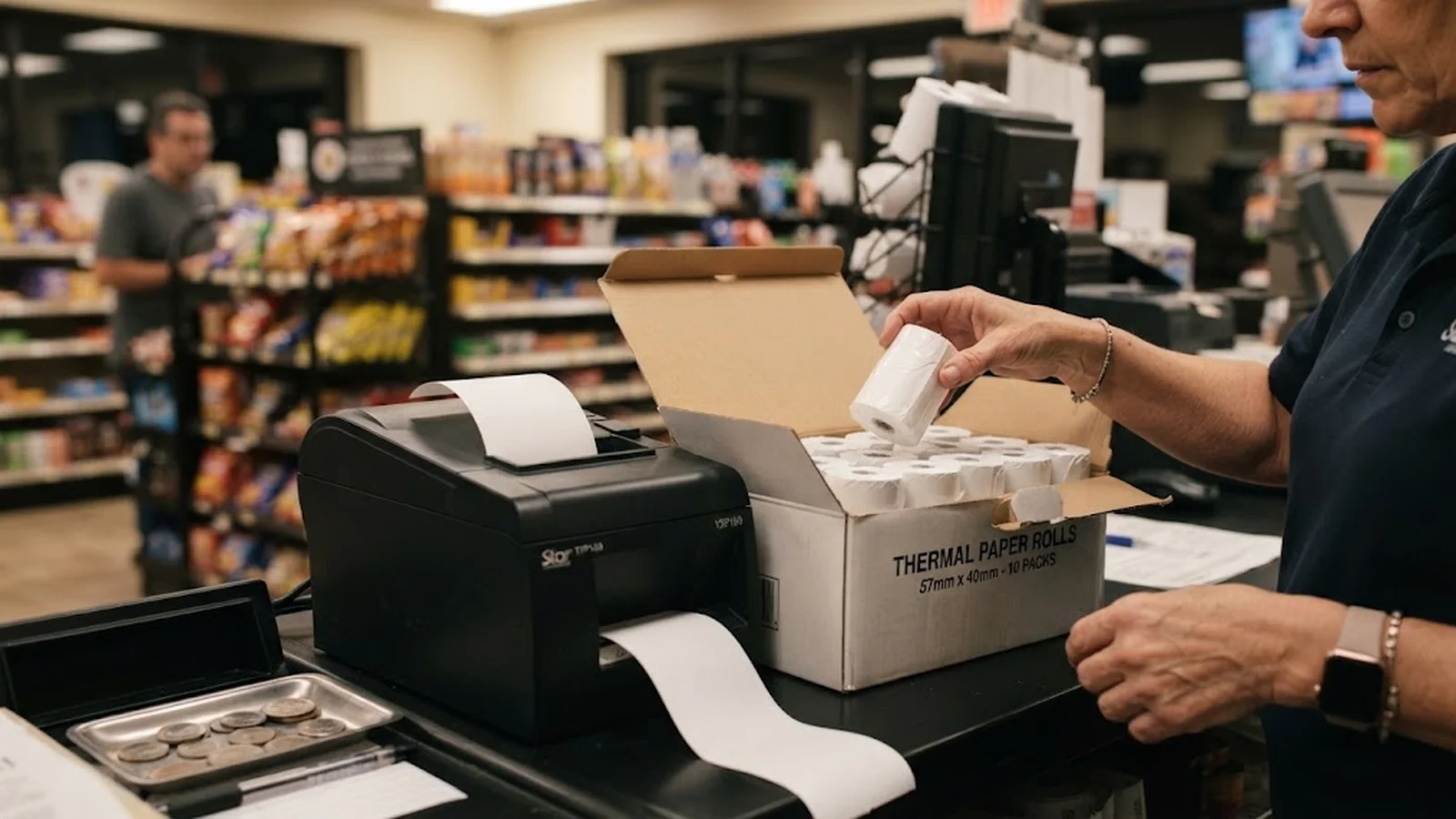
Programme shorthand: '80 mm till and kitchen, 57 mm terminal, self-service per fleet list; BPA-free declared fleet-wide; case configs per store volume; replenishment on rolls-per-station-per-week; storage rotated and sealed.'
Frequently asked questions
What size paper does a convenience store till use?
Most modern c-store point-of-sale units run 80 mm rolls; some markets and legacy fleets still use 76 or 76.2 mm. Payment terminals take the narrow 57 mm or 2 1/4 inch family. Confirming both the width and the roll diameter against each printer model prevents the mis-sized cartons that stall replenishment.
Why do c-store receipts fade faster than expected?
Heat and daylight. Compact counters place printers beside heated food cases and sunlit windows, and the receipt's next stop is often a warm car — all accelerants for thermal image fade. A construction with documented image life, and placement choices that keep stock out of heat, extend the readable window materially.
Do convenience stores need BPA-free receipt paper?
In markets that restrict BPA in thermal paper, including the EU, yes — and most chains now standardise BPA-free or phenol-free constructions fleet-wide because every c-store slip is guest-handled. The declaration should appear on the datasheet and repeat on batch documentation so compliance is auditable.
Can receipts be preprinted with the store's branding?
Yes. Header and footer branding, return terms, coupon codes and reverse-side advertising are standard converting services, quoted per artwork with a minimum run length. For chains, amortising one design family across all stores keeps the preprint premium small against the media value it adds.
How should a chain calculate its paper replenishment?
From transaction counts, not cupboard inspections: rolls per station per week by stream, converted into case configurations per store format, delivered on a fixed rhythm. Stores with longer trading hours or foodservice volumes get a different case mix — the point is a calculated schedule that survives store-manager turnover.