
Unopened thermal paper rolls last two to three years in cool, dark storage before print quality starts to decline, and printed documents last from a few weeks to ten years or more depending on conditions and grade. A standard uncoated receipt grade keeps a printed image legible for roughly 3–5 years stored cool, dark and dry; a top-coated grade extends that to 7–10 years or more. Under heat, sunlight or contact with PVC and solvent adhesives, the same receipt can fade in weeks. Longevity is therefore not a fixed date but a function of grade plus environment: keep it cool, dark, dry and away from plastics, and thermal paper outlives most record-keeping needs.
'How long does thermal paper last?' is probably the single most common question end customers ask distributors of receipt rolls — and the honest answer has two clocks running at once. The first clock is the unprinted roll: how long it sits in your storeroom before it stops printing crisply. The second clock is the printed document: how long the receipt, ticket or label stays readable after it leaves the printer.
The confusion is understandable because thermal paper carries no ink to dry out or flake off. Its image is a chemical state inside the coating, formed by the print head and stable only as long as the environment leaves it alone. That makes longevity a matter of conditions rather than a fixed expiry — the same receipt can die on a sunlit dashboard in a fortnight or remain perfectly legible in an archive a decade later.
This guide gives the numbers for both clocks: realistic lifespan figures by scenario, the factors that move each timeline, how to read the shelf-life markings on cartons, and the specification language buyers should use when a customer's documents must outlast the default. For the underlying mechanisms, see our companion guides on why thermal paper fades and image retention; this page focuses on the practical question of time.
Buyers comparing these specifications can review our custom thermal paper programme, where basis weight, coating construction and packing are documented per grade before an order is placed.
- Unopened rolls: 2–3 years of best print quality in cool, dark storage; usable beyond that but with rising background grey and lower density.
- Printed receipts, standard grade: about 3–5 years legible in cool, dark, dry storage.
- Printed receipts, top-coated grade: 7–10 years or more, with laboratory ageing data to back the claim.
- Hostile conditions compress everything: car dashboards and sunlight fade receipts in weeks; PVC wallets and solvent adhesives can blank them in months.
- There is no universal expiry date — treat carton markings as production dates and manage rotation, not expiration.
The two clocks: unprinted rolls vs printed documents
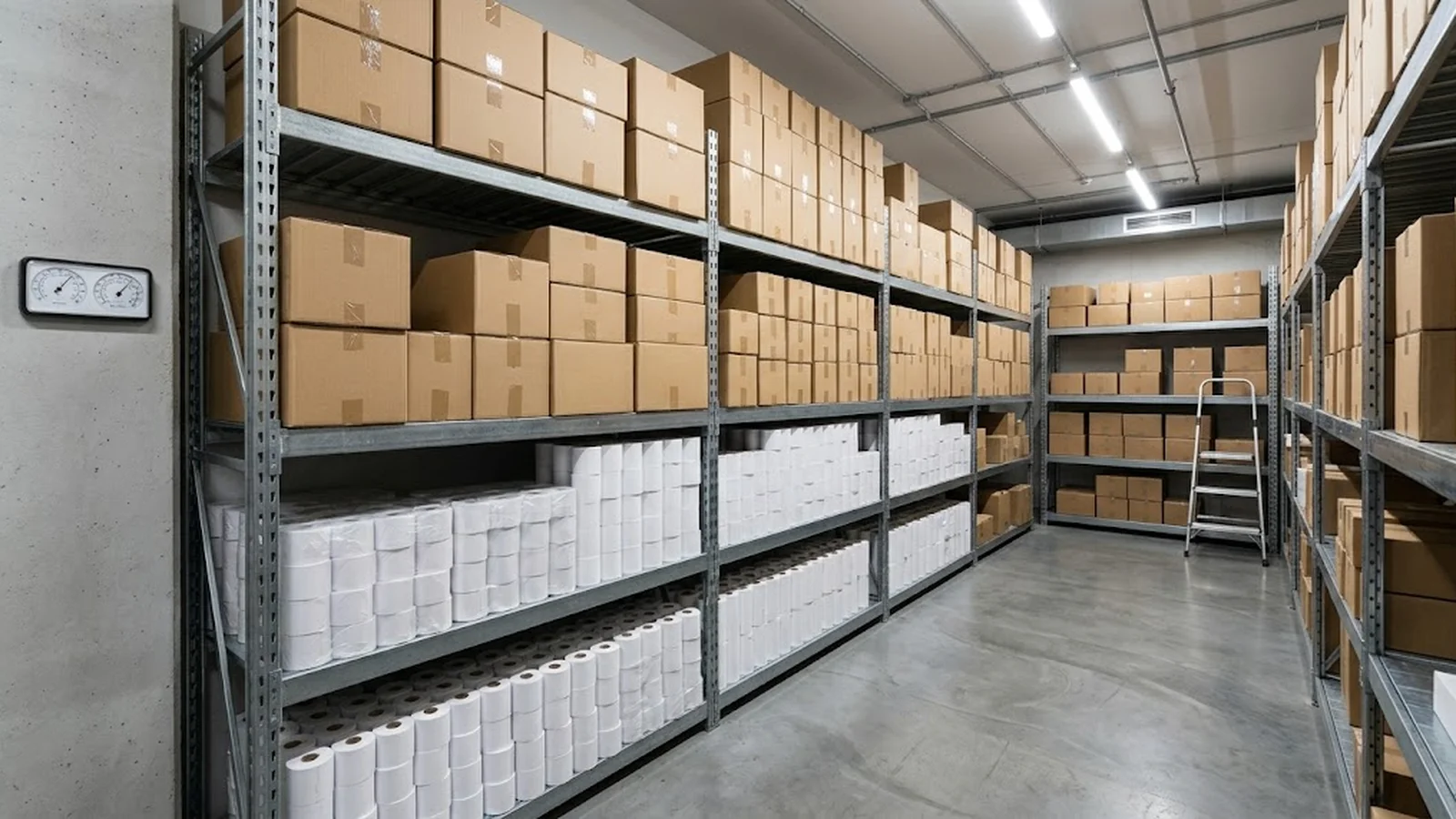
Unprinted thermal paper has a finite life because its chemistry is active even before printing. The leuco dye and developer sit together in the coating from the day it is made, and given time, warmth or humidity they react slowly on their own — showing up as a grey background, reduced contrast and weaker print density. Stored at or below 30 °C and about 65 percent relative humidity in original sealed packaging, a quality roll keeps its best printing performance for two to three years. Rolls stored in hot or damp conditions age much faster: a season in a 40 °C storeroom can consume a large fraction of that budget before the roll is ever loaded.
Once printed, the second clock starts, and it depends first on the grade. Standard uncoated receipt grades are engineered — and tested — for roughly 3–5 years of legibility in cool, dark storage. Top-coated grades add a protective barrier layer against water, oil, plasticiser migration and abrasion, and their documented image retention runs 7–10 years and beyond under accelerated ageing protocols. Between those benchmarks sit specialty grades for tickets and banking documents with intermediate or extended ratings.
The practical takeaway for buyers is that 'how long it lasts' is always a pair of answers: grade times environment. A cheap uncoated roll kept hot in a drawer behind the kitchen pass may fail inside a year; a top-coated grade archived in a cool office can outlast the business that printed it. Neither number is a promise — both are engineering targets with published test methods behind them, which is exactly what a serious supplier should be able to show.
| Scenario | Roll life (unopened) | Printed image life | Notes |
|---|---|---|---|
| Cool, dark, dry storage (≤30 °C, ≤65% RH) | 2–3 years at best quality | 3–5 years (standard grade); 7–10+ years (top-coated) | The reference condition for all ratings |
| Normal office / drawer storage | 2–3 years | 2–5 years | Indoor light acts slowly; avoid filing near heaters |
| Hot storeroom or vehicle (35–45 °C) | 6–12 months | Weeks to months | Background grey rises; image fades fast |
| Sunlight / dashboard exposure | n/a | Days to weeks | UV bleaches the developed dye quickly |
| PVC wallet or solvent adhesive contact | n/a | Weeks to months | Plasticisers chemically attack the image |
| High humidity (>80% RH) or damp storage | 12–18 months | 6–18 months | Coating mobilises; sheet weakens, edges curl |
| Frozen / cold-chain handling | Extended if sealed | Condensation risk when warmed | Let rolls reach room temperature sealed before use |
What shortens life: the factors behind the timelines
Heat is the dominant factor on both clocks, and it works continuously rather than in dramatic moments. Chemical reactions roughly double in rate for every 10 °C increase, so a roll stored at 40 °C ages several times faster than one at 25 °C — the same principle warehouses use for food shelf life applies unchanged to thermal coating. This is why unopened rolls near boilers, in delivery vans or in top-floor stockrooms in summer quietly lose quality long before anyone opens a carton.
Light, moisture and chemistry act mainly on the printed image. Ultraviolet light bleaches the developed dye directly, which is why documents displayed in windows or left on counters are the first to fade. High humidity mobilises the coating slightly, allowing unwanted reactions at room temperature, and softens the base sheet. Chemical attackers are the sneakiest: plasticisers migrating from PVC sleeves, solvent-based adhesives, rubber bands, carbonless paper stored in contact, and aggressive sanitisers can all blank or ghost an image in weeks — often in neat shapes that reveal exactly what touched the paper.
Abrasion is the final factor and the only purely physical one. The image layer is a few micrometres thick; receipts carried loose in pockets, labels rubbed by conveyor belts and rolls mis-fed through worn printers lose fine print through friction alone. Grade choice again matters here: top-coated layers are measurably harder to scuff, which is part of why they carry the longer retention ratings.
Where a programme needs several formats from one supplier, our POS and receipt paper rolls covers width, core, roll diameter and developer class in a single specification sheet.
- Heat accelerates both clocks — storage temperature is the single biggest lever you control.
- UV light and humidity mainly shorten the printed document's life.
- PVC plastics and solvent adhesives chemically attack images — the classic hidden killers in wallets and files.
- Abrasion removes fine print physically; top-coated grades resist it best.

Reading dates, rotating stock and specifying for longevity
Cartons of thermal paper usually carry a production date or lot code rather than an expiry date, and the distinction matters. There is no universal day on which thermal paper stops working; the marking exists so warehouses can rotate stock first-in, first-out and so buyers can verify they were not shipped aged inventory. When auditing a delivery, check that production dates are recent — ideally within the last six months for fast-moving receipt sizes — and push back on offers of heavily discounted old stock, which is the most common way short-lived paper enters a supply chain.
Stock rotation and storage discipline convert paper lifespan from luck into process. Keep rolls sealed until loading, store cartons off the floor and away from exterior walls, radiators and windows, and open only what the week will consume. For printed documents that matter, the sequence is simple: paper folder or polypropylene sleeve rather than PVC, out of sunlight, out of hot vehicles, and a scan for anything that must survive indefinitely — digitisation is the only truly permanent archive.
When a customer's requirement exceeds the defaults — warranty records, medical documentation, transport tickets, legal receipts — put longevity in the specification rather than hoping: required retention years, assumed storage temperature and humidity, and the grade chosen to meet them. A manufacturer with its own coating line and test laboratory can supply accelerated-ageing and image-retention data per batch, which turns 'it should last about seven years' into a documented, warrantable figure. That is the difference between selling paper and selling a record-keeping solution.
Where image life is the deciding factor, our top-coated vs non top-coated guide compares the two constructions on retention, cost and machine behaviour.
Rule of thumb: 2–3 years sealed, 3–5 years printed for standard grade, 7–10+ for top-coated — and every degree of heat or hour of sunlight spends that budget faster.
Frequently asked questions
How long does thermal paper last on average?
Unopened rolls keep best quality for about 2–3 years in cool, dark storage. Printed documents on a standard grade stay legible roughly 3–5 years under the same conditions; top-coated grades extend that to 7–10 years or more. Heat, sunlight, humidity and PVC contact shorten all of these figures substantially.
Do thermal receipts expire?
Not on a fixed date. Cartons carry production or lot codes for stock rotation, not expiry dates. The image degrades according to grade and storage conditions — the same receipt can fade in weeks on a dashboard or last a decade in an archive.
How long does a receipt last in a wallet?
It depends on the wallet. Leather and paper wallets are relatively kind; PVC wallets and sleeves can blank a receipt within weeks to months because plasticisers migrate into the coating and attack the image. For receipts that matter, move them to a paper folder or polypropylene sleeve.
Can I still use thermal rolls that are past two years old?
Often yes — test one roll first. Aged paper prints with lower density and a greyer background rather than failing outright. If print quality on the test roll is acceptable for your use, the rest are usable; expect shorter printed-image life from older stock, and do not use aged rolls for documents that must be retained.
What should I specify to get long-lasting thermal paper?
State the required retention years, the storage conditions the documents will see, and ask for a top-coated grade with documented image-retention and background-ageing test data. A capable manufacturer supplies batch-level results rather than marketing claims, so the longevity figure becomes part of the purchase contract.