

A thermal jumbo roll manufacturer controls the variables no converter can repair downstream: base paper integration, coating weight uniformity across the web, developer chemistry class, and the winding quality that decides how the parent roll slits weeks later. Qualifying a mill therefore means verifying four things before volume is committed — an honest capability matrix (coating widths, grade classes, developer systems the mill actually runs), measured batch QC with traceable records rather than catalogue claims, a documentation set (COA, SDS, compliance papers) that survives retail-channel audits, and capacity plus continuity evidence that the mill can hold supply through peak quarters. A mill that shows measured data on those four points will outperform a cheaper trading quote every time the buyer's own converting line and end customers apply pressure.
Every finished thermal roll inherits its character from the parent jumbo it was slit from. Coating weight uniformity sets how evenly the image develops across the roll's full width; developer chemistry sets the compliance class the finished goods can claim; winding hardness and core bond decide how the jumbo behaves on the buyer's slitter months after it left the mill. When a finished-roll programme misbehaves, the root cause is very often upstream of the converter — which is why sourcing teams increasingly qualify the mill, not just the shipment.
The difficulty is that a jumbo roll quote looks thin: width, gsm, length, price. The substance sits behind the quote in capability, measurement and documentation, and that substance differs enormously between an integrated coating mill and a trader rebagging stock. Two quotes on the same grade can behave completely differently at the slitter and in the buyer's own customer audits, and the difference never appears on the price line. For production volumes, the same construction logic applies to our thermal paper jumbo rolls, quoted per jumbo roll, slit reel or finished format.
This guide walks the qualification in the order risk actually appears: what the mill controls that nobody downstream can fix, the capability matrix to verify, the QC and documentation discipline to demand, and the capacity and audit questions that close the evaluation. Worked in that order, the evaluation fits inside a single sourcing cycle — one specification letter, one batch-record request and one mill visit.
- Coating uniformity, developer chemistry and winding quality are set at the mill — no converting step downstream can repair them.
- Verify a capability matrix of coating widths, grade classes and developer systems the mill actually runs, not a brochure range.
- Demand measured batch QC with traceable records; a tolerance nobody measures is a tolerance nobody holds.
- The documentation set (COA, SDS, compliance papers) must survive the buyer's own retail-channel audits, not just the shipment.
- Capacity and continuity evidence — machine count, dual sourcing of base paper, peak-quarter history — decides whether supply holds when the season presses.
What a jumbo roll manufacturer actually controls
Base paper integration is the first differentiator. Mills that control their own base stock can hold the porosity, stiffness and moisture profile the thermal coating expects; mills buying base paper on the open market inherit whatever the market gives them that month, and the buyer sees the variation six months later as image density drift between batches. Ask directly how base paper is sourced and how incoming lots are qualified — the answer separates integrated mills from coaters renting capacity.
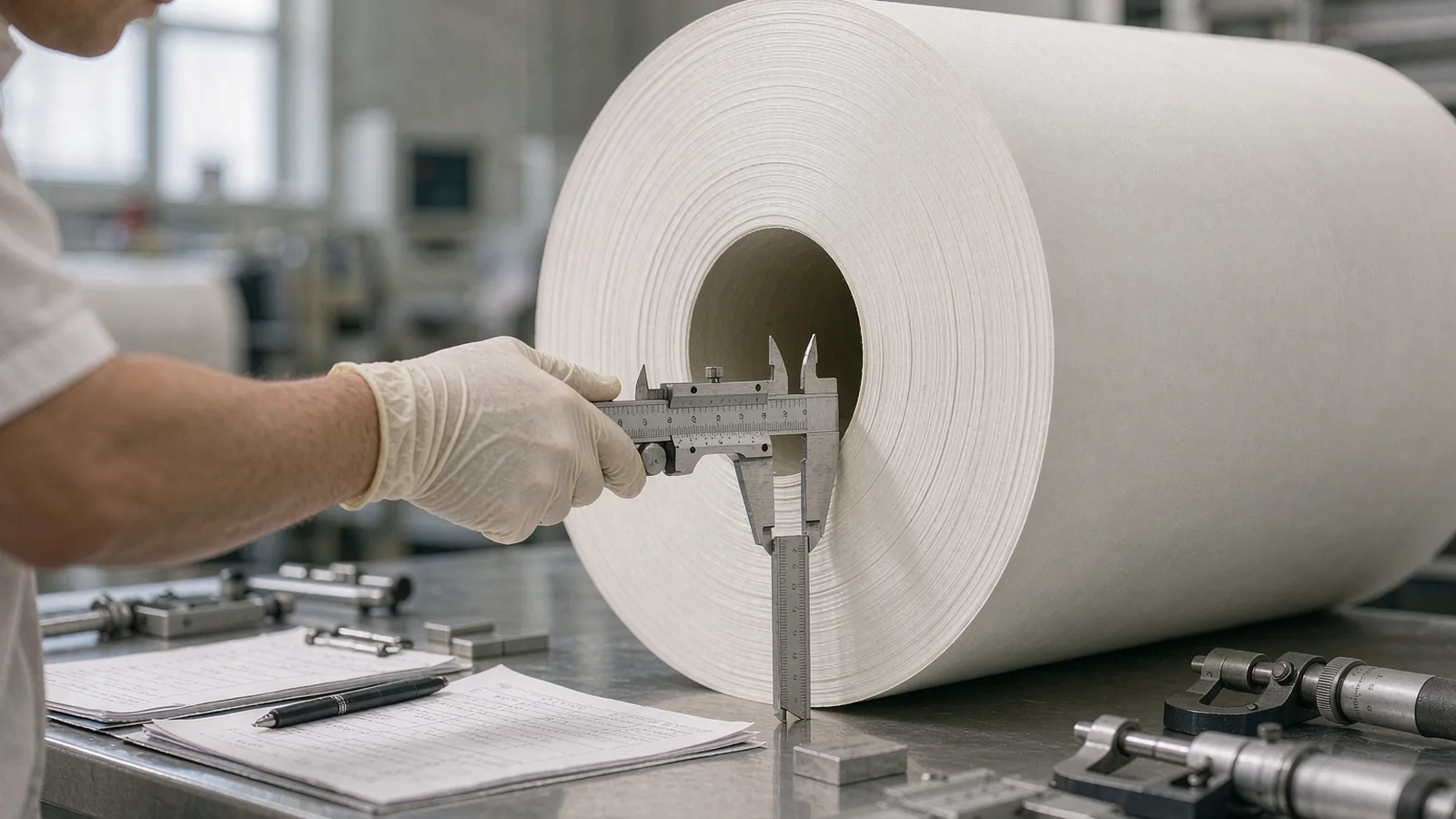
Coating process control comes next. The thermal layer is a suspension of developer and sensitizer chemistry applied at a wet coat weight and dried to a finished grammage; uniformity across the web width decides whether a slit roll images identically at both edges. A manufacturer running on-line coat-weight measurement and closed-loop control can show cross-web profiles per batch. A mill that cannot show them is asking the buyer to discover non-uniformity at the slitter.
Winding and finishing finish the list. Jumbo hardness, core bond and wrap quality determine how the parent roll runs on the buyer's slitter: a soft-wound or starred jumbo telescopes, vibrates and sheds, and the resulting width variation and dust become the converter's problem. None of these defects can be corrected after the fact, which is precisely why they belong in the qualification before the first order rather than in the claims conversation after it.
The capability matrix: widths, grades and developer classes
Start with coating width. Jumbos are specified against the slit plan the buyer's converting line needs, and a mill whose maximum coating width forces extra trim or limits slit-count flexibility quietly raises the buyer's cost per finished roll. Ask for the machine list: coater widths, winder configurations and the width range each line genuinely runs, so the buyer's slit plan can be checked against reality instead of against a brochure.
Grade classes follow. A serious mill runs a defined grade ladder — lightweight receipt classes, standard POS grades, heavyweight ticket and label stocks — with documented basis weights and sensitivity ratings per class. Where a programme needs several formats from one supplier, our 75 gsm heavyweight thermal paper covers width, core, roll diameter and developer class in a single specification sheet, and the mill's ability to hold adjacent grades to the same discipline is exactly what the capability review tests.
Developer chemistry class is the third axis and the compliance-critical one. Mills run different developer systems across their range — conventional, phenol-free alternatives — and the class a buyer can claim on finished goods is fixed at the mill. Confirm which classes are standard on which lines, what changeover between classes involves, and how the mill prevents cross-contamination between developer systems in a shared coating kitchen. The answers decide whether a compliance upgrade is a purchase order or a requalification project.
- Capability matrix lines to collect per candidate mill: coater widths and winder configurations, grade classes with documented basis weights, developer systems per line, and changeover rules between classes.
- Cross-check each matrix line against the buyer's own slit plan and compliance claims before quoting — a capability the mill runs but never measures is not a capability.
Batch QC, documentation and traceability
Measured QC is what turns claims into evidence. The minimum set: coat weight and image density per batch, moisture and stiffness records, winding hardness checks, and dimension verification of each jumbo against its specification. What matters is not that the tests exist but that they are recorded per batch and traceable to the roll shipped — ask to see a batch record for a recent lot, not the QC procedure document.
Documentation travels with the goods. A certificate of analysis referencing the shipped batch, safety data sheets declaring the developer system, and the compliance paperwork the buyer's own customers will demand all belong in the standard shipment set. Mills serving export programmes know the retail-channel audit trail; a mill that treats documentation as a special request is signalling how it will behave when the buyer's customer asks. Agree the document set once, in writing, as part of the specification rather than per shipment.
Traceability closes the loop. Batch numbers on jumbos, records linking parent rolls to base paper lots, and a retention-sample policy give the buyer a defensible response when a downstream quality question surfaces months later. Where a programme combines several grades or developer classes, our custom thermal paper programme publishes the test data behind each grade, so specifications can be verified against the mill's own measurements rather than a catalogue claim.
Capacity, continuity and the audit visit
Capacity questions are continuity questions. Machine count and utilisation, coater speed, and the share of output already committed to contract buyers determine whether a mill can hold delivery through a peak quarter — and whether the buyer's order is strategic volume or filler between larger programmes. A useful exercise: ask the mill to describe its worst quarter and how allocation was decided. The answer reveals the behaviour the buyer will experience.
Continuity has a second layer: inputs. Base paper sourcing, coating chemistry supply and spare-parts depth each carry interruption risk, and a qualification that stops at finished-goods QC misses them. Dual sourcing of base paper, buffer stock policy and a stated recovery plan for the coating line are the difference between a one-week delay and a missed season.
The audit visit settles what documents cannot. Walk the coating line and the winder, sample the QC lab's measurement discipline, and check whether the warehouse holds finished jumbos in the storage conditions the mill recommends to its customers. Talk to the line supervisors about how specification changes are communicated — a mill where changes travel by conversation rather than by document will eventually ship the conversation's errors. Where developer compliance is part of the specification, our BPA-free vs phenol-free guide documents the chemistry, the regulations and the paperwork behind each class — and the audit is where the buyer confirms the mill can actually deliver the class it quoted.
Frequently asked questions
What should a first mill audit of a jumbo roll manufacturer cover?
Coating line capability (widths, grades, developer classes actually run), the QC lab's measurement discipline with real batch records, input sourcing for base paper and chemistry, and finished-goods storage conditions. Documents frame these questions; the walk-through answers them.
How is jumbo roll quality verified before shipment?
Batch-level records: coat weight and image density, moisture and stiffness, winding hardness and dimension checks against the jumbo specification, each traceable to the shipped roll. Ask for a sample batch record from a recent lot rather than the QC procedure.
Why does coating width matter when buying jumbos?
The mill's coating width range constrains the buyer's slit plan. Limited width forces extra trim, restricts slit-count flexibility and raises cost per finished roll. Verify machine widths against the converting plan before quoting volumes.
Can a converter fix a poorly wound jumbo?
No. Soft winding, starring and weak core bond cause telescoping, vibration and dust at the slitter, and the resulting width variation cannot be recovered downstream. Winding quality is a mill-controlled variable and belongs in the qualification.