
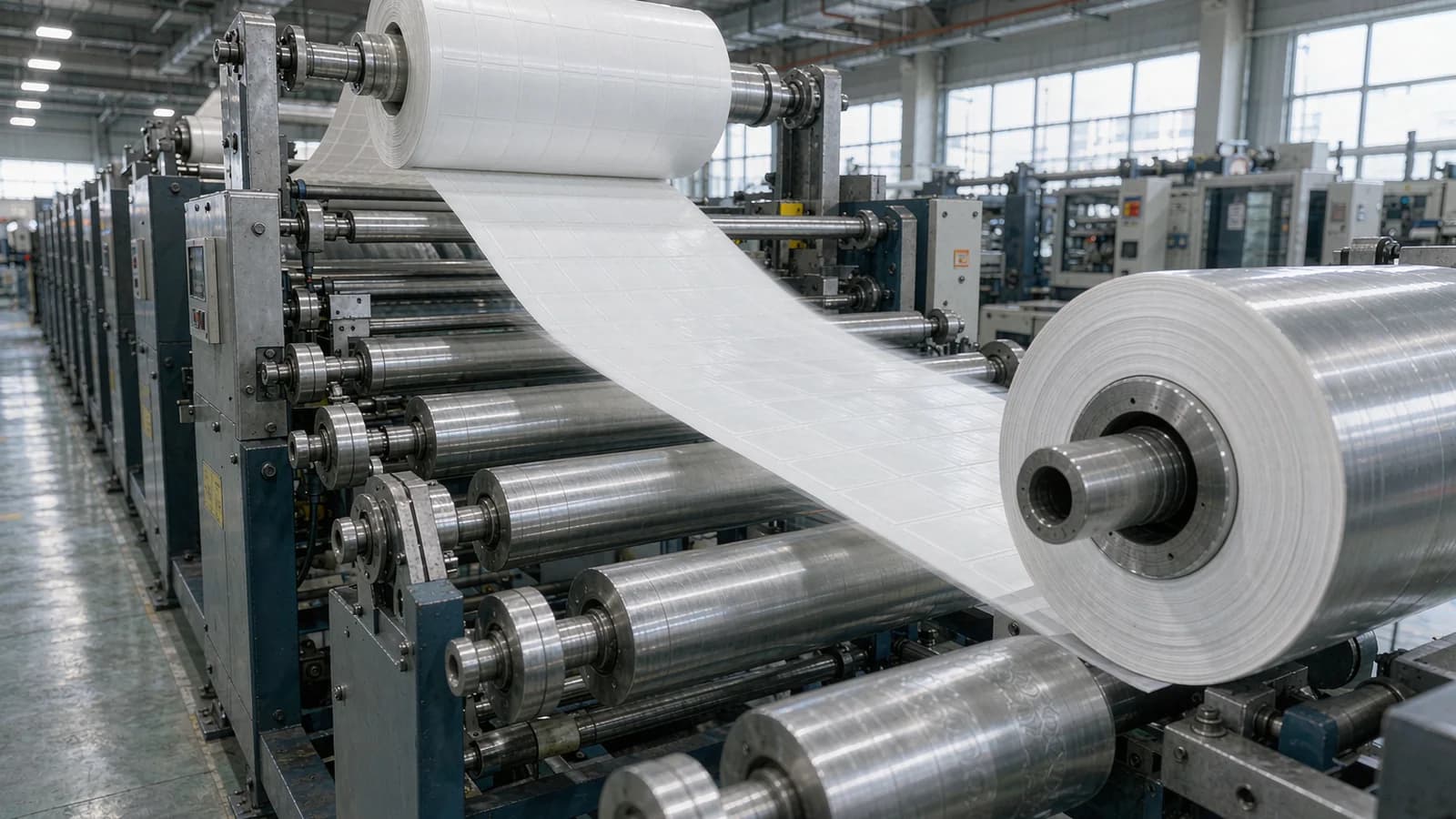
A direct thermal shipping label is a three-layer construction — thermal facestock, adhesive, liner — and a repeatable programme specifies all three: adhesive class matched to the parcel surface and journey (general, permanent, removable or cold-chain), facestock gsm between 60 and 78 with a top coat where scan life matters, die-cut tolerances of ±0.5 mm on a fully cut but intact liner, print darkness re-checked per grade, and stock stored cool and dry for a two-year shelf life.
A direct thermal shipping label fails in ways a receipt never does: the adhesive lets go on a recycled carton in a humid trailer, the facestock curls at the die-cut edge and misfeeds the printer, or the barcode prints with edges soft enough to slow a scan. All three failures trace back to decisions made on a specification sheet — adhesive class, facestock weight, liner and die-cut tolerance — long before a parcel ships.
This guide walks through the specification of direct thermal shipping labels as a converter or programme buyer would: the anatomy of the construction, the adhesive classes and where each belongs, facestock and top-coating choices, the liner and die-cut tolerances that decide printer feeding, and the print-darkness and storage parameters that protect scan rates.
Buyers comparing these specifications can review our top-coated thermal label stock, where basis weight, coating construction and adhesive class are documented per grade before an order is placed.
The final section covers programme buying for e-commerce sellers and 3PLs, where label stock is consumed by the pallet and specification discipline is worth more than unit price.
- The label is a three-layer system — facestock, adhesive, liner — and a specification that names all three, with tolerances, is the minimum for repeatable supply.
- Adhesive class follows the surface and the journey: general acrylic for standard parcels, high-tack for recycled corrugate, removable for reusable totes, cold-chain grades for freezer intake.
- Die-cut quality decides printer feeding: full cut through facestock and adhesive, intact liner, ±0.5 mm dimensions and a consistent 3–4 mm gap.
- Print darkness must be re-checked whenever the grade changes — it is the most common cause of soft barcodes, not the label itself.
- Programme economics live in the specification: gsm without excess, liner yield, and adhesive matched to the actual parcel mix.
Anatomy of a direct thermal shipping label
Every shipping label is a three-layer construction. The facestock is the thermal paper itself, typically 60 to 80 gsm for shipping formats, carrying the coating that images under the printhead. Beneath it sits the adhesive — the layer that decides which surfaces the label survives. The liner, usually a glassine or clay-coated release paper, carries the die-cut label through the printer and peels away at application.
The interactions between the layers matter as much as each layer's datasheet. A heavyweight facestock on a light adhesive will lift at the edges on curved surfaces; an aggressive adhesive on a thin liner can grab in the printer before it ever reaches a carton. A specification that names all three layers — with tolerances on each — is the minimum document for a repeatable supply.
Adhesive classes and where each belongs
Adhesive is the most consequential choice on a shipping label, and it divides into four working classes. General-purpose acrylic adhesive covers the majority of e-commerce parcels: corrugated cartons, polybags and paper mailers at ambient temperatures. Permanent, high-tack adhesive raises initial grab for rough or low-energy surfaces — recycled corrugate, shrink wrap, dusty pallets — where general adhesive can peel at the corners. Removable adhesive serves internal logistics, totes and reusable packaging where the label must come off cleanly. Cold-chain and freezer adhesives are formulated to wet out and hold at low temperatures and through condensation, the condition that defeats ordinary adhesives at the moment of application.
The two numbers to demand from any adhesive datasheet are minimum application temperature and service temperature range — and the second must be read against the label's actual journey, not the warehouse. A parcel that rides a summer trailer can see surface temperatures well above the level at which some adhesives soften and labels shift.
| Adhesive class | Typical surfaces | Watch-outs |
|---|---|---|
| General-purpose acrylic | Corrugate, poly mailers, paper envelopes | Minimum application temperature around 0 °C; condensation defeats the bond |
| Permanent / high-tack | Recycled corrugate, shrink wrap, rough timber | Removal damages the surface — not for reusable totes |
| Removable | Totes, trays, reusable packaging | Shorter outdoor life; limited repositioning window |
| Cold-chain / freezer | Frozen cartons, chilled produce, cold-store intake | Must be applied at storage temperature, not in a warm room |
Facestock weight, top coating and image life
Shipping-label facestock runs lighter than receipt paper for the same stiffness requirement, because a label must lie flat on a curved carton. Common weights sit between 60 and 78 gsm, with the heavier end chosen for large 4 × 6 inch labels that must resist edge curl in dry printing environments, and for labels that double as documents.
The top-coating decision follows the label's life expectancy. Non top-coated facestock images crisply and keeps cost down, which suits labels scanned within days of printing. A top-coated facestock adds a protective layer that resists smearing under light moisture and abrasion and extends the scannable life — the right choice where parcels face rain and rough handling, or where labels must remain scannable for weeks.
For production volumes, the same construction logic applies to our thermal paper jumbo rolls, quoted per jumbo roll or slit reel for converters who die-cut shipping labels on their own lines.
Liner, die-cut tolerance and printer feeding
The liner is the least discussed layer and the source of most printer complaints. Its release level must be tuned to the application method: machine application needs a liner that releases evenly at speed, while hand dispensing tolerates a firmer release. Liner thickness also governs roll yield — a programme that consumes liners by the kilometre notices a ten-micron difference.
Die-cutting tolerances decide whether labels feed. The cut must penetrate the facestock and adhesive fully without scoring the liner — a shallow cut leaves labels clinging to the matrix waste; a deep cut weakens the liner and produces the classic mid-roll liner break that empties a printer bay. Label dimensions should hold within ±0.5 mm on a quality die-cut, and the gap between labels must match what the printer's sensor expects, typically 3 to 4 mm.
- Die-cut depth — through facestock and adhesive, liner intact; verify with a liner peel test on arrival.
- Label dimension tolerance — within ±0.5 mm on length and width across the roll.
- Gap consistency — nominal 3–4 mm gap, constant across the roll so the sensor does not hunt.
- Winding — labels out or in per printer requirement, roll diameter within the printer's maximum.
Print darkness, warehousing and shelf life
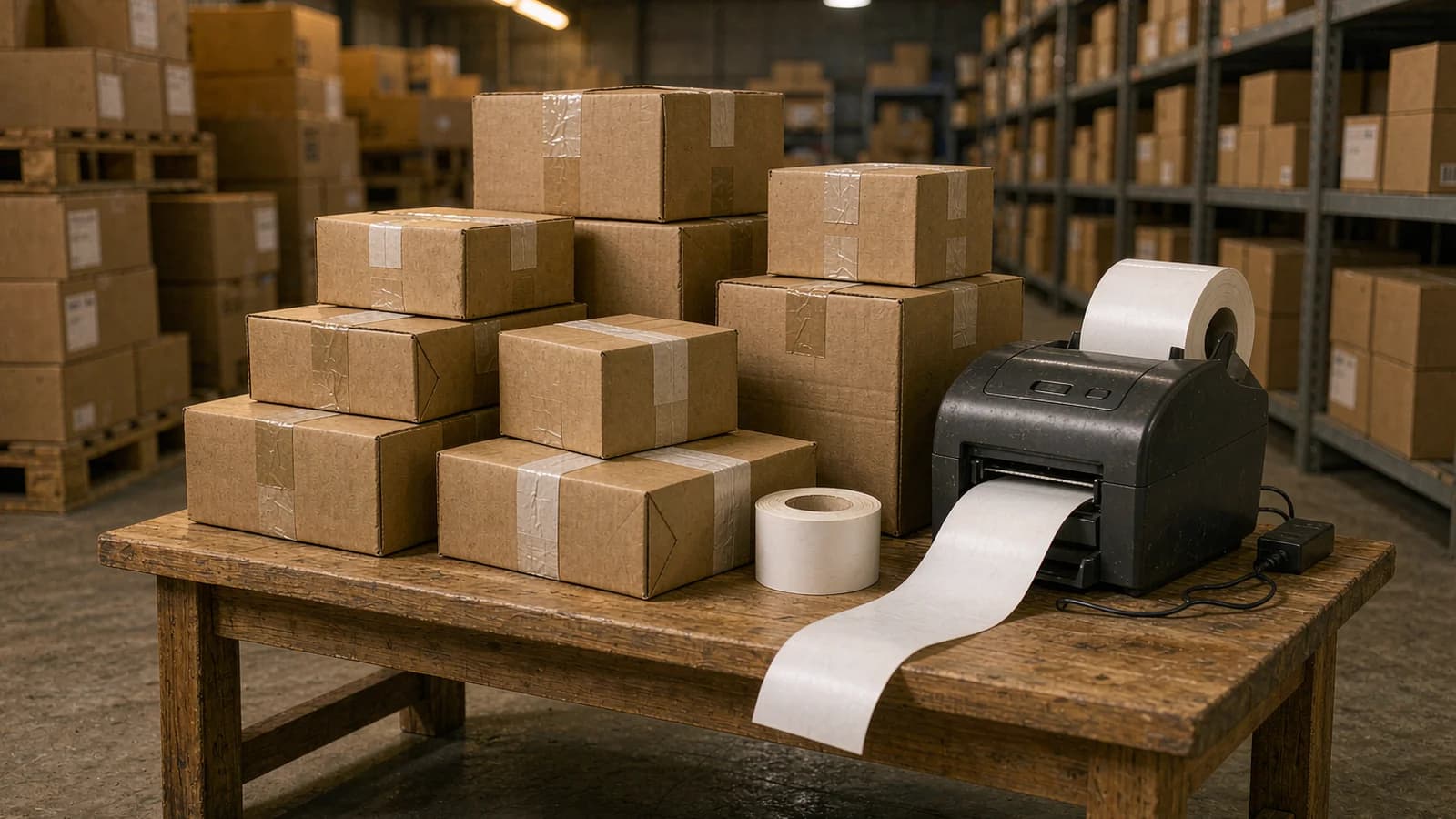
Direct thermal labels image through the same chemistry as receipt paper, and the same print-darkness rules apply: darkness is set at the printer to match the grade's sensitivity, and a grade change without a darkness check is the most common cause of soft barcodes. The verification is objective — print a test label, scan it with the devices used at dispatch, and check edge definition at the quiet-zone boundaries.
Storage conditions decide both shelf life and printed life. Unprinted label stock keeps full performance for around two years in cool, dry storage away from direct light; printed labels remain scannable for months to years depending on facestock and exposure. Heat is the enemy — a pallet of labels stored against a sunny wall or above a heat source will darken in the roll before it is ever printed, and humidity swings curl the facestock at the die-cut edges.
Warehousing discipline is cheap: keep label rolls in their moisture-barrier packaging until loaded, store them off cold floors and away from windows, and rotate stock so the oldest rolls print first.
Programme buying for e-commerce and 3PL operations
Label consumption in fulfilment is steady and forecastable, which makes it well suited to programme supply: a fixed specification per label format, a rolling forecast by season, and agreed stock cover at the mill, the converter or the 3PL's own warehouse. The economics of a 4 × 6 shipping label are won in the specification — a facestock gsm trimmed without losing stiffness, a liner that yields more labels per roll, an adhesive matched to the parcel mix rather than over-specified for all of it.
Where container planning is the next step, our export shipping guide covers pallet standards, moisture-barrier packing and the document set for ocean freight — relevant once label programmes move to mill-direct volumes.
Review the programme on scan-failure rates rather than price alone: a label that scans first time, at every station, is the specification working as designed — and the cheapest label is never the one that triggers a re-print queue.
Programme shorthand: 'Three layers specified with tolerances, adhesive matched to surface and journey, darkness re-checked per grade, stock rotated cool and dry, programmes scored on scan-failure rate.'
Frequently asked questions
What size is a standard direct thermal shipping label?
The de facto standard for e-commerce and carrier labels is 4 × 6 inches (100 × 150 mm), with 4 × 8 inch variants used where the label carries an additional document panel. Roll diameter and core are set by the desktop or industrial printer model.
Why do shipping labels peel off recycled cartons?
Recycled corrugate has a rougher, more absorbent surface and often carries dust or release residues. A high-tack permanent adhesive specified for low-energy and rough surfaces solves it; a general-purpose adhesive applied to cold or damp recycled board will lift at the corners.
How long do direct thermal shipping labels last?
Unprinted rolls keep around two years in cool, dry storage. Printed labels remain scannable for months to years depending on facestock and exposure; top-coated constructions resist moisture and abrasion and extend the scannable life significantly.
Can direct thermal shipping labels be used in cold storage?
Yes, with a cold-chain adhesive and an application-temperature check. The adhesive must be formulated to wet out at low temperature, and the label should be applied at the storage temperature rather than in a warm room and then moved to the freezer, where condensation defeats the bond.