
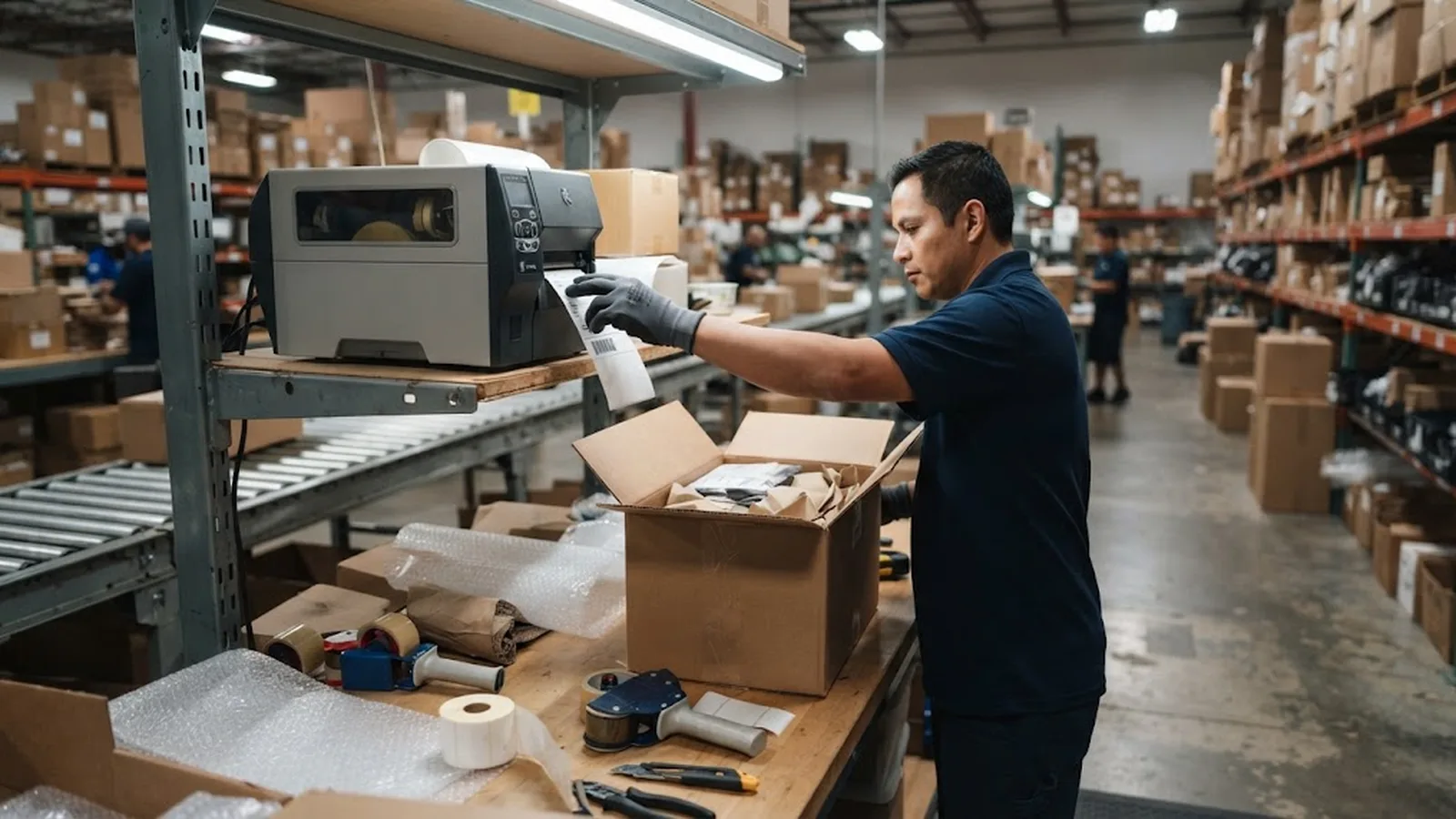
Ecommerce thermal labels are direct thermal labels — most famously the 4x6 inch (100x150 mm) shipping label — that carry the barcode a courier's network must scan at every hub between the seller's bench and the customer's door. The specification question is never 'will it print?' but 'will it scan on day four, in the rain, on a curved parcel face?'. That pushes buyers toward top-coated facestock, an adhesive matched to the carton surface and the journey's temperature range, a liner and die-cut that feed reliably through desktop and industrial printers alike, and a supplier who can hold consistency across container-scale volumes. First-scan rate is the KPI: every mis-scan costs a manual intervention in someone's sort centre, and repeat offenders lose carrier goodwill long before they lose the label cost.
Ecommerce runs on a label most shoppers never look at. Between the buy button and the doorstep, a parcel's barcode is scanned half a dozen times or more — origin sort, linehaul, destination hub, van load, driver's handheld, sometimes a locker or pickup point in between. One failed scan inserts a human into that chain. A few failed scans across a peak-season wave insert hundreds, and carriers notice which shippers' labels read clean and which do not.
That is the real brief for ecommerce thermal labels: not stationery, but network infrastructure in miniature. The label stock a brand or 3PL chooses decides whether the barcode survives the rain on a doorstep, the abrasion inside a sortation machine, and the three-day ride in a cold trailer — and whether the packing bench feeds smoothly at two labels a second during the November peak.
Buyers comparing these specifications can review our top-coated thermal label stock, where facestock, adhesive class and coating construction are documented per grade before an order is placed.
This guide covers the formats carriers and marketplaces standardise on, the failure modes that destroy first-scan rate and how facestock, adhesive and top-coat choices prevent them, the printer-side requirements that keep fulfilment lines feeding, and the specification checklist for buying label stock at container scale.
- First-scan rate is the KPI for ecommerce labels — every mis-scan is a manual touch in a carrier's network and a goodwill cost the shipper pays for.
- 4x6 inch (100x150 mm) is the global shipping-label workhorse; check each carrier's thermal printing specs for minimum barcode contrast and quiet-zone rules.
- Top-coated facestock is the default for parcel labels: it holds scan-grade contrast through moisture, abrasion and the temperature swings of linehaul.
- Adhesive choice is application-specific — general-purpose acrylic for standard cartons, stronger grab or low-temperature grades for recycled board and cold-chain parcels.
- Buy stock by printer class and peak volume: liner, die-cut tolerance and roll geometry decide whether desktop and industrial printers feed cleanly at two labels a second.
The formats: what carriers and marketplaces actually demand
The 4x6 inch shipping label — 100x150 mm in metric markets — is the universal parcel format, accepted by the global integrators, national posts and the regional couriers that carry most ecommerce volume. Around it sit the smaller formats of the fulfilment bench: 4x2 and 4x1 labels for carton contents and pick slips, 100x100 and similar squares for returns and shelf-to-bench identification, and the folding or dual-zone layouts some 3PLs print for combined carrier-plus-warehouse data. Marketplaces impose their own overlays — seller SKUs, returns instructions, promotional panels — but the carrier barcode zone remains the part the network actually reads.
Print quality rules come from the carrier side, and they are worth reading literally: minimum printed density for the barcode, defined quiet zones around it, and orientation guidance that keeps the barcode on the flattest available face of the parcel. A label stock cannot fix a badly placed barcode, but it can guarantee the density and edge sharpness the carrier's specification assumes — which is where facestock and coating choices start earning their keep.
Volume context decides the buying format. Small sellers feed desktop printers from 250- or 500-label rolls; 3PLs and brand warehouses run industrial print engines on 1,000-label rolls or fanfold stacks through peak; container-scale buyers work the other way around, sourcing converted labels or slitting their own from jumbo stock. Each tier buys the same construction question — will the barcode scan at the end of the journey? — at very different units of purchase.
Requests that combine several formats can be quoted together; see thermal paper jumbo rolls for the construction options behind each one.
The journey: failure modes and the construction that beats them
A parcel label's enemies are mechanical and climatic. Sortation machinery rubs labels against belts and rollers; parcels stack, slide and shear inside trailers; rain meets the doorstep or the transfer trolley; and between summer loading docks and winter holds, a label can cross a thirty-degree temperature swing in a day. Each enemy maps to a construction choice: the top coat that resists abrasion and moisture, the adhesive that holds on dust, moisture or cold, and the facestock weight that keeps the label flat instead of lifting at the edges.
Top-coated facestock is the default answer for parcel labels, and the economics justify it: the coating's cost per label is trivial against the cost of one manual scan intervention, and uncoated stock's fading or scuffing shows up precisely in the barcode zone where density matters most. Uncoated construction retains a place for short-life internal labels — pick slips, tote tags, bench labels consumed inside the warehouse the day they print — where the image never faces the network and cost per thousand is the deciding line.
Adhesive is where bespoke complaints begin. Standard carton board suits general-purpose acrylic; recycled board with surface fibres needs stronger initial grab; cold-chain and winter-freight parcels need low-temperature grades that still wet the surface at near freezing; and high-cast surfaces like poly-bagged apparel need adhesives rated for filmic substrates. Matching adhesive to the actual parcel surface — not the catalogue default — removes the peeling-edge failure that takes a barcode out of readable alignment without ever damaging the print itself.
Our custom thermal paper programme publishes the test data behind each grade, so adhesive class, liner and die-cut can be verified against the mill's own measurements rather than a catalogue claim.
| Duty | Facestock | Coating | Adhesive class | Typical format |
|---|---|---|---|---|
| Carrier shipping label | Direct thermal paper | Top-coated | General-purpose acrylic | 4x6 in / 100x150 mm |
| Cold-chain / winter freight | Direct thermal paper | Top-coated | Low-temperature grade | 4x6 in |
| Recycled / rough cartons | Direct thermal paper | Top-coated | High-grab acrylic | 4x6 in, 100x100 mm |
| Poly-bag / filmic surfaces | Direct thermal paper | Top-coated | Film-rated adhesive | 4x2, 4x6 in |
| Internal pick / tote labels | Direct thermal paper | Uncoated acceptable | General-purpose | 4x1, 4x2 in |
Buying at scale: printers, peaks and the container-scale checklist
Printer class frames the buying decision. Desktop thermal printers in small-venue fleets are tolerant but slow; industrial print engines at 3PL scale are fast and unforgiving, demanding consistent liner release, precise die-cut registration and clean roll geometry to sustain two labels a second through a peak shift. Roll geometry — core size, outside diameter, wind direction — must match the printer fleet in the building, and buyers consolidating several sites should standardise geometry so any roll feeds any bench.
Peak planning is a supply-chain exercise, not a stationery order. November and festival seasons can double or triple label consumption, and carriers' cut-off discipline means a label stockout stops shipping outright — there is no manual fallback for a network barcode. Buyers who forecast label volume with parcel volume, hold buffer stock against the peak curve, and agree production slots with their converter before the season starts, treat labels with the seriousness the network already does.
The container-scale specification checklist that closes the loop: facestock and gsm stated with tolerance; coating class declared (top-coated or not) with image-life test conditions; adhesive matched to the actual parcel surfaces in the operation; liner type and release consistent with the printer fleet; die-cut and roll geometry per printer model; developer system and bisphenol status declared with test evidence; and per-batch quality documentation from the manufacturer. A supplier who answers every line on the datasheet — and proves it with samples run on your own printers — is a supplier whose labels will scan first time in someone else's network.
Where container planning is the next step, our export shipping guide covers pallet standards, moisture-barrier packing and the document set for ocean freight.
For the construction trade-off behind that choice, our top-coated vs non top-coated guide compares the two builds on retention, cost and machine behaviour.
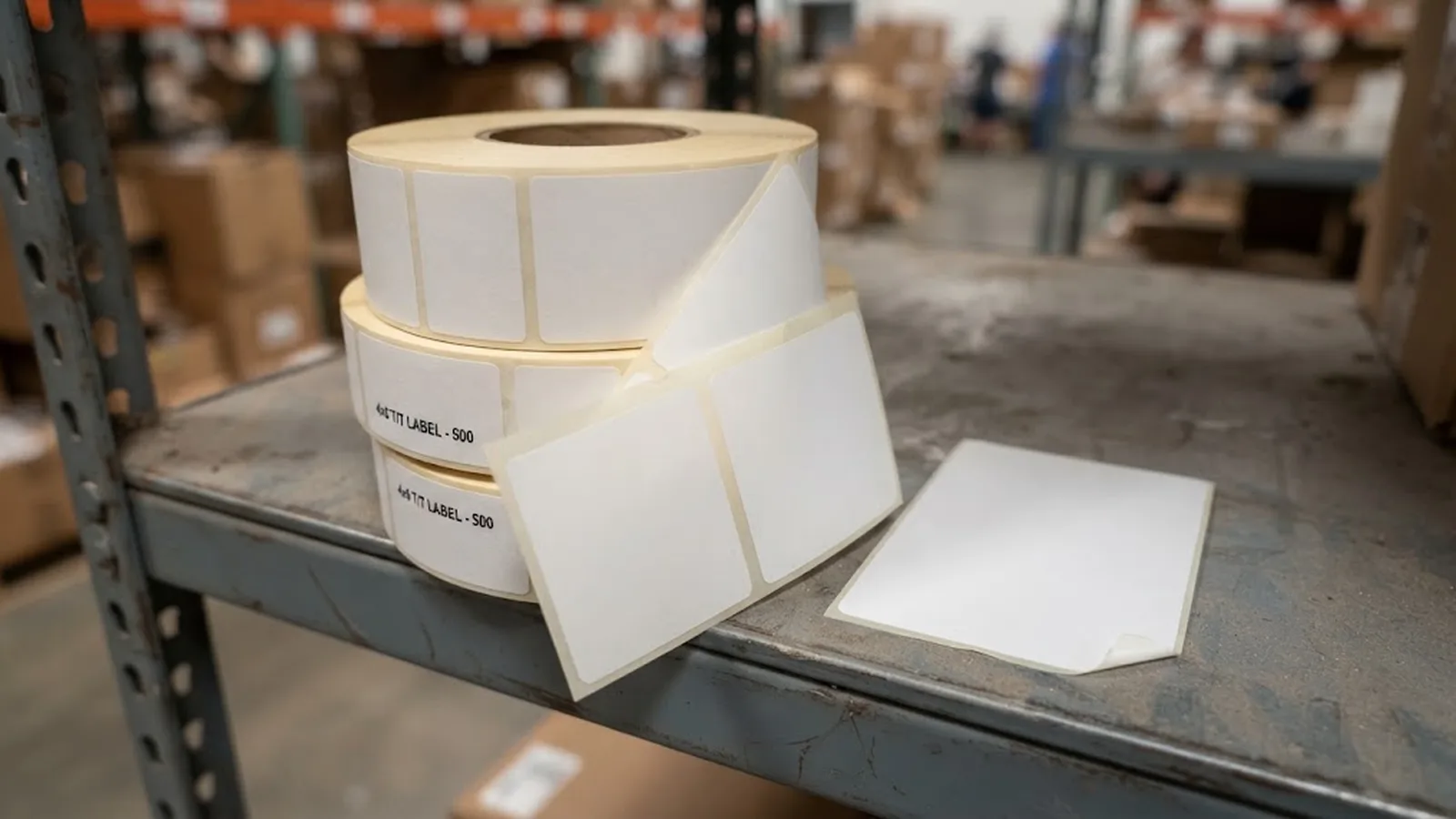
Specification shorthand for any label tender: 'Top-coated direct thermal facestock, [gsm] with tolerance; adhesive rated for [surface and temperature range]; liner and die-cut per [printer model]; barcode density verified to carrier spec; developer system declared with per-batch test reports.'
Frequently asked questions
What size are ecommerce shipping labels?
The 4x6 inch (100x150 mm) label is the global carrier standard for parcels, with smaller 4x2 and 4x1 formats used for pick slips and carton contents and 100x100 mm squares for returns. Always confirm each carrier's specification, since barcode zone and quiet-zone requirements sit on top of the label size.
Do shipping labels need to be top-coated?
For labels that travel the courier network, yes in practice — the top coat holds barcode contrast through moisture, abrasion and temperature swings that fade or scuff an uncoated image. Uncoated stock is a sensible cost saving only for internal labels consumed inside the warehouse on the day of printing.
Why are my shipping labels scanning poorly?
The usual causes, in order: print head energy or head cleanliness at the printer, uncoated or low-sensitivity stock losing density, abrasion damage in transit, adhesive failure letting the label lift or skew on the parcel, and barcode placement violating quiet-zone rules. Match the stock construction to the duty before adjusting the printer.
What adhesive should ecommerce labels use?
General-purpose acrylic suits standard carton board; recycled and rough surfaces need high-grab grades; cold-chain parcels need low-temperature adhesives; poly-bagged goods need film-rated adhesives. Match the adhesive to the actual parcel surface in your operation, not the catalogue default.
How should 3PLs plan label stock for peak season?
Forecast label volume alongside parcel volume, hold buffer stock for the peak curve, standardise roll geometry across sites so any roll feeds any bench, and agree production slots with the converter before the season. A label stockout stops shipping outright — there is no manual fallback for a network barcode.