
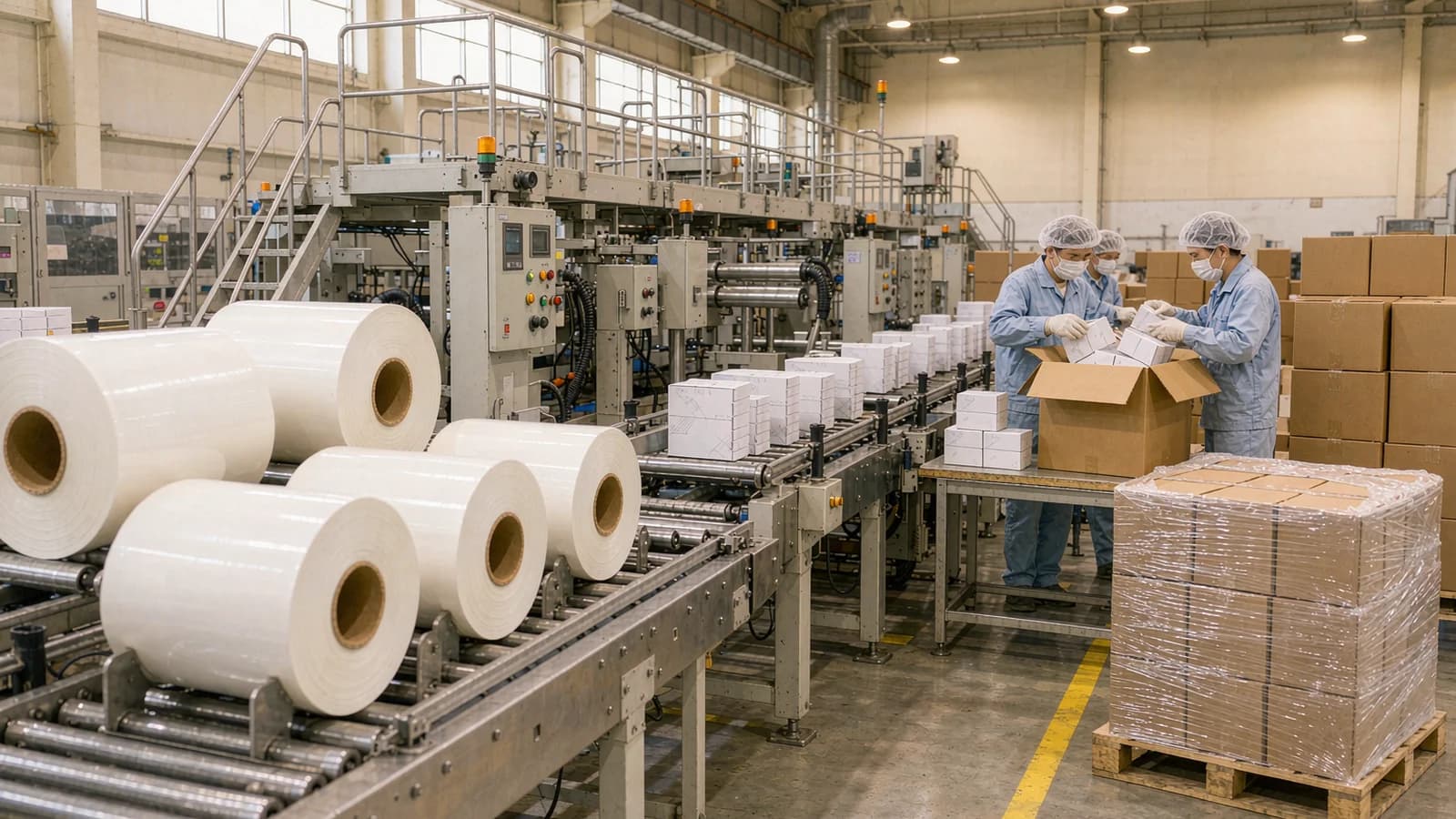
Custom packaging for thermal paper runs in four layers: the roll wrap or bag that protects each roll from moisture and light; the retail unit (color box, blister card, OPP bag or shrink pack) if the product sells through stores; the export carton, whose board grade, inner liner and desiccant decide how the goods survive six weeks on the ocean; and the pallet or load plan that determines container utilisation. A usable packaging specification names all four layers with materials, weights, print colours, barcode data and acceptance standards — and is fixed at order stage, because packaging changes mid-order are where lead times and budgets slip.
Packaging is the least examined cost in thermal paper purchasing, and the first place a good order goes wrong. The paper itself can be perfectly made — right grade, right sensitivity, right widths — and still arrive as a container of curly, grey-edged rolls because the carton had no moisture barrier and the sea crossing was six weeks through the tropics. At the other end of the journey, a distributor selling through retail lives or dies by whether the roll's box actually stands on a shelf and scans at the till.
For buyers working with an OEM supplier, packaging is also the visible half of the brand. The paper inside two competitors' rolls is often chemically indistinguishable; the wrap design, the colour box, the printed core and the carton label are what the end customer actually experiences. That makes packaging a specification discipline, not an afterthought tacked onto the proforma invoice — and factories respect buyers who treat it that way.
This guide walks the four layers of thermal paper custom packaging from the roll outward, explains the engineering behind export packing for ocean freight, lists the fields a packaging specification must contain to be quotable and inspectable, and describes how MOQ, tooling and sampling work so private-label programs start without surprises.
Buyers comparing these specifications can review our custom thermal paper programme, where basis weight, coating construction and packing are documented per grade before an order is placed.
- Four layers, each with its own spec: roll wrap or bag, retail unit, export carton, pallet and load plan.
- Moisture is the enemy in ocean freight: barrier-lined cartons, desiccant and sealed wraps protect the image layer before a single receipt is printed.
- Brand lives on the touchpoints — wrap print, color box, core printing, carton labels — all fixed in the spec at order stage.
- Carton board grade, bursting strength and maximum gross weight are engineering choices, not defaults; state them.
- Custom packaging raises MOQ (print run minimums) and needs a proofing cycle — budget two to three weeks for samples before mass production.
Layer one: the roll wrap and what it must do
Each roll's first protection is its wrap, and its jobs are specific: block light, slow moisture exchange, keep the edges clean, and survive handling without tearing. The common options are OPP (oriented polypropylene) bags, paper wraps with or without a barrier layer, and printed film sleeves. For counter and back-office receipt stock, a plain or one-colour printed OPP sleeve is the industry default — cheap, transparent enough to show the roll, and adequate for short distribution chains.
Printed wraps carry brand and compliance information: logo, size, grammage, roll count, batch number and barcode. This is where private-label packaging for thermal rolls usually starts, because the wrap is the cheapest surface that carries the brand into the end user's hands. Two practical constraints matter. First, print runs have minimum quantities — typically 50,000 to 100,000 sleeves per design — which is why custom wraps raise the MOQ of an order. Second, every printed element must be fixed in artwork at order stage; a barcode that scans wrong is discovered at the customer's till, not at the factory.
For premium and long-chain products, upgraded wraps earn their cost: barrier films for label stock and ticket grades, light-blocking wraps for stock stored in bright retail back rooms, and tamper-evident or resealable designs for pharmacy and healthcare distribution. The wrap choice should follow the distribution chain's length and the storage conditions at the far end — a roll sold to a beachside kiosk in a humid climate needs different protection than one consumed in an air-conditioned office within a month.
- OPP sleeve: default for receipt rolls; 1–2 colour print; cheapest branded surface.
- Paper wrap: stiffer presentation for jumbo-cut sheets and label stacks.
- Barrier film: for label stock, ticket grades and long ocean chains.
- Every wrap carries batch and size data — keep it in the artwork, not in handwriting.
Layer two: retail and counter display units
If the product sells through retail or dealer channels, the single roll becomes a designed unit. The workhorse is thermal roll color box packaging: a folding carton, usually white or kraft board, printed four-colour with the brand, sized so the roll fits snugly without rattling. Colour boxes lift perceived value substantially and are standard for supermarket and pharmacy own-brand programs. Below that in cost sit blister cards (roll strapped to a printed card), shrink packs with a header, and labelled plain shrink — in descending order of shelf presence.
Two engineering details decide whether a color box works. The first is fit: board thickness, roll diameter tolerance and the box's internal dimensions must be reconciled, or the box bulges or the roll rattles — both visible on the shelf. The second is display physics: a box that must stand on a hook or a shelf needs the board grade and glue area to survive stacking in a warm stockroom. Provide the factory with the roll's maximum outer diameter (including wrap) and let the die-line be cut around reality, not around a catalogue number.
Multi-packs belong in this layer too — twin packs, three-packs and counter display boxes of ten or twenty rolls that clubs and convenience chains order. Multi-pack design affects the export carton below it: a carton of 50 single rolls and a carton of 25 twin-packs have different internal arrangements, different stacking behaviour and different packing labour. Decide the retail architecture before the carton is engineered, never after.
Where a programme needs several formats from one supplier, our POS and receipt paper rolls covers width, core, roll diameter and developer class in a single specification sheet.
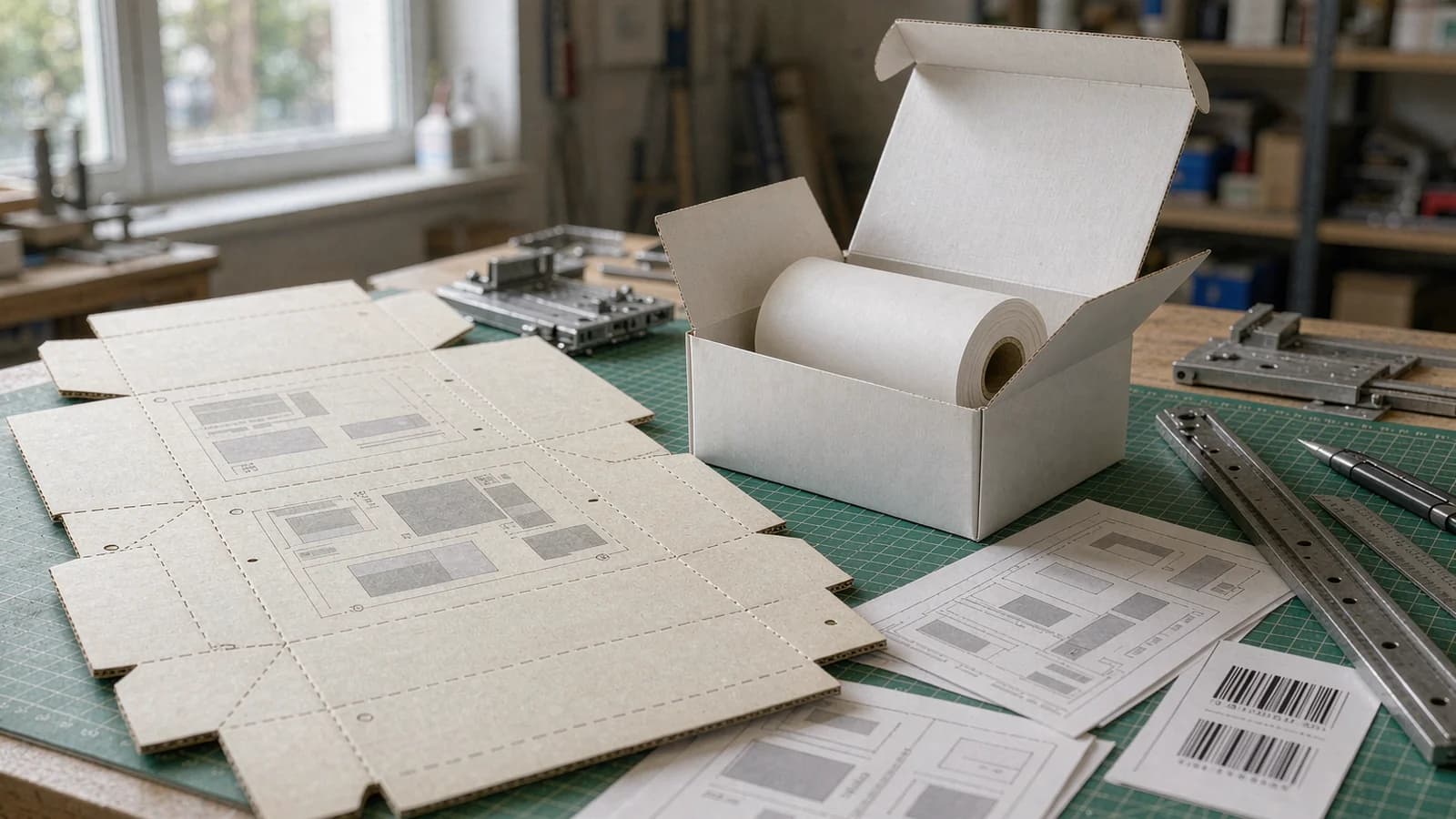
Fix the retail architecture first — single, twin or display pack — because every layer below inherits its dimensions.
Layer three and four: export cartons, pallets and the ocean crossing
The export carton is an engineering item. Its specification should name the board (corrugated type and ply — typically double wall for heavy thermal stock), bursting strength or edge crush value, internal dimensions with the packing arrangement (rolls standing versus lying, rows and layers), maximum gross weight, and sealing method. Rolls are dense: a carton of 57 mm x 40 mm rolls can reach 20–25 kg easily, and under-specified board fails in the middle of a pallet stack, not in the sample room. State the numbers; do not accept 'standard export carton' as a spec.
Moisture protection is the second half of carton engineering. Six weeks at sea through humid latitudes exposes paper to conditions no warehouse duplicates. The standard defence is a barrier-lined or poly-lined carton, desiccant sachets for high-risk lanes, cartons sealed with water-resistant tape, and rolls whose own wraps are closed properly. Unprinted thermal stock tolerates dry, cool storage well — the shelf-life articles on this site cover that — but the ocean crossing is the one environment a buyer cannot manage, so the packaging must.
The fourth layer is the pallet and the load plan. Standard export practice is a defined cartons-per-pallet, stretch-wrapped, with the pallet size matched to the container — and the load plan calculated so the container fills by volume before it fills by weight. Thermal paper is dense, so the binding constraint is usually weight: a 20-foot container maxes out near 25–28 tonnes of payload depending on the line. A factory that packs well squeezes the most roll tonnage into that limit; a factory that packs carelessly ships air or, worse, overloads. Ask for the packing drawing and the container load plan with the quotation.
| Field | Example entry | Why it matters |
|---|---|---|
| Board | 5-ply double wall, BC flute | Stack strength under dense rolls |
| Strength | Bursting ≥ 1200 kPa or stated ECT | Prevents mid-pallet failure |
| Inner protection | Poly lining + 2 desiccant sachets | Ocean humidity defence |
| Packing pattern | Rolls standing, 5 x 5, 2 layers | Labour, stability, carton count |
| Max gross weight | 22 kg | Handling and pallet design |
| Marking | Shipping marks, size/qty label, batch | Customs and warehouse accuracy |
Writing the packaging spec: fields, MOQ and sampling
A quotable packaging specification is one page with four blocks. Block one, the roll: size, grammage, wrap type and print colours, artwork reference. Block two, the retail unit if any: format, board, print, barcode data. Block three, the carton: board, strength, lining, packing pattern, gross weight, marking. Block four, the pallet and load: pallet size, cartons per pallet, container type, target utilisation. Add the acceptance standard for each block — for example carton drop test per ISTA, barcode grade per ISO/IEC 15416, print colour tolerance against a signed proof. With all four blocks, two factories can quote the same package and the comparison means something.
MOQ and tooling follow from print, not from paper. The paper MOQ is the converting run; the packaging MOQ is the print run of the wrap or the box, plus die costs if a custom size is new. Typical wrap minimums run 50,000–100,000 sleeves; color boxes 5,000–10,000 units. Reorders of existing artwork carry no tooling cost, which is why brand owners standardise on a packaging family early — one box design across sizes costs less than a new design per size. Digital print has lowered some minimums, but unit costs rise steeply below the flexo economic run.
Sampling closes the loop: artwork proof (digital, for content and colour), then a physical pre-production sample — one printed box or wrap with a real roll inside — signed by both sides before mass production. Budget two to three weeks for this cycle on a new program. The discipline repays itself: a signed packaging proof converts the most common OEM argument ('that is not the colour we agreed') into a ten-minute check against a sample both parties hold.
Where container planning is the next step, our export shipping guide covers pallet standards, moisture-barrier packing and the document set for ocean freight.
- Four blocks in the spec: roll/wrap, retail unit, carton, pallet and load plan — each with an acceptance standard.
- Packaging MOQ is a print-run minimum; standardise artwork across sizes to amortise tooling.
- Artwork proof then physical pre-production sample, signed by both sides, before mass production.
- Changes after order confirmation reset lead times — fix artwork and specs at order stage.
Frequently asked questions
What packaging options exist for private-label thermal paper rolls?
The standard set: printed OPP sleeves or paper wraps per roll; retail units such as color boxes, blister cards, shrink packs with headers or labelled shrink; branded export cartons with your shipping marks; and printed cores if the program warrants them. Most distributor programs start with a printed wrap plus a neutral carton, then add color boxes as retail listings develop.
Why does custom packaging increase the MOQ?
Because wraps and boxes are printed items with minimum print runs — typically 50,000–100,000 sleeves or 5,000–10,000 boxes per design — plus tooling for any new size. The paper converting minimum and the packaging print minimum are separate; the order MOQ is the higher of the two. Reorders of existing artwork avoid tooling costs and usually the print minimums are easier to meet.
How is thermal paper protected against moisture during ocean freight?
In layers: closed wraps on each roll, poly-lined or barrier-lined export cartons, desiccant sachets for humid lanes, water-resistant tape and stretch-wrapped pallets. Thermal paper's image layer tolerates dry storage well but the sea crossing adds weeks of humidity exposure the warehouse never sees — the carton liner is the main defence.
What should a packaging specification contain to be quotable?
Four blocks with acceptance standards: roll and wrap (size, grammage, wrap type, print), retail unit (format, board, barcode data), export carton (board type, bursting strength or ECT, lining, packing pattern, gross weight, marking), and pallet/load (pallet size, cartons per pallet, container type, target utilisation). With that page, any two factories quote the same package.
How long does the packaging sampling cycle take?
Two to three weeks for a new program: artwork proof for content and colour, then a physical pre-production sample — printed wrap or box with a real roll inside — signed by both sides before mass production. Reorders of approved artwork skip the cycle entirely, which is a further reason to standardise the packaging family early.